
The Complete Valuation Playbook for Automotive Products and Services Businesses
A practical guide to how automotive products and services businesses are valued and what drives high multiples.

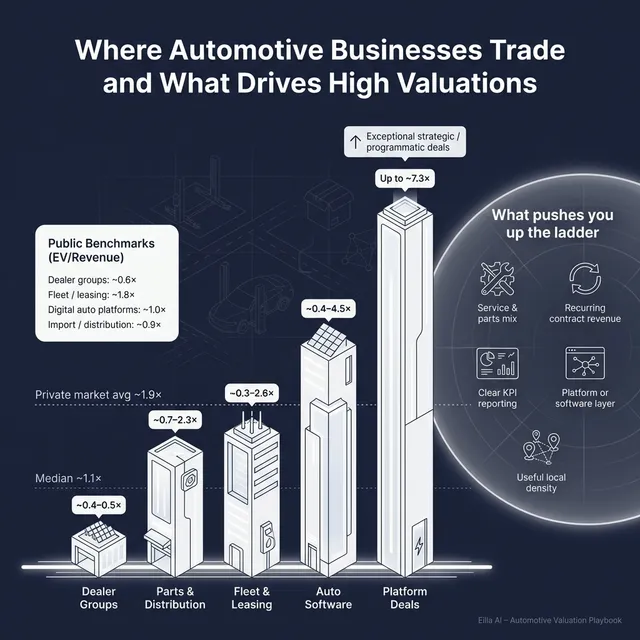
If you own an Automotive Products and Services business and are thinking about a sale in the next 1-12 months, this is a good time to get serious about valuation. The sector is still fragmented, buyers remain selective, and the gap between average assets and truly premium assets is wide. In other words, good businesses can still sell well - but buyers are no longer paying up just because a company is in a busy market.
This playbook is built to help you answer three practical questions. What do Automotive Products and Services businesses actually sell for? What separates the better multiples from the weaker ones? And what can you do in the next 6-12 months to move your business closer to the top of the range?
The numbers below are anchored in the private deals and public market data you provided, then translated into plain English for founders and CEOs.
1. What Makes Automotive Products and Services Businesses Unique
Automotive Products and Services is not one simple sector. It includes dealership groups, aftermarket parts distributors, service and repair networks, fleet and leasing businesses, digital used-car platforms, telematics providers, parts e-commerce software, and other mobility-related operators. A buyer will not value all of those the same way, even if two businesses have similar revenue.
The big reason is revenue quality. In automotive, USD 10m of revenue can mean very different things. One company may earn that through low-margin vehicle sales with heavy working capital needs. Another may earn it through parts distribution, service labor, fleet contracts, software, subscriptions, financing income, or recurring maintenance work. Buyers care a lot more about how revenue is earned than the headline number alone.
This sector is also unusually exposed to cycles. Vehicle demand moves with consumer confidence, interest rates, financing availability, OEM production, used-car pricing, and local economic conditions. That means buyers spend extra time testing whether your earnings hold up when volumes soften.
There is also a major split between asset-heavy and asset-light models. Dealer groups, fleet operators, and leasing businesses usually need more inventory, more working capital, and more operational coordination. Software-enabled commerce, telematics, and marketplace models can scale faster with better margins and less capital tied up. That difference shows up clearly in the valuation data.
The main risks buyers will always check include OEM or supplier concentration, dependence on floorplan or inventory financing, margin pressure in new vehicle sales, technician availability, customer concentration in fleet contracts, used-vehicle price volatility, and whether higher-margin aftersales revenue is truly stable or just temporarily strong.
2. What Buyers Look For in an Automotive Products and Services Business
At a basic level, buyers look for scale, growth, profit, and predictability. But in this sector, they also want to know what part of your model is structurally valuable. Are you mainly a reseller of vehicles, where margins are thin and volumes matter most? Or have you built a business with sticky service revenue, parts pull-through, financing income, fleet relationships, or software-like recurring revenue?
They also look closely at gross margin mix. A business with a strong aftersales engine - service, parts, maintenance programs, accessories, repair, recurring fleet work - is usually more attractive than one driven mostly by one-time vehicle transactions. Buyers know vehicle sales can be volatile. They pay more for the parts of the business that behave like an annuity.
Customer stickiness matters a lot. If your customers come back for service, buy parts repeatedly, renew fleet contracts, keep vehicles on subscription, or rely on your platform to transact, that lowers buyer risk. If revenue resets every month and must be won again from scratch, multiples tend to stay lower.
Operational discipline also matters more here than in many sectors. Buyers want clean inventory management, clear gross profit by business line, service bay utilization, technician productivity, finance penetration, retention, and evidence that the business is run off real numbers rather than founder instinct alone.
How private equity thinks about it
A private equity buyer is not just asking whether your business is good today. They are asking whether they can buy it at one multiple and sell it at a higher or at least similar multiple in 3-7 years.
That means they care about three things. First, whether your current earnings are durable enough to support debt and future growth. Second, whether there is a clear next buyer - another sponsor, a larger strategic, a bigger dealer or aftermarket platform, or in rare cases a public market path. Third, whether they can improve the business after buying it through pricing, acquisitions, cross-sell, procurement, better service mix, digitalization, and cost efficiency.
If your story depends entirely on the founder, has weak reporting, or lacks obvious value-creation levers, PE interest usually softens. If it has recurring income, clear KPI tracking, fragmented tuck-in opportunities, and a path to larger scale, PE interest gets stronger.
3. Deep Dive: Revenue Mix Matters More Than Revenue Size
The most important valuation question in this sector is simple: what percentage of your revenue comes from low-margin transactions versus higher-quality, more repeatable income?
The data points in that direction very clearly. Traditional full-service dealer groups mostly trade on low revenue multiples, because a large part of revenue comes from selling vehicles, which carries thin margins and meaningful working capital needs. By contrast, vehicle rental, leasing, and fleet lifecycle companies trade at meaningfully higher revenue multiples on average, because more of their economics come from recurring contracts, utilization, and ongoing customer relationships. Software-enabled automotive commerce and telematics businesses can sit even higher when buyers believe the product has scale, reach, and switching costs.
Why do buyers care so much? Because higher-quality revenue is easier to underwrite. A vehicle sale happens once. A service relationship, fleet program, finance stream, parts account, or software subscription can repeat for years. Buyers do not just want revenue - they want revenue that survives downturns, keeps customers attached, and creates more profit over time.
This is why two companies with the same top line can be worth very different amounts. A dealership-led model with weak aftersales and little recurring income will usually sit toward the lower end. A hybrid model with strong service absorption, financing, recurring fleet revenue, and customer retention will often justify a materially better range.
If your business looks more like the lower-value profile today, you usually do not need a total reinvention to improve valuation. You need to show more of your business as repeatable, profitable, and sticky. That can mean growing service plans, improving retention, increasing parts mix, building fleet maintenance relationships, raising attachment rates on financing or ancillary products, or turning one-time customer contacts into repeat revenue.
4. What Automotive Products and Services Businesses Sell For - and What Public Markets Show
Here is what the data actually shows. This sector does not have one neat valuation range. It has clusters. Traditional retail and dealership assets tend to trade lower on revenue. Asset-heavy fleet and leasing businesses tend to trade higher when revenue is contract-backed and earnings are more durable. Software-enabled automotive platforms can command a premium when they own demand, workflow, or dealer/OEM connectivity.
The headline lesson is not just "what is the average multiple?" The real lesson is "which economic model does your business most resemble?"
4.1 Private Market Deals (Similar Acquisitions)
Across the precedent transactions set, the overall average was about 1.9x EV/Revenue and 6.9x EV/EBITDA, but the median was lower at about 1.1x EV/Revenue and 5.4x EV/EBITDA. That gap tells you something important: a handful of strong or strategic deals pull the average up, while many real-world automotive transactions still happen at more modest levels.
Traditional dealership transactions in the dataset sit around the low end on revenue multiples, roughly 0.4x to 0.5x revenue. Aftermarket parts and distribution deals show a wider band, roughly 0.7x to 2.3x revenue, with better profitability supporting stronger pricing. Fleet and mobility services are broader still - roughly 0.3x to 2.6x revenue for asset- and service-heavy operators, with one standout leasing-platform transaction much higher because buyers underwrote the business more like a defensible programmatic platform than a plain operator. Digital automotive platforms and telematics also span a wide range, from sub-1.0x for smaller or less proven assets to around 4.5x for stronger software-enabled commerce models.
These ranges are illustrative, not a direct pricing guide. Where you fall depends on scale, margin, growth, customer stickiness, and whether buyers see your business as a local operator, a strong regional platform, or a strategically useful asset.
4.2 Public Companies
Public markets provide a useful reference point, but not a direct private-company price tag. Based on the public comp set as of late 2025, full-service franchised auto dealer groups averaged about 0.6x EV/Revenue and about 12.0x EV/EBITDA, though the median EBITDA multiple was closer to 8.4x and the sample included clear outliers. Vehicle rental, leasing, and fleet lifecycle businesses averaged about 1.8x EV/Revenue and about 8.9x EV/EBITDA. Digital-first used vehicle platforms averaged about 1.0x EV/Revenue and roughly 17.9x EV/EBITDA, reflecting the market's willingness to pay more for scalable digital models despite volatility.
The broad pattern makes sense. Dealer groups are large but structurally low-margin, so revenue multiples stay low. Fleet and leasing businesses can justify higher revenue multiples because they have recurring contracts and better visibility. Digital platforms can attract higher earnings multiples where buyers believe scale, reach, and software-driven operating leverage can improve over time.
*That EBITDA average is skewed by outliers. The central tendency in that group is much more moderate.
Founders should use public multiples as a reference band, not as proof of what a buyer should pay for a private company. Public businesses are larger, more diversified, more liquid, and usually better resourced. A private company is often adjusted downward for smaller scale, weaker reporting, higher customer concentration, and founder dependence.
That said, some private assets do deserve more than a simple discount to public comps. If your business is scarce, strategically useful, strongly profitable, and has sticky recurring economics, a buyer may pay up - especially if the asset solves a real gap in their network, geography, product offering, or customer access.
5. What Drives High Valuations (Premium Valuation Drivers)
The data does not show that buyers blindly pay the highest multiples for the biggest revenue base. It shows they pay more for better revenue quality, better strategic fit, and better defensibility.
5.1 Durable, repeatable earnings
The clearest premium pattern is earnings quality. Buyers pay more when they believe profits are repeatable and not too exposed to swings in vehicle volumes. That usually means recurring service income, maintenance contracts, subscription or leasing revenue, sticky fleet relationships, and customers who come back without costly re-acquisition.
Practical examples:
- A service and parts business with high repeat rates will usually be valued better than a pure transaction-led reseller.
- A fleet maintenance or lifecycle provider with multi-year contracts is easier to underwrite than a walk-in retail model.
- A finance or mobility program with reliable renewals can command more attention than a one-time sales operation.
5.2 Strategic adjacency and synergy value
Some buyers pay up because your business fits cleanly into what they already own. In the deal data, the strongest strategic premiums showed up when the buyer could point to clear synergies like branch expansion, workshop density, procurement gains, or cross-sell opportunities.
Founders often miss this. Buyers are not only valuing your current EBITDA. They are also asking, "What does this asset become inside our system?" If you fill a regional gap, add service capacity, strengthen fleet coverage, deepen OEM relationships, or bring a valuable customer set, your value to the right buyer can rise.
5.3 Software or platform characteristics
The highest revenue multiples in the set do not come from ordinary physical retail. They come from software-enabled or platform-style automotive businesses - parts e-commerce enablement, telematics, dealer software, or marketplace-like demand generation.
Why? Because buyers see reach, data, scalability, and switching costs. If your business has a real software layer, recurring subscriptions, dealer or OEM integrations, or a workflow that customers depend on daily, buyers often stop viewing you as just another operator.
5.4 Distribution moat and installed base
Scale matters, but only when it creates a moat. A large installed base of workshops, branches, service bays, fleet customers, dealers, or recurring program participants can support higher value because it creates cross-sell opportunities and makes the customer relationship harder to displace.
A founder-friendly way to think about this is simple: buyers pay more when your footprint is not just big, but useful. Ten locations with strong local density and repeat service behavior may be worth more than a scattered footprint with weak economics.
5.5 Proven profitability and capital efficiency
In this sector, higher valuation often comes from proving that your margins are structurally better than peers. Buyers like service-heavy mix, efficient inventory turns, disciplined pricing, strong labor productivity, and capital that generates profit rather than sitting idle.
This is especially important in sub-10x sectors. You usually do not jump to a premium valuation by telling a bigger growth story. You get there by proving the business converts revenue into dependable cash earnings better than competitors.
5.6 Clean structure, good reporting, and a team buyers can trust
Not every premium driver shows up in a comp table, but every serious buyer cares about it. Clean financials, monthly reporting by business line, a management team below the founder, documented KPIs, and a credible growth plan all help buyers stretch.
In practice, buyers pay more when they trust what they are buying. Trust is often built through clarity, not just performance.
5.7 Earn-out readiness when needed
Some businesses cannot justify a full premium on current numbers alone, but can still get to a higher headline price through a well-structured earn-out. The data shows this repeatedly. Buyers will sometimes agree to pay more if part of the price is tied to future EBIT or EBITDA targets.
That only works when your numbers are auditable and the targets are realistic. Earn-outs are not magic. But for the right business, they can bridge the gap between current proof and future upside.
6. Discount Drivers (What Lowers Multiples)
The businesses that land at the low end usually share one trait: buyers see more risk than reward. Sometimes that risk is financial. Sometimes it is operational. Often it is both.
The first discount driver is being too exposed to low-margin, volatile revenue. If most of your business depends on one-time vehicle sales, inventory availability, or promotional pricing, buyers tend to hold the multiple down. They know those earnings can change quickly.
The second is weak profitability or weak visibility into profitability. If you cannot clearly show gross profit by segment, service margin, customer retention, technician productivity, or which business lines actually make money, buyers assume the worst. Uncertainty becomes a discount.
The third is concentration. That can mean too much dependence on one OEM, one fleet customer, one financing partner, one location, or even one founder. In automotive, concentration risk shows up fast in diligence because buyers know one broken relationship can materially hurt earnings.
The fourth is sub-scale operations. Small businesses can absolutely sell well, but small and messy is a bad combination. If you are sub-scale, local, founder-led, and lacking systems, you are much more likely to be valued as an operator business rather than a platform.
The fifth is capital intensity without strong returns. Heavy inventory, fleet assets, weak utilization, or slow-moving parts stock can all pressure valuation if buyers do not see clear earning power behind the capital employed.
The good news is that many discount drivers are fixable. You may not change your whole model in a year, but you can improve reporting, clean up customer concentration, strengthen service revenue, reduce working capital drag, and build a clearer case for stability.
7. Valuation Example: An Automotive Products and Services Company
Let’s make this real with a fictional company.
Assume RoadBridge Mobility, a fictional regional automotive business with USD 10m of annual revenue. It combines a small dealership operation with aftersales service, repair, financing referral income, and a growing subscription and leasing-style mobility offer. The company and the revenue figure are fictional. The range below is illustrative only - not investment advice and not a formal valuation.
Step 1: Start with the right comp logic
If RoadBridge were a pure dealer-led business, the public dealer group band would point to a relatively low revenue multiple. In the source logic you provided, the most relevant dealer band was roughly 0.343x to 0.769x EV/Revenue.
But RoadBridge is not a pure dealer. It also has mobility-style recurring revenue, which points toward the vehicle rental, leasing, and fleet lifecycle group. In the source logic, that band was roughly 1.312x to 1.987x EV/Revenue.
Because the business is hybrid, the best approach is to blend the two. The source logic used an approximate weighting of 70% mobility-services economics and 30% dealer economics, which produced a blended range of about 1.02x to 1.62x revenue before judgment adjustments. Then the range was widened modestly upward to reflect a better-than-pure-dealer profile, resulting in an illustrative band of about 1.21x to 1.87x revenue.
That is the right way to think about this sector. Do not ask, "What is the automotive multiple?" Ask, "Which part of automotive does my business economically resemble?"
Step 2: Apply the logic
For RoadBridge Mobility on USD 10m revenue:
How to think about those scenarios
The discounted case fits if the business still looks mostly dealer-led, with weak recurring income, limited reporting, founder dependence, or unstable margins.
The core range fits if the company has a credible hybrid model, decent service contribution, some recurring mobility or financing income, and clean numbers that let a buyer underwrite the business with confidence.
The premium case needs more than just a good story. It would usually require strong retention, visible service profitability, meaningful repeat revenue, a defendable local or regional moat, and a buyer who sees strategic synergies or platform value.
What this means for founders
Two automotive businesses with the same USD 10m of revenue can easily be worth very different amounts. One may trade at USD 9-12m. Another may trade above USD 20m. The gap is not just size. It is quality, mix, predictability, and buyer fit.
That is why valuation work matters before going to market. You are not only trying to prove revenue. You are trying to prove what kind of revenue you have.
8. Where Your Business Might Fit (Self-Assessment Framework)
Use this as a rough scoring tool, not a scientific answer. Score each factor from 0 to 2.
- 0 = weak today
- 1 = acceptable but not standout
- 2 = strong and buyer-friendly
How to interpret your score
8-10 points: You are closer to the premium end of the realistic range. Buyers are more likely to view the business as strategic or platform-capable.
5-7 points: You are in fair-market territory. The business should attract interest, but valuation will depend heavily on process quality and how well you frame the strengths.
0-4 points: More preparation could materially improve value. That does not mean you cannot sell now. It means the buyer will likely price in more risk.
The goal here is honesty. A self-assessment is most useful when it shows you where a few targeted improvements could make the biggest difference.
9. Common Mistakes That Could Reduce Valuation
The first mistake is rushing the sale. If you go to market without clean numbers, a sharp equity story, segment-level KPIs, and a prepared diligence file, buyers will sense it immediately. You lose leverage before negotiations even start.
The second is hiding problems. If there is OEM concentration, weak service margins, legal exposure, old inventory, poor retention, or a lease issue, it will usually come out in diligence. When buyers discover a problem late, they do not just reduce price - they lose trust.
The third is weak financial records. In this sector, buyers want to see what each part of the business really earns. If service, parts, vehicle retail, financing income, fleet work, and other lines are mixed together with no clarity, valuation usually suffers. Many founders could improve this meaningfully in 6-12 months.
The fourth is running an unstructured sale process. A structured, competitive process with an advisor usually improves buyer coverage, creates negotiating leverage, and often leads to meaningfully better pricing. Some advisor market research cites gains of up to about 25% in final sale price when a business is properly prepared and marketed through an advisor-led process. (Axial)
The fifth is naming your price too early. If you tell buyers you want USD 10m, many of them will come back with USD 10.1m or USD 10.2m instead of telling you what they might actually pay in a competitive setting. You kill price discovery before the market has had a chance to work.
Two industry-specific mistakes matter a lot here. One is failing to separate low-margin vehicle sales from higher-quality aftersales and recurring income in your presentation. The other is neglecting operational KPIs like service bay utilization, technician productivity, attachment rates, and inventory aging. In automotive, those details often drive buyer confidence more than a polished slide deck.
10. What Automotive Products and Services Founders Can Do in 6-12 Months to Increase Valuation
10.1 Improve the numbers buyers care about
Start by making your financials easier to underwrite. Break revenue and gross profit out by business line. Show how much comes from vehicle sales, service, parts, finance, fleet, subscriptions, or other recurring activity. Buyers will pay more for clarity.
Then focus on margin quality. Improve service labor efficiency, parts mix, pricing discipline, utilization, and inventory turns. In many automotive businesses, a modest improvement in margin quality matters more than a flashy growth story.
10.2 Increase recurring and sticky revenue
You probably cannot rebuild your model in a year, but you can improve your revenue quality. Push service plans, maintenance contracts, fleet accounts, financing attachment, accessory packages, or recurring software and telematics subscriptions where relevant.
The goal is not to change what your business is. The goal is to make a larger share of revenue look repeatable, defendable, and less dependent on one-time transactions.
10.3 Reduce risk before buyers find it
Address concentration. If one OEM, fleet account, supplier, or location matters too much, start reducing that exposure now. Review contracts, leases, compliance issues, and employment dependencies before buyers do.
Also build a second layer of management. If every important relationship or decision flows through you, buyers will price that risk in. Even a modestly stronger leadership bench can help.
10.4 Build the right data room and narrative
Prepare as if diligence starts tomorrow. Organize monthly financials, segment reporting, customer data, contracts, leases, inventory reports, org charts, and KPI dashboards.
At the same time, sharpen the story. Explain why your business is more than a transactional automotive operator. Show your service moat, your recurring economics, your customer retention, your local density, or your strategic fit for likely buyers.
10.5 Position for the right buyer, not just any buyer
Different buyers value the same asset differently. A strategic buyer may pay more for geography, branches, workshop density, or customer overlap. A PE buyer may care more about EBITDA quality, tuck-in opportunities, and the ability to scale.
Your preparation should reflect that. The best sale processes do not just market the company broadly. They frame the business in the language each buyer type cares about.
11. How an AI-Native M&A Advisor Helps
Selling well is not just about getting a valuation range. It is about running a process that finds the right buyers, creates competition, and keeps momentum through diligence.
An AI-native M&A advisor improves outcomes first by expanding the buyer universe. Instead of relying on a short list of obvious names, AI can help identify hundreds of qualified buyers based on deal history, strategic fit, geography, synergies, and financial capacity. That broader reach usually means more relevant conversations, stronger competition, and a better chance the deal closes even if one buyer drops out.
It also helps compress the timeline. With AI-driven buyer matching, faster preparation of marketing materials, and better support through diligence, initial conversations and offers can often be reached much faster than in a manual-only process - often in under 6 weeks for the first serious indications when the business is prepared correctly.
Just as important, AI should not replace real advisory judgment. It should enhance it. The best outcome comes from experienced human M&A advisors using AI to sharpen positioning, prepare better materials, speak the buyer's language, and run a disciplined process with Wall Street-grade quality - without traditional bulge-bracket costs.
If you'd like to understand how our AI-native process can support your exit, book a demo with one of our expert M&A advisors.
Are you considering an exit?
Meet one of our M&A advisors and find out how our AI-native process can work for you.


