
The Complete Valuation Playbook for Aviation Software Businesses
A practical guide to how aviation software companies are valued and what drives high multiples.

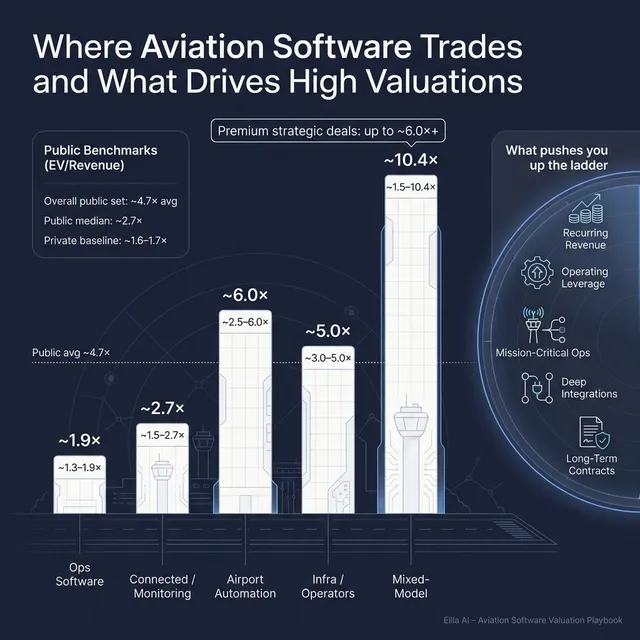
If you run an Aviation Software business and are thinking about a sale in the next 1-12 months, valuation is not just a finance question. It is a story, a positioning exercise, and a risk review wrapped around the numbers. In this sector, that matters even more because buyers do not value all "aviation tech" the same way. A cloud platform used every day by airports, airlines, or MRO teams will be judged very differently from a services-heavy business, a hardware-led automation vendor, or an airport operator.
This is also a good time to think seriously about valuation. Aviation has continued its digital catch-up, airports and airlines still face pressure to improve efficiency with limited staff, and buyers are more selective than they were in the easy-money years. That usually rewards businesses with clear recurring revenue, strong customer retention, and mission-critical products.
This guide is built to help you do three things: understand what Aviation Software businesses actually sell for, see what drives higher and lower multiples, and work out where your company might fit - plus what you can do in the next 6-12 months to improve your outcome.
1. What Makes Aviation Software Unique
Aviation Software is not one simple category. It includes airport operations platforms, air cargo and logistics software, maintenance and predictive maintenance tools, inflight connectivity software, passenger flow and terminal systems, identity and security platforms, and other workflow products tied to aviation operations. Some of these are pure software. Others look like software on the surface but carry a lot of implementation work, hardware, systems integration, or support labor underneath.
That matters because buyers care deeply about what your revenue really is. A true software business with subscription revenue, strong gross margins, and low churn is usually valued very differently from a business that depends on one-off deployments, custom projects, or hardware bundled with the product. In aviation, many companies sit somewhere in between, which is why valuation ranges can be wide.
The sector also has some features that make it different from generic SaaS. Sales cycles are often long. Buyers may include airports, airlines, ground handlers, MRO operators, cargo players, and public-sector linked entities. The cost of failure is high because software often touches safety, compliance, operational continuity, passenger flow, aircraft turnaround, or maintenance planning. That can create strong customer stickiness - but it also raises the bar for diligence.
There are a few risk factors buyers will always test. One is customer concentration, because landing one major airport group can be great, but overdependence on a few contracts is dangerous. Another is implementation burden - if every new customer needs a heavy services effort, buyers will worry that growth is expensive and margins may stall. They will also look hard at product integration depth, regulatory exposure, cybersecurity, uptime, and whether your software is genuinely embedded in daily operations or merely helpful.
In short, Aviation Software can deserve premium valuations - but only when buyers believe it is sticky, scalable, and important to the customer’s operation.
2. What Buyers Look For in an Aviation Software Business
At the most basic level, buyers look for scale, growth, profitability, and predictability. They want to know whether your revenue is recurring, whether customers stay, whether margins improve as you grow, and whether the business can keep performing after the founder exits.
But in Aviation Software, the standard checklist is not enough. Buyers also ask whether your product sits close to the operational heartbeat of the customer. Software that helps run gates, stands, turnarounds, baggage flow, crew coordination, cargo visibility, MRO planning, or airport resource allocation tends to matter more than a reporting layer that is nice to have but easy to replace.
They also care about where you sit in the ecosystem. If your product connects to airport systems, airline systems, identity systems, maintenance platforms, or customs and cargo workflows, that can increase stickiness. Integrations make switching harder. They also make your business more strategically useful to a larger buyer that already sells into the same customer base.
Another key question is whether your business is really software-led. Founders often describe a company as SaaS, but buyers will strip the model down fast. They will separate recurring subscription fees from setup fees, custom development, implementation revenue, and support-heavy contracts. The more your revenue looks recurring and repeatable, the stronger the valuation case.
How private equity thinks about it
Private equity buyers usually think in three layers. First, they ask what entry multiple they would pay today. Second, they ask who they can sell the business to in 3-7 years. Third, they ask what they can improve in between.
That means they care not only about your current quality, but about the path to a better business. Can prices be increased? Can cross-sell improve revenue per customer? Can services be standardized so margins rise? Can smaller aviation tech assets be added around the core? Can the business become a strategic platform for airport, cargo, or maintenance workflows?
A private equity buyer will also think hard about exit multiple risk. If they buy you at a premium, they need a believable story for why a future buyer - perhaps a larger strategic, a bigger private equity fund, or in rare cases public markets - will still pay well later. That is why they love recurring revenue, strong retention, and evidence that the business is becoming more deeply embedded over time.
3. Deep Dive: Product-Led Software vs Implementation-Heavy Aviation Tech
One of the biggest valuation questions in this sector is simple: are you really a software business, or are you a project business with software in it?
This matters because the data shows a clear split between asset-light software and data platforms on one side, and more infrastructure-heavy, services-heavy, or hardware-linked aviation businesses on the other. The worked example in your source materials makes that especially clear. The best fit for a modular airport software platform was not airport operators or infrastructure owners, and not hardware-heavy automation businesses either. It was the software and connected monitoring buckets - but with a reality check because many public names in those groups are still mixed models.
Buyers care because software scales better. If a new airport customer can be onboarded largely through configuration, repeatable integration, and a proven rollout process, the buyer can believe margins will expand with growth. If every deal needs custom development, long on-site work, and founder-led delivery, then the business looks less scalable and more risky. That usually brings the multiple down.
This is also where many founders leave money on the table. They have built a strong product, but the business still presents itself like a bespoke implementation shop. Revenue may be bundled. KPIs may not clearly separate recurring software revenue from services. Gross margin by revenue stream may be unclear. That makes it harder for a buyer to pay for the business you are becoming.
A useful way to think about it is this:
If your business looks more like the left side today, the path forward is usually not a total strategic rewrite. It is operational discipline. Separate revenue streams cleanly. Standardize onboarding. Reduce custom work. Show that new customers can go live faster. Prove that support burden does not rise in line with revenue. Those changes can make a very real difference in how buyers frame your business.
4. What Aviation Software Businesses Sell For - and What Public Markets Show
Here is what the data actually shows. The first thing to understand is that aviation-related valuation data is messy because the sector contains very different business models. Public markets include airport operators, systems integrators, security platforms, connectivity businesses, and automation vendors. Private deals also span software, infrastructure, and services. So the goal is not to find one magic number. It is to find the right reference band for your business type.
For most privately held Aviation Software companies, the most relevant reference points are the asset-light software and data platform deals, then the connected software and monitoring public bucket, with hardware-heavy or infrastructure-heavy categories used only as directional checks.
4.1 Private Market Deals (Similar Acquisitions)
The closest private deal group in your data is "Aviation, travel & logistics software / data platforms." That group points to low-to-mid single digit revenue multiples, with the source example noting private quartiles around 1.3x-1.9x EV/Revenue for the lower-growth or more mature software/data businesses. The broader precedent set has an overall average of 1.7x EV/Revenue and median of 1.6x, plus an average EV/EBITDA of 12.1x and median of 13.6x.
That said, the private data also shows why founders should be careful. Lower multiples often reflect businesses with services mix, modest scale, or limited proof of software-like economics. Better-positioned, more product-led Aviation Software assets can justify a step-up above those low private ranges, especially if they look more like mission-critical workflow software than generic travel tech.
The practical reading is straightforward. If your company is small, services-heavy, or still proving profitability, you are more likely to sit near the lower private bands. If you have a cleaner recurring model, stronger product identity, and visible operating leverage, you can move above them. These are illustrative ranges, not guaranteed outcomes.
4.2 Public Companies
Public market data as of mid to late 2025 gives a broader map. Across the whole aviation-adjacent public set in your sources, average EV/Revenue is 4.7x and median is 2.7x, while average EV/EBITDA is 17.7x and median is 11.7x. That gap between average and median tells you a few high-multiple names are pulling the average up.
The most relevant public bucket for many Aviation Software founders is "Connected Aviation Software & AI/IoT Monitoring." In your data, that bucket ranges from around 1.5x EV/Revenue at the low end to more than 10.0x at the high end. That is a huge spread. It reflects the fact that the group mixes stronger software-like narratives with smaller, unprofitable, or hybrid businesses. It is useful as a valuation map, but not a direct price list.
Other public buckets matter as cross-checks. Systems integrators and conglomerate OEMs trade lower on revenue because they blend software with hardware and services. Airport automation OEMs can also show meaningful revenue multiples, but those often reflect embedded software plus physical systems. Security and command/control platforms can trade well when they are mission-critical and profitable.
Founders should use public multiples as guardrails. They show what scaled, listed businesses in adjacent categories trade for, but private companies are usually adjusted down for smaller scale, lower liquidity, customer concentration, and higher execution risk. On the other hand, if your asset is scarce, strategically useful, and very sticky, a buyer may stretch above the obvious private comp range.
That is why public multiples are best used as an upper and lower reference band. They help frame what is possible. They do not tell you what a buyer will actually pay for your company.
5. What Drives High Valuations (Premium Valuation Drivers)
Higher valuations usually come when buyers believe your business is not just growing, but becoming harder to replace and easier to scale. In Aviation Software, a few themes come up again and again.
Mission-critical role in airport or airline operations
Buyers pay more when your software sits in a workflow the customer cannot easily operate without. The premium driver data points to scaled platforms embedded in critical infrastructure, where the value comes from footprint, lock-in, and strategic importance. In plain English, this means software that helps keep operations moving is worth more than software that mainly helps report on what already happened.
Examples are products tied to gate and stand allocation, turnaround coordination, baggage flow, cargo visibility, maintenance planning, or other daily operational decisions. If your software affects on-time performance, aircraft utilization, labor efficiency, or passenger movement, buyers pay attention.
Strong recurring revenue and contract visibility
Premium EV/EBITDA outcomes in the data were linked to durability of earnings and the ability to support leverage. For a software company, that usually means recurring subscription revenue, multi-year contracts, high renewal rates, and low surprise in the revenue base. Buyers love visibility because it reduces downside risk.
A founder can usually improve this by moving customers away from one-year, easily cancellable arrangements and toward longer terms, built-in renewal mechanisms, and broader multi-module contracts. The more of next year’s revenue is already visible, the better.
Clear operating leverage
The premium driver section in your sources highlights step-change margin improvement. Buyers paid up when they believed forward earnings would be better than trailing earnings. That matters a lot in Aviation Software because many businesses look messy early on, then become much stronger once implementations are standardized and customer support is more efficient.
Practical examples include reducing custom work, shortening time to go-live, lifting gross margin on services, and proving that headcount does not need to rise one-for-one with revenue. Buyers often care less about whether margins are perfect today than whether the path to stronger margins is believable.
Strategic footprint and integration depth
Aviation buyers care about network effects, even if they do not always call them that. If your product is used across multiple airports, airlines, or nodes in the aviation chain, it becomes more valuable. The same is true if you integrate deeply into the customer’s other systems. That kind of footprint makes you harder to displace and more useful to a larger buyer that wants to cross-sell into the same accounts.
This is especially important in aviation because switching costs can be high. Every integration, certification step, workflow dependency, and training requirement makes replacement harder. If your product has become part of the customer’s operational fabric, that is valuable.
Performance-backed growth
The data also shows that buyers will sometimes support a higher headline value when future growth is part of the bet, but they protect themselves with earnouts or deferred consideration. That is common when the strategic logic is strong but execution risk remains. It does not mean the buyer distrusts the business. It means they want proof.
For founders, this can be good news if you truly believe in your next phase of growth. A well-structured earnout tied to deployments, customer wins, or efficiency outcomes can sometimes bridge a valuation gap. But it works best when the milestones are clear and within your control.
Clean fundamentals
Some premium drivers are not glamorous, but they matter. Clean financials, a diversified customer base, clear product KPIs, strong leadership beyond the founder, and well-documented contracts all help buyers move faster and bid with more confidence. In competitive deals, confidence itself can become a valuation driver.
6. Discount Drivers (What Lowers Multiples)
Most lower-end outcomes do not happen because the market is bad. They happen because buyers see risk, complexity, or weak proof.
The first common discount driver is a mixed business model. If too much of your revenue comes from custom projects, implementation work, or support-heavy services, buyers may view the company as less scalable. Even if total revenue looks good, the market usually pays less for revenue that has to be re-earned through labor.
Another major discount is weak proof of stickiness. If you cannot clearly show renewal rates, expansion within existing customers, usage depth, or contract visibility, buyers will assume more risk. Aviation customers can be sticky, but if you do not present the evidence well, the valuation benefit may never show up.
Customer concentration also hurts. A few marquee airports or airline groups can sound impressive, but if a large share of revenue depends on one or two relationships, buyers will worry about re-contracting risk and pricing pressure. The same goes for heavy founder dependence - if customers buy because of you personally, the buyer will discount that.
Unclear margin quality is another common problem. If gross margin is low, or if EBITDA is positive only because the founder underpays themselves or cuts product investment, buyers will adjust fast. They want durable profitability, not cosmetic profitability.
The sector has some specific risk flags too. One is implementation sprawl - long go-live cycles, project overruns, or customer-specific customizations that are hard to maintain. Another is product positioning drift. If your business sells into aviation but the product category is fuzzy, buyers may struggle to place you into a strong comp set, which can lower the multiple.
The good news is that many discount drivers can be improved before a sale. Buyers are often willing to forgive a business that is still maturing. They are much less forgiving when the founder seems not to understand the weakness or cannot measure it.
7. Valuation Example: A Aviation Software Company
Let’s apply the logic to a fictional company. Call it SkyFlow OS - a fictional aviation software business with USD 10m in annual revenue. SkyFlow OS sells cloud software to airports and ground operations teams for stand planning, turnaround coordination, resource allocation, and operational analytics. This example, the company, and the revenue figure are all illustrative. This is not investment advice or a formal valuation.
Step 1: Start with the right comp set
The first rule is to pick the right peers. SkyFlow OS is not an airport owner, not a ground handler, and not a hardware-heavy automation company. The best fit is product-led aviation software, with connected aviation software and data platforms as the main reference points.
In your source logic, the closest private software/data platform range looked too low on its own for a stronger product-led airport software business, while the public connected aviation software bucket was too wide to use literally. So the right approach is to anchor between them: above the low private range, but below the top public outliers unless the business has very strong proof of growth, margin, and defensibility.
Step 2: Select a sensible core range
The source logic proposed 2.5x-6.0x EV/Revenue as the best risk-adjusted band for a modular aviation software company at this stage. That still makes sense. It acknowledges software positioning and strategic relevance, while staying realistic about the lack of public-company scale.
On USD 10m of revenue, that implies:
Step 3: What would move SkyFlow OS up or down?
A discounted case around USD 25m might apply if SkyFlow OS has a heavy services mix, a few concentrated customers, limited proof of renewal strength, and slow implementations that require a lot of hands-on work. In that case, the buyer may like the product but still price the company as a partially proven software business.
A core range of USD 35-50m would make sense if the company has good recurring revenue, several reference customers, decent gross margins, clean integrations, and a believable path to stronger profitability. This is where many solid Aviation Software businesses should expect to live.
A premium outcome of USD 50-60m would require more than a nice story. Buyers would want strong evidence that the product is mission-critical, customer retention is high, multi-year contracts are common, revenue expansion within accounts is real, and implementation has become repeatable. If several of those are present, a buyer may underwrite a better future and pay toward the top of the range.
The big lesson for founders is simple: two Aviation Software businesses with the same USD 10m revenue can be worth very different amounts. Revenue alone does not determine valuation. The quality, predictability, and strategic importance of that revenue matter just as much.
8. Where Your Business Might Fit (Self-Assessment Framework)
A useful way to assess your likely valuation position is to score yourself honestly across a few high-impact areas. Give each factor a score of 0, 1, or 2. Zero means weak, one means decent but not special, and two means clearly strong.
How to use it
Start with the high-impact factors. These are the ones that most strongly shape the multiple. If your recurring revenue is strong, customers stick, and the product sits in a critical operational workflow, you are already much closer to the top half of the range.
Then look at the medium-impact factors. These often explain the difference between a fair valuation and a great one. A business can have good growth, but if services mix is too high or customer concentration is severe, buyers will still hesitate.
The bonus factors usually do not rescue a weak deal, but they can improve a strong one. A strong second layer of management, clean reporting, and obvious strategic fit with multiple buyers can all help push outcomes higher in a competitive process.
As a rough guide, a business scoring mostly twos is more likely to attract premium interest. A mixed score suggests fair-market valuation. A score with many zeros usually means the business is sellable, but more preparation could materially improve the outcome.
9. Common Mistakes That Could Reduce Valuation
One of the biggest mistakes is rushing the sale. Founders sometimes decide they want to exit and go to market before the numbers, story, and process are ready. Buyers then fill in the blanks themselves, and they rarely do it in the founder’s favor. A rushed process usually creates more perceived risk, not more urgency.
Another mistake is hiding problems. If there is churn, a customer dispute, margin pressure, an implementation issue, or a product weakness, it will usually come out in diligence. When buyers discover problems late, the real damage is often not the issue itself - it is the loss of trust. That can reduce price, worsen terms, or kill the deal.
Weak financial records also cause real damage. In Aviation Software, buyers want to see recurring revenue clearly separated from services, margin by revenue stream, retention metrics, customer concentration, and credible forward forecasts. If you can improve revenue recognition, KPI tracking, or reporting clarity in the next 6-12 months, that is often worth doing before a sale.
A very common value leak is running an unstructured process without an advisor. Strong research and market experience both point in the same direction: a structured, competitive process with the right advisor typically leads to meaningfully higher purchase prices, often around 25% higher, because more buyers see the deal, competitive tension increases, and the founder has better control over terms and timing.
Another major mistake is revealing the price you want too early. The moment you tell buyers you are looking for, say, USD 10m of enterprise value, many of them will anchor around that number. Instead of telling you what the business is truly worth to them, they may come back with USD 10.1m or USD 10.2m. That kills price discovery.
There are also sector-specific mistakes. One is failing to separate software from project revenue in your materials. Another is allowing customer-specific custom development to quietly become the business model. Both make it harder for buyers to underwrite scale, and both can lower the multiple.
10. What Aviation Software Founders Can Do in 6-12 Months to Increase Valuation
Improve the quality of revenue
Focus first on making revenue more predictable. Push for longer contracts where possible. Tighten renewal processes. Identify opportunities to expand within existing customers through extra modules, seats, or sites. Buyers care a lot about whether customers stick around and pay more over time.
If you still have a lot of one-off implementation or services revenue, start separating it clearly from recurring software revenue. Even if you cannot change the mix overnight, better visibility alone helps buyers understand what they are paying for.
Improve the scalability of delivery
Look closely at onboarding and implementation. Where are projects slowing down? What still depends on the founder or on custom work? Create a more repeatable deployment playbook, standard integration templates, and clearer handoff between sales, implementation, and support.
This matters because operating leverage was one of the clearest premium signals in the data. If buyers can see that your margin profile improves as you grow, they are much more willing to pay for future earnings rather than just current revenue.
Strengthen proof of stickiness
Build a cleaner evidence pack. Show customer retention, renewal history, contract terms, expansion within accounts, case studies, and referenceability. If your product is mission-critical, do not assume buyers will just "get it." Prove it with customer outcomes such as reduced delays, faster turnaround, better asset use, fewer manual steps, or stronger compliance performance.
Also show how embedded your software is. The more integrations, workflow dependencies, and daily usage patterns you can demonstrate, the more valuable the business tends to look.
Reduce obvious risk flags
If customer concentration is high, try to sign new logos or expand the customer base before launching a process. If the founder is still central to delivery or product decisions, start pushing responsibility deeper into the team. If your contracts are inconsistent, clean them up.
You do not need to become perfect before a sale. You do need to show that the business is becoming more robust and less risky.
Prepare the equity story
A good deal process is not just a data room. It is a narrative. You need to explain what category you are in, why your product matters, why customers stay, and why a buyer can grow the business from here.
For Aviation Software founders, that usually means framing the business as a sticky operational software layer - not just another travel tech company, and not a services business with software attached. That positioning can materially change which buyers engage and how they value the asset.
11. How an AI-Native M&A Advisor Helps
A good outcome in M&A is rarely just about having a strong business. It is also about finding the right buyers, creating real competition, and presenting the company in the clearest possible way. That is where an AI-native advisor can materially improve results.
First, AI expands the buyer universe. Instead of relying on a narrow list, it helps identify hundreds of qualified acquirers based on deal history, strategic fit, synergies, financial capacity, and other signals. More relevant buyers usually means more competition, stronger offers, and a higher chance the deal actually closes if one party drops out.
Second, AI can help move the process much faster. With AI-driven buyer matching and outreach, faster creation of process materials, and better support during diligence, founders can often reach initial conversations and offers in under 6 weeks. Speed matters because momentum matters.
Third, the best AI-native advisory models combine technology with experienced human bankers. You still get expert M&A advisors with decades of deal experience driving the process, shaping the positioning, and speaking the buyer’s language. The result is high-quality materials, stronger deal framing, and Wall Street-grade advisory quality without traditional bulge bracket costs.
If you'd like to understand how our AI-native process can support your exit - book a demo with one of our expert M&A advisors.
Are you considering an exit?
Meet one of our M&A advisors and find out how our AI-native process can work for you.


