
The Complete Valuation Playbook for Cloud Security Businesses
A data-driven guide to what cloud security businesses are worth and what drives higher or lower multiples.

If you run a Cloud Security business and you are thinking about a sale in the next 1-12 months, valuation is not just a math exercise - it is a story, a risk review, and a market-clearing process.
This playbook is built specifically for Cloud Security founders. It will (1) show what similar Cloud Security and adjacent security businesses actually sold for, (2) decode what pushes multiples up or down, and (3) give you a practical self-assessment and a 6-12 month action plan to improve outcomes.
One more reason to get serious about valuation now: Cloud Security is consolidating. Platform buyers are still hungry for assets that reduce buyer risk (sticky, high-margin software) and expand their product suites - but they are far less forgiving about churn, messy revenue, or unclear product positioning than they were a few years ago.
1. What Makes Cloud Security Unique
Cloud Security businesses get valued differently because buyers are not just buying “software.” They are buying trust, risk reduction, and a claim on future security budget that is often non-discretionary after a breach, audit, or new regulation.
The main types of Cloud Security businesses
Most businesses in this sector fall into a few common buckets:
- Cloud-native security platforms (CNAPP, CSPM, CWPP, KSPM) - software that finds risk and misconfigurations across cloud workloads and containers
- Zero Trust access and secure web gateway (SASE / ZTNA) - software that controls access to apps and internet traffic
- Data security, backup, and cyber resilience - backup, archiving, ransomware recovery, and data governance
- Identity, DLP, and enterprise access security - controls around identities, permissions, and sensitive data movement
- Application and network protection (WAF, DDoS, ADC) - protecting apps and network traffic
- Managed security services (MSSP/MDR/XDR) - people + software delivering detection and response outcomes
Unique valuation considerations in Cloud Security
Cloud Security valuations usually hinge on a few sector-specific realities:
- Buyer fear is real: one customer breach tied to your product can destroy trust quickly. Buyers price this “reputation tail risk.”
- Product sprawl vs platform clarity: Cloud Security categories overlap heavily. Buyers pay more when your product is clearly “must-have” rather than “nice-to-have.”
- High gross margin is expected for software, not optional: premium outcomes cluster around software-first models with high gross margins and scalable delivery (seen in the premium deal patterns for high-margin security software) and the public comps where many software platforms show strong gross margin profiles.
- Proof beats promises: buyers want evidence that your product reduces incidents, passes audits faster, or lowers operational burden - not just features.
Key risk factors buyers will always check
In Cloud Security, expect deep diligence around:
- Customer stickiness: retention, expansion, and whether usage drops after initial deployment
- Cloud provider dependency: AWS/Azure/GCP platform changes can break integrations or reduce differentiation
- Competitive intensity: crowded CNAPP/CSPM markets mean buyers want proof of differentiation and why you win
- Security credibility: how you handle vulnerabilities, disclosure, and product security practices
- Data and compliance: what data you touch, where it is stored, and whether you can support sovereign or regulated requirements (a recurring premium pattern in sovereign/security-critical deals)
2. What Buyers Look For in a Cloud Security Business
Buyers generally underwrite Cloud Security acquisitions around two ideas: “Can this become part of a broader security platform?” and “Will customers keep paying and expanding without heroic effort?”
The universal basics (that still matter)
Even in a specialized security sector, the basics drive value:
- Revenue scale and growth rate
- Gross margin profile and delivery scalability
- Predictability: recurring revenue, renewal rates, and customer concentration
- Clear metrics and clean financials (buyers pay more when they trust your numbers)
The Cloud Security specifics buyers care about
This is where Cloud Security differs from “generic SaaS”:
- Mission-critical placement: Are you a control plane in security operations, or a bolt-on tool?
- Time-to-value: How fast do customers get measurable risk reduction after onboarding?
- Integrations: Do you sit inside workflows (SIEM, SOAR, cloud logs, IAM, ticketing) or outside them?
- Proof of outcomes: Reduction in misconfigurations, improved audit readiness, reduced dwell time, fewer incidents
- Product velocity and roadmap credibility: especially if you’re in fast-moving areas like Kubernetes security, identity misconfigurations, or cloud attack simulation
How strategic buyers think
Strategic buyers (platform security vendors, cloud providers, large IT vendors) pay more when:
- Your product fills a clear gap in their suite
- They can cross-sell you into their installed base quickly
- They can remove duplicated costs and improve margins post-close
This pattern shows up clearly in premium deals where high-margin security software with clear synergy plans achieved strong revenue multiples (e.g., strategic security software/platform acquisitions with high gross margins and explicit synergy theses).
How private equity buyers think (in plain English)
Private equity (PE) tends to value your business like a “future resale.” Their questions look like this:
- Entry vs exit multiple: “If we buy at X, can we sell later at X or higher?”
- The exit path: “In 3-7 years, who buys this - strategics, a larger PE fund, or public markets?”
- The value creation levers they expect:
- Pricing discipline (can you raise prices without churn?)
- Distribution expansion (channel/MSP partnerships)
- Cross-sell and bundling
- Add-on acquisitions (rolling up adjacent capabilities)
- Cost efficiency (especially sales efficiency and services delivery)
If you look like a software-led platform with scalable margins, PE can underwrite more upside than if you look like a services-heavy business.
3. Deep Dive: The Single Biggest Valuation Fork - Software-Led vs Services-Led Delivery
If there’s one factor that repeatedly separates “premium” Cloud Security valuations from “middling” ones, it’s the mix of scalable software revenue vs people-heavy delivery.
Buyers are not anti-services. They are anti “services that scale linearly with headcount” because it caps margins and makes growth harder to sustain.
How it shows up in the deal data
In the precedent transaction group data, software-forward security categories tend to command materially higher EV/Revenue bands than services-heavy categories:
- Cloud security software platforms show higher average EV/Revenue than managed security services and consulting categories
- Consulting, DevSecOps, and services-heavy models cluster in lower EV/Revenue ranges, while software-oriented groups (cloud security platforms, backup/data protection SaaS, cloud infrastructure/Kubernetes platforms) show higher ranges
You can see this directly in the grouped precedent ranges: cloud security software platforms and adjacent software categories sit meaningfully above services-heavy group ranges, while MSSP/MDR is lower on EV/Revenue. (Your exact multiple depends on your profile, but the “software vs services” directionality is consistent in the grouped data.)
Why buyers care
- Margin durability: software margins can stay high as you grow; services margins often get squeezed as you scale
- Repeatability: software onboarding can be standardized; services vary by customer
- Integration value: strategics pay more when your product becomes a repeatable module in their platform (a core theme in premium synergy-driven software deals)
How to move from “services-led” to “software-led” in 6-12 months
If you have meaningful services today, you can still improve valuation by changing how services show up:
- Productize implementation: fixed-scope packages, standard timelines, standard pricing
- Make services optional: move “required” work into the product via automation
- Separate reporting: show software gross margin and services gross margin clearly
- Shift success metrics: measure time-to-value, adoption, and renewal health - not hours delivered
Lower-value vs higher-value profile
4. What Cloud Security Businesses Sell For - and What Public Markets Show
This section is intentionally data-first. Private deals show what buyers actually paid. Public markets show the reference bands that influence buyer psychology - especially for larger acquirers and PE funds benchmarking return targets.
4.1 Private Market Deals (Similar Acquisitions)
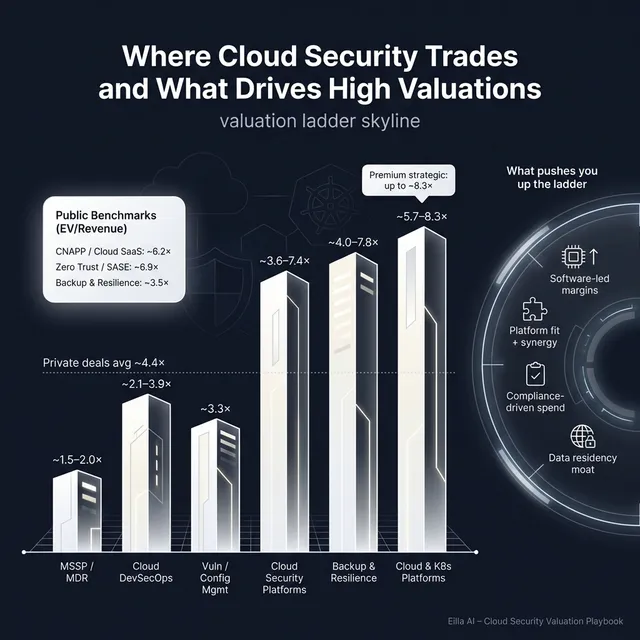
Across the precedent transaction group data, the overall average EV/Revenue is around 4.4x. But Cloud Security is not one market - deal multiples cluster by business model and category.
Here are the most useful deal-type bands for founders of Cloud Security businesses:
A practical interpretation: if your business is truly software-led (high gross margin, repeatable deployment), you tend to benchmark against the Cloud Security Software Platforms band first. If you’re services-heavy, buyers will mentally anchor you closer to the consulting or MDR bands - even if you call yourself “SaaS.”
Remember: these are illustrative ranges from comparable deal groups, not guarantees. Deal structure (earn-outs, retention packages, deferred consideration) also changes what “headline multiple” means in practice.
4.2 Public Companies
Public market multiples are not a direct price tag for your private business - but they shape how buyers think about “what is reasonable,” especially in a world where capital is more disciplined than it was in 2021.
Using the public group averages provided (as of mid/end-2025), here’s what the market reference bands look like:
Two important founder takeaways:
- Use public multiples as a reference band, not a valuation output. Your business is smaller, less liquid, and often riskier - so buyers usually adjust downward for scale and concentration risk.
- Private outcomes can still beat public “math” when you are scarce and strategic. The premium deal commentary shows strategics paying up when they see clear platform synergies, margin accretion, and cross-sell potential.
5. What Drives High Valuations (Premium Valuation Drivers)
Premium valuations in Cloud Security are rarely “because the market is hot.” They happen when buyers can tell a simple story: high-margin software + strategic fit + low risk + clear growth path.
Below are the premium drivers that show up in the deal patterns, grouped into themes, plus a few universal M&A drivers that always matter.
5.1 High-margin, scalable software (and proof it stays high)
Buyers pay more when your economics look like software, not projects.
What it looks like in practice:
- High gross margin that holds as you grow
- Repeatable onboarding and support model
- Limited reliance on custom services to deliver outcomes
Why it drives value:
- Buyers can scale revenue without scaling headcount at the same rate
- It supports “margin accretion” narratives that strategics love (a repeated theme in premium strategic security software deals)
5.2 Strategic platform fit and obvious synergies
The biggest premiums cluster where acquirers can clearly explain “buy vs build.”
What it looks like:
- Your product fills a missing piece: CNAPP module, cloud identity risk, Kubernetes posture, cloud attack simulation, API security adjacency
- Clear cross-sell path into the buyer’s installed base
- Integration is realistic (not a science project)
Practical founder examples:
- You already integrate into common security stacks (SIEM, ticketing, cloud logs)
- Your product uses data the acquirer already has, making value immediate
- Your roadmap aligns with buyer priorities (not just your own vision)
5.3 Regulated, mission-critical compliance tailwinds
Premium outcomes show up when spend is mandated, not optional.
What it looks like:
- Strong recurring revenue tied to compliance workflows
- Clear mapping to standards (SOC 2, ISO 27001, industry regulations)
- Evidence your product shortens audits or reduces compliance burden
This pattern is visible in regulated compliance/GRC SaaS deals achieving premium outcomes when recurring growth and margin scaling were credible.
5.4 Sovereignty and trust moats (especially outside the US)
In some geographies and customer sets, “where data lives” is a buying decision, not a preference.
What it looks like:
- Data residency, sovereign cloud posture, government-grade requirements
- Certifications, references, procurement readiness
- Clear differentiation vs global hyperscaler-native tools
Sovereign/security-critical positioning shows up as a valuation catalyst in the precedent patterns.
5.5 Channel distribution that scales (MSP / platform ecosystems)
Channel fit can create “distribution leverage,” which buyers love.
What it looks like:
- MSP/RMM ecosystem integrations
- High attach rates and strong retention through partners
- Low-cost customer acquisition relative to direct enterprise sales
This shows up in cloud data protection/security deals where channel integration supported premium appetite.
5.6 Clean numbers and a credible story
Even great security products get discounted if diligence is messy.
Premium signals include:
- Clear revenue recognition and cohort reporting
- Predictable renewals and churn tracking
- A leadership bench that can run the business post-close
6. Discount Drivers (What Lowers Multiples)
Discounts are usually not about one flaw. They happen when buyers see a bundle of risks and decide they need protection: lower price, earn-out, or harder terms.
6.1 Services-heavy delivery and low software leverage
If customers require lots of human work to get value, buyers worry about margin ceilings and scalability. This is why services-heavy categories cluster at lower EV/Revenue in the precedent group ranges.
What you can do:
- Separate services from software financially and operationally
- Productize onboarding and reduce bespoke work
6.2 Weak retention or unclear “stickiness”
Cloud Security tools get ripped out when:
- they don’t become part of daily workflows
- they generate noise (false positives)
- they don’t prove value quickly
What you can do:
- Show retention and expansion by cohort
- Track outcomes (risk reduced, incidents prevented, audit time reduced)
6.3 Crowded positioning with no “why you win”
If you sound like “another CNAPP” with similar features, buyers assume pricing pressure and churn risk.
What you can do:
- Define your wedge: Kubernetes posture depth, cloud attack simulation, automation, vertical specialization, sovereignty, etc.
- Prove it with win/loss data and customer references
6.4 Customer concentration and single-channel dependency
If one customer, one partner, or one cloud provider change can hurt you, buyers will discount.
What you can do:
- Diversify revenue and show resilience scenarios
- Document partner terms and pipeline diversity
6.5 Product security and compliance gaps
Buyers will dig into your own security posture. If your company cannot pass diligence as a security vendor, value drops fast.
What you can do:
- Document secure development practices
- Prepare for deep technical diligence, not just financial diligence
7. Valuation Example: A Cloud Security Company
This is a worked example to show valuation logic, not investment advice or a formal valuation.
The fictional business
Assume a fictional Cloud Security company, “AtlasKite Security”, with:
- USD 10.0m in annual revenue (fictional)
- Software-led CNAPP/KSPM-style product with some professional services for onboarding
- Strong integrations into cloud logging and ticketing
- Competes in a crowded market but has real differentiation in Kubernetes posture automation and cloud attack simulation
Step 1: Build a realistic multiple “home base”
Start with the most relevant private and public reference bands:
- Private Cloud Security Software Platforms: ~3.6-7.4x revenue
- Relevant public bands for CNAPP/SaaS and Zero Trust/SASE show wide ranges, but a practical “core cluster” for a software-led cloud security vendor often lands around ~4.0-6.0x revenue when you adjust for being smaller and private.
Then adjust:
- Up if you look more like high-margin scalable software with strategic fit
- Down if you look more like services-led delivery or have retention and positioning risk
Step 2: Apply to USD 10.0m revenue
Why these scenarios are reasonable:
- The core range matches the “anchor” corridor implied by the most relevant private and public bands for cloud security platforms.
- The premium case reflects measured upside for strong software economics and strategic adjacency (like Kubernetes platform relevance) without jumping to outlier categories.
- The discounted case reflects what happens when services mix rises, differentiation is unclear, or growth/retention is below peer expectations.
Step 3: What this means for you
Two Cloud Security businesses with the same USD 10m revenue can end up with very different outcomes because buyers are pricing risk, stickiness, and strategic fit - not just revenue.
If you want a higher multiple, the path is usually: improve the business profile (retention, margin, clarity) and run a process that creates competition.
8. Where Your Business Might Fit (Self-Assessment Framework)
This framework helps you estimate where you may land within the valuation spectrum - and where improvements will have the biggest payoff.
How to use it:
- Score each factor 0, 1, or 2
- Be strict. Buyers will be.
- Use the total to guide priorities, not to “calculate” a valuation
How to interpret your total (illustrative):
- High band (most 2s): you look more like the premium end of software platform outcomes
- Middle band (mix of 1s and 2s): fair market outcomes, strong process matters
- Low band (many 0s): expect discounts or heavier earn-outs unless you fix key issues first
9. Common Mistakes That Could Reduce Valuation
These are avoidable. They routinely cost founders real money.
9.1 Rushing the sale
If you start a process without clean numbers, a clear story, and prepared diligence materials, buyers slow down, ask for protections, and reduce offers.
Fix:
- Treat a sale like a product launch: plan, prepare, test, then execute.
9.2 Hiding problems
Issues will surface in diligence. If buyers feel misled, value drops and deals can die.
Fix:
- Disclose issues early with a mitigation plan. Buyers can accept risk - they won’t accept surprises.
9.3 Weak financial records
Cloud Security buyers expect SaaS-grade reporting: recurring revenue, churn, cohorts, gross margin, services margin, and clear customer concentration.
Fix in 6-12 months:
- Clean revenue classification (recurring vs services)
- Monthly KPI dashboard
- Clear gross margin logic and consistency
9.4 No structured, competitive sale process with an advisor
A structured, competitive process usually produces better outcomes than a single-buyer negotiation. Academic and practitioner research commonly cites meaningful purchase price uplift (often referenced around ~25%) when sellers run a competitive process with experienced advisors, versus negotiating with one buyer in a vacuum.
Fix:
- Run a process that creates real competition and time pressure.
9.5 Revealing your “target price” too early
If you tell buyers “we want USD 50m,” you often cap the upside. Buyers anchor to your number and come back with tiny increments instead of showing their real willingness to pay.
Fix:
- Let the market speak first. You manage the process; buyers compete on price and terms.
9.6 Cloud Security-specific mistake: unclear category narrative
If your deck sounds like a grab bag (CNAPP + CSPM + KSPM + attack simulation + chaos engineering) without a clear “why now” and “why you,” buyers label it as unfocused.
Fix:
- Choose one “wedge” narrative and show how adjacencies expand from it.
9.7 Cloud Security-specific mistake: underpreparing for technical diligence
Security buyers often run deep product reviews. Weak documentation, unclear architecture, or immature internal security practices can force price chips or earn-outs.
Fix:
- Prepare security posture materials like a product: policies, audits, penetration testing history, incident response, secure development practices.
10. What Cloud Security Founders Can Do in 6-12 Months to Increase Valuation
You don’t need a massive pivot. You need targeted moves that reduce buyer risk and increase strategic value.
10.1 Improve the numbers buyers trust most
- Tighten retention: prioritize renewals and expansions, especially your top cohorts
- Increase recurring mix: shift one-off work into subscriptions where possible
- Improve gross margin visibility: report software vs services margins separately
- Reduce customer concentration: even modest diversification can remove a major discount
10.2 Move toward a more “software-led” delivery profile
- Productize onboarding into fixed packages
- Automate remediation and reporting so outcomes don’t depend on consultants
- Standardize deployments and documentation to reduce implementation friction
This directly moves you away from services-heavy valuation bands and toward software platform bands seen in the private deal group ranges.
10.3 Make your differentiation undeniable
- Build a clean positioning story: one wedge, one clear ICP (ideal customer profile), clear proof points
- Document win/loss and why you replace incumbents
- Show outcomes: time-to-value, misconfigurations reduced, audit time saved, incidents avoided
10.4 Increase strategic acquirer attractiveness
- Strengthen integrations into common platforms (cloud logs, SIEM, ticketing, IAM)
- Package adjacencies in ways platform buyers can sell (bundles, modules)
- Build a simple synergy story: “here’s who buys you and why”
Premium outcomes cluster around high-margin software with clear synergy narratives - you can influence this without changing your whole business.
10.5 De-risk diligence before it starts
- Prepare a data room early: contracts, revenue schedules, customer cohorts, security posture, product docs
- Fix obvious compliance gaps (SOC 2/ISO mapping, secure development documentation)
- Build a leadership bench: buyers pay more when they don’t fear founder dependency
11. How an AI-Native M&A Advisor Helps (Soft CTA)
An AI-native M&A advisor can improve outcomes in Cloud Security exits because it combines human deal judgment with machine-scale buyer discovery and process execution.
First, higher valuations through broader buyer reach: AI can map hundreds of qualified acquirers and investors based on deal history, product adjacency, financial capacity, and likely synergy fit. More relevant buyers means more competition, stronger offers, and more paths to close if a preferred bidder drops out.
Second, initial offers in under 6 weeks: with AI-driven buyer matching, faster outreach, and streamlined creation of marketing materials and diligence workflows, you can reach serious conversations and early indications of interest much faster than a manual-only process.
Third, expert advisory, enhanced by AI: you still need experienced human advisors to frame the narrative, manage bidder psychology, and negotiate terms. AI helps those advisors move faster and go deeper - delivering “Wall Street-grade” materials, sharper positioning, and a tighter process without traditional bulge bracket costs.
If you’d like to understand how an AI-native process can support your exit, book a demo with one of our expert M&A advisors.
Are you considering an exit?
Meet one of our M&A advisors and find out how our AI-native process can work for you.


