
The Complete Valuation Playbook for Compliance Businesses
A data-driven guide to how compliance businesses are valued today and what drives high multiples.

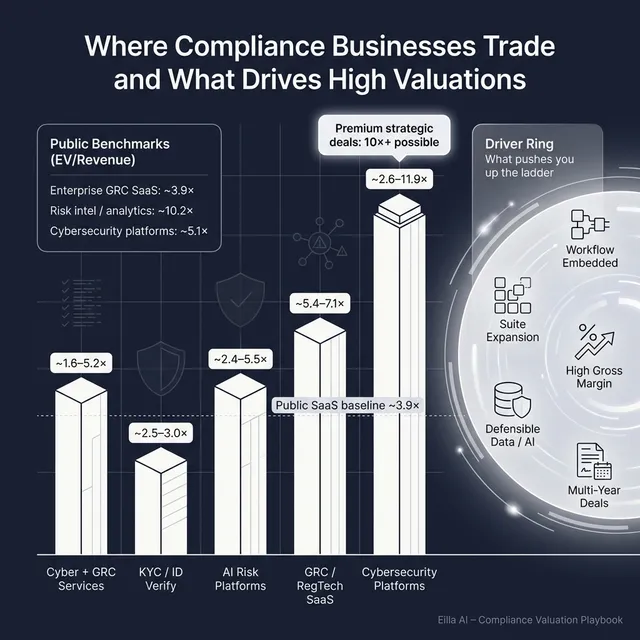
If you are a founder or CEO of a compliance business and you are considering a sale in the next 1-12 months, valuation becomes less about "what you think it should be worth" and more about "what buyers can underwrite with confidence."
This is a data-driven playbook built specifically for compliance businesses - from GRC and RegTech SaaS to KYC/AML platforms, risk intelligence, and compliance-heavy cyber services. You will see what similar companies have sold for, what public markets imply, what actually drives premium outcomes, and what you can realistically do in the next 6-12 months to improve your deal.
A simple promise: you will leave with a clearer idea of where your business sits on the valuation spectrum, what moves you up (or down) that spectrum, and how to run a process that lets the market compete for you.
1. What Makes Compliance Businesses Unique
Compliance is not a “nice to have” category. When it is working, it prevents fines, license risk, reputational damage, and operational disruption. That changes how buyers value it.
Most compliance businesses fall into a few recurring types:
- Compliance software platforms (SaaS): GRC tools, regulatory reporting, policy management, audit workflows, communications monitoring, risk analytics.
- Identity verification and KYC/AML platforms: onboarding, screening, verification, fraud signals, watchlists.
- Risk intelligence and investigative analytics: entity resolution, fraud detection, sanctions screening, investigative workflows.
- Cybersecurity + compliance services: advisory, managed services, audits, security governance, certifications, incident readiness.
Three valuation considerations show up again and again in this sector:
- Mission-critical + sticky workflowsIf your product is embedded in regulated processes (audit cycles, surveillance, reporting, onboarding), replacement pain is high - buyers pay more for "hard to rip out."
- Proof matters more than promisesBuyers love the story of "regulation is increasing." But they pay for evidence: renewal rates, multi-year contracts, procurement wins, and measurable compliance outcomes.
- Risk cuts both waysCompliance companies can be resilient in downturns, but buyers will always stress test: regulatory exposure, liability, model accuracy (if you use AI), customer concentration, and data/privacy posture.
Key risks buyers always check in this industry:
- Regulatory credibility risk: Are your outputs trusted by compliance teams, auditors, regulators?
- Data risk: How you collect, store, and secure sensitive customer data.
- Outcome risk: False positives, missed detections, poor reporting accuracy.
- Delivery risk: Heavy implementation burden, services dependence, “founder holds everything together.”
2. What Buyers Look For in a Compliance Business
Buyers broadly fall into two camps: strategic acquirers (industry players buying capability) and private equity (financial buyers buying cash flows and scalability). They overlap, but their valuation lens differs.
The obvious things still matter
- Revenue scale: Bigger is safer. Scale reduces customer concentration risk and signals a real market.
- Growth: Buyers pay up when growth looks durable (not a one-time regulatory spike).
- Margins: Compliance businesses can look like software or like services. Buyers will price you accordingly.
- Retention: If customers stick around because they have to (not just because they like you), that is valuable - but you must prove it.
Industry-specific nuances that matter a lot
- Procurement dynamics: Enterprise compliance budgets move slowly, but once you are in, you can stay for years. Buyers want to see evidence you can win and expand in that environment.
- Audit readiness and reporting rigor: Your product is often judged in high-stakes moments (audits, investigations). Buyers want proof your outputs hold up under pressure.
- Multi-module potential: Compliance buyers love consolidation. If you can sell more modules into the same account, your value increases.
How private equity buyers think (in plain language)
Private equity cares about what they can buy you for, improve, and sell for in 3-7 years.
- Entry multiple vs exit multiple: If they buy at 5.0x revenue, can they sell at 6.0x later? They need a believable reason (higher growth, higher margins, broader product suite).
- Who they can sell to later: Bigger strategics, larger PE funds, or occasionally public markets.
- Levers they expect to pull:
- Price increases (if your product is truly mission-critical)
- Cross-sell (more modules per customer)
- Reduce services burden (more productized onboarding)
- Improve gross margin and EBITDA (operating discipline)
- Add bolt-on acquisitions (if your category consolidates)
If you show that these levers are already working, buyers assume less risk and often pay more.
3. Deep Dive: The Biggest Valuation Nuance in Compliance - “Workflow Embeddedness” vs “Point Solution”
Two compliance businesses with the same revenue can be valued very differently depending on one question:
Are you embedded in a recurring, unavoidable compliance workflow - or are you a point tool that can be swapped easily?
This factor shows up clearly in the deal data. Scaled, mission-critical compliance platforms embedded across regulatory workflows have achieved premium, sometimes double-digit EV/Revenue outcomes in the most strategic cases (for example, large risk and regulatory platforms and identity security platforms). Meanwhile, narrower tools and services-heavy models tend to cluster lower.
Why buyers care:
- Switching cost: If removing you creates operational risk (missed filings, audit failures, surveillance gaps), you become “sticky.”
- Budget defensibility: Compliance workflow tools survive scrutiny even when budgets tighten.
- Expansion: Workflow products expand naturally into adjacent needs (archive - monitoring - reporting - investigations), increasing revenue per customer.
How to move from lower-value to higher-value over time:
- Productize the “last mile” so implementation is lighter.
- Build integrations into the systems of record (ERP, HRIS, email/collaboration tools, identity providers, core banking/CRM).
- Prove the outcome (reduced manual work, faster audits, fewer incidents, better detection precision).
Mini-table:
4. What Compliance Businesses Sell For - and What Public Markets Show
Here is the calm truth: multiples in this space are wide, because “compliance business” can mean software with 80% gross margins, or consulting with 30% gross margins, or data-driven risk intelligence with unique datasets.
The best way to use comps is to find the closest business model and risk profile, then adjust based on your strengths and weaknesses.
4.1 Private Market Deals (Similar Acquisitions)
The private deal data shows a few clear clusters:
- Core compliance software and RegTech SaaS tends to land in a mid band.
- Services-heavy compliance and security consulting tends to trade lower, because revenue is less scalable.
- Mission-critical platforms in high-stakes regulated environments can move into a premium band, especially when they have platform breadth and strong software economics.
A founder-friendly way to look at it is by deal “type” rather than by company name:
These ranges are illustrative. In real deals, the same segment can trade higher or lower depending on growth, margins, retention, customer concentration, and the strength of the buyer’s strategic reason.
4.2 Public Companies
Public markets give you a reference band - not a “price tag.” They help answer: what do scaled, liquid, comparable businesses trade at?
Across relevant public segments, the data shows:
- Enterprise GRC and RegTech SaaS around ~3.4x median EV/Revenue and ~3.9x average, with EV/EBITDA around the mid-teens where EBITDA is meaningful.
- RegTech reporting SaaS around ~3.1x EV/Revenue, with high EV/EBITDA in some cases because EBITDA is small but positive.
- Investigative analytics and risk intelligence tends to trade higher on average (~8.0x median EV/Revenue, ~10.2x average) because data and risk workflows can be highly defensible.
- Cybersecurity software platforms around ~3.7x median EV/Revenue and ~5.1x average, with wide dispersion for premium growth names.
A simple table founders can use:
These public multiples are best treated as a reference band (mid to end of 2025 snapshot). Private companies typically trade at a discount for smaller scale and illiquidity, but some trade at a premium if they are scarce, strategic assets with strong growth and defensibility.
5. What Drives High Valuations (Premium Valuation Drivers)
Premium outcomes in compliance M&A are not random. The drivers repeat across deals and buyer narratives. Here are the themes that consistently move you toward the top of the range.
5.1 You are mission-critical in regulated workflows
Buyers pay more when your product is not optional.
Practical examples:
- You sit in surveillance, reporting, audit, onboarding, or investigations where failure has consequences.
- Your tool is referenced in internal compliance policies and audit processes.
- Customers standardize you across countries or business units.
What buyers want to hear: “If we turn this off, risk goes up immediately.”
5.2 You have software-like gross margins and a credible path to EBITDA scale
Premium deals often share a simple pattern: high gross margins and improving profitability trajectory.
What this looks like in practice:
- Recurring software revenue is the majority of your mix.
- Services exist, but they accelerate software adoption rather than define the business.
- Your EBITDA trend is improving (even if not perfect).
Buyers anchor on whether you can become a “scaled software cash generator,” not a perpetual services machine.
5.3 You benefit from compliance acceleration and procurement leverage
Regulation creates urgency - but the premium comes when you convert urgency into repeatable wins.
Examples:
- You can show measurable reductions in manual compliance work.
- You win multi-year enterprise procurements.
- You help buyers pass audits faster or reduce false positives in monitoring.
5.4 You have data or AI that is genuinely defensible
AI can be a premium driver, but only when it is proven.
High-value signals:
- Clear performance metrics (lower false positives, better detection quality).
- Evidence regulators and auditors accept your outputs.
- Proprietary datasets or domain-specific models that competitors cannot easily copy.
A buyer will not pay for “we use AI.” They pay for “our models reduce risk and workload, measurably.”
5.5 You are a suite, not a single-product bet
Consolidation is a strong theme in compliance buying. Suites win because they reduce vendor count and unify control systems.
Premium signals:
- Multiple modules adopted per customer.
- Expansion revenue from add-ons is predictable.
- You integrate workflows across teams (risk, compliance, legal, security, finance).
5.6 You show growth that holds up through regulatory cycles
Compliance demand can spike with new rules, then normalize. Premium buyers want durable growth that does not depend on a single “regulation wave.”
Proof points:
- Multi-year contracts
- Renewal resilience
- Backlog and pipeline quality tied to ongoing regulatory complexity
And yes - the “boring” premium drivers still matter: clean financials, diversified customers, a strong leadership bench, and predictable reporting.
6. Discount Drivers (What Lowers Multiples)
Discounts in compliance deals usually come from buyer fear - fear that revenue is less durable, margins are less scalable, or risk is higher than it looks.
Common discount drivers in this sector:
- Services-heavy revenueIf a large share of revenue is consulting, audits, or custom projects, buyers often value you more like a services firm than a software company.
- Weak retention or unclear stickinessBuyers will discount if renewals are inconsistent or if customers treat you as an annual decision.
- Customer concentrationCompliance companies often land big accounts. If one or two customers drive a large share of revenue, buyers worry about single-point failure.
- Implementation riskIf every deployment is unique, slow, or founder-led, buyers assume churn risk and margin compression.
- Regulatory or liability exposureIf your outputs could be challenged (false positives, missed detections, weak audit defensibility), buyers price that risk.
- Unclear unit economics in regulated salesEnterprise compliance sales can be long. If you cannot show repeatability in go-to-market (sales cycle, conversion, expansion), buyers hesitate.
The good news: many discount drivers can be improved materially in 6-12 months with focused execution.
7. Valuation Example: A Compliance Company (Fictional)
This is a worked example to show how valuation logic works in practice. The company and numbers are fictional. The multiples and logic are based on the patterns in the data you provided.
Step 1: The logic (plain English)
- Start with the closest business model comps
- If you are compliance SaaS with strong software margins, you should not anchor to services-heavy comps.
- If you are risk intelligence / investigative analytics, you may deserve a higher reference band than basic GRC.
- Pick a “core” multiple range
- Broad compliance/RegTech public comps tend to cluster roughly ~3-6.5x EV/Revenue as a defensible public reference band.
- Private RegTech SaaS and financial regulatory compliance deals show a higher mid band around ~5-7x in many cases.
- The higher bands (above ~10x) typically require truly exceptional defensibility, scale, or strategic scarcity.
- Adjust up for premium drivers, down for discount drivers
- Strong margins + improving EBITDA + mission-critical workflow embedding can push you upward.
- Heavy services mix, concentration, weak proof, or delivery risk pushes you downward.
Step 2: Apply it to a fictional company
Meet ClearLedger (fictional):
- Compliance SaaS for regulated financial institutions
- 80% gross margin, positive and improving EBITDA
- Multi-module suite: monitoring + archive + investigations workflow
- Revenue: USD 10m (fictional)
Now apply scenarios:
How to interpret these:
- Discounted case: ClearLedger is more “tool-like,” has services-heavy onboarding, or has concentration and weak proof of stickiness.
- Core case: Strong software economics, credible retention, and clear workflow value.
- Premium case: ClearLedger looks like a scarce, mission-critical platform with strong margins, improving profitability, and real suite expansion per customer.
Step 3: What this means for you
Two compliance companies with the same USD 10m revenue can be worth USD 30m or USD 90m because buyers are not buying revenue - they are buying future durability and scalability.
This is not investment advice or a formal valuation. It is a worked example to show how buyers think.
8. Where Your Business Might Fit (Self-Assessment Framework)
Use this to quickly sanity-check where you likely sit today. Score each factor 0 / 1 / 2:
- 0 = weak or unclear
- 1 = acceptable, but not strong
- 2 = strong and well-proven
Scoring table
Interpreting your total
You can treat this as directional:
- High band: You are closer to premium outcomes (buyers see durability + scalability).
- Mid band: You are likely in fair-market territory.
- Low band: You likely have fixable issues that buyers will use to push price down.
The goal is not to “win the score.” The goal is to identify the 2-3 improvements with the biggest valuation payoff.
9. Common Mistakes That Could Reduce Valuation
These mistakes are common and avoidable - and they can cost real money.
9.1 Rushing the sale
If you start outreach before your numbers, story, and buyer list are ready, you lose leverage fast. Buyers sense disorganization and assume hidden risk.
9.2 Hiding problems
In M&A, issues almost always surface in diligence. Hiding them destroys trust, triggers retrades, and can collapse a deal. You are better off framing issues honestly with a plan.
9.3 Weak financial records
Founders often underestimate how much confidence clean reporting creates.
Fixable improvements in 6-12 months:
- Clear revenue categories (recurring software vs services)
- Cohort retention tracking
- Gross margin consistency and explanation
- Basic KPI discipline (pipeline, churn, expansion)
9.4 No structured, competitive sale process with an advisor
A structured process creates competition - competition creates higher prices. Research often cited in M&A practice suggests that running a structured competitive process with an advisor can lead to meaningfully higher purchase prices (often referenced around ~25%), largely due to better buyer coverage and negotiation leverage.
9.5 Telling buyers your price too early
If you say, “We want USD 10m,” you kill price discovery. Buyers will cluster around that number instead of showing what they would actually pay in a competitive process.
9.6 Compliance-specific mistake: over-relying on “regulation is increasing” as the story
Regulation tailwinds are real, but buyers will discount hype. They want proof: measurable outcomes, renewal resilience, and why your solution wins even when budgets tighten.
10. What Compliance Founders Can Do in 6-12 Months to Increase Valuation
You do not need to reinvent the company in 6 months. You need to reduce buyer-perceived risk and increase buyer confidence in the drivers that move multiples.
10.1 Improve the numbers (without financial gymnastics)
- Increase recurring revenue mix (even modest shifts help)
- Productize onboarding to reduce services dependency
- Show margin discipline: stable gross margin and improving EBITDA trend
- Tighten retention reporting and expansion tracking
10.2 Make stickiness undeniable
- Document renewal drivers and “why customers cannot leave”
- Capture workflow embeddedness: policy references, audit usage, cross-team adoption
- Build a simple ROI narrative: hours saved, false positives reduced, audit time improved
10.3 Strengthen the “suite and expansion” story
- Identify 1-2 attach opportunities and execute them now
- Build playbooks for cross-sell: what triggers expansion, what package, what proof points
- Track module adoption per customer as a core KPI
10.4 De-risk compliance credibility
- Improve your security and data governance posture (buyers will diligence it anyway)
- Collect third-party validation: certifications, audit acceptance examples, customer references
- If you use AI, publish performance metrics in plain language (precision, false positives, workflow impact)
10.5 Prepare for diligence like it is a product launch
- Centralize customer contracts, KPIs, security documentation, and product roadmaps
- Clarify what is “recurring” vs “non-recurring”
- Identify issues early and build a credible mitigation plan
If you do only one thing: make the business easier to underwrite. Buyers pay more when they feel less uncertainty.
11. How an AI-Native M&A Advisor Helps
A strong exit is usually not about finding one buyer - it is about creating a market for your business. AI-native advisory can widen that market in ways traditional manual processes struggle to match.
First, higher valuations through broader buyer reach. AI can map your business to hundreds of relevant acquirers based on deal history, synergy fit, and financial capacity. More relevant buyers means more competition, stronger offers, and a higher chance the deal closes because you have options if one buyer drops.
Second, initial offers in under 6 weeks is increasingly realistic when buyer matching, outreach, and the creation of marketing materials are accelerated with AI - while diligence workflows are supported instead of reinvented from scratch.
Third, expert advisory, enhanced by AI. The best outcomes still require experienced human M&A advisors who can position the business credibly, run negotiation, and manage process psychology. AI makes that expertise go further: cleaner materials, stronger buyer targeting, faster iteration, and “Wall Street-grade” preparation without traditional bulge bracket costs.
If you would like to understand how an AI-native process can support your exit, book a demo with one of our expert M&A advisors at Eilla AI.
Are you considering an exit?
Meet one of our M&A advisors and find out how our AI-native process can work for you.


