
The Complete Valuation Playbook for Customer Experience Businesses
A data-driven guide to how Customer Experience businesses are valued and what drives high multiples.

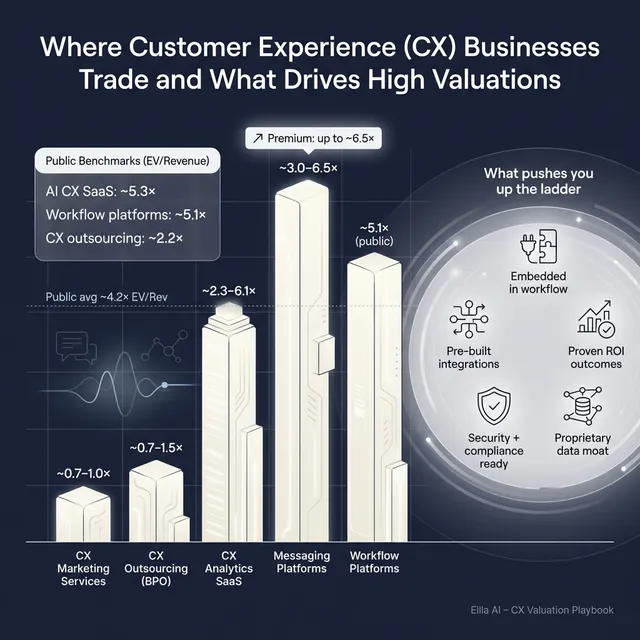
If you are a founder or CEO of a Customer Experience (CX) business thinking about a sale in the next 1-12 months, valuation is not just a formula - it is a story backed by proof.
This sector is in a consolidation wave. Large software platforms want CX coverage, private equity wants predictable cash flows, and AI has made “experience data” and “conversation data” more strategic than ever. That creates real upside - but only for businesses that can show they are durable, defensible, and easy to scale.
This playbook is built to help you do three things: understand what CX businesses actually sell for, decode what drives higher vs lower multiples, and give you a practical self-assessment plus a 6-12 month action plan to improve your outcome.
1. What Makes Customer Experience Businesses Unique
“Customer Experience” is a broad label. Buyers split it into different business models - and those models price very differently.
The main CX business types you’ll see in M&A:
- CX software (SaaS): customer engagement platforms, voice-of-customer, analytics, conversation intelligence, workforce engagement, digital adoption overlays, knowledge management.
- Messaging and conversational platforms: chat, messaging orchestration, live chat with automation, channel-specific platforms (WhatsApp, LINE, etc.).
- Tech-enabled CX services (BPO/contact centers): managed agents, omnichannel support operations, outsourcing with varying levels of tech overlay.
- Analytics and digital marketing services: agency-like or services-led analytics, campaign execution, deliverability, consulting-heavy models.
Why valuation is different here than “normal software” or “normal services”:
- Data is part of the product. Buyers care about whether your interaction data (tickets, calls, chat logs, feedback) creates a learning loop that improves outcomes over time - and whether you can legally and securely use it.
- Outcomes matter more than features. CX buyers pay up for proof that you reduce cost-to-serve, increase conversion, reduce churn, or improve customer satisfaction - not for a long feature list.
- Integration drives value. A CX product that sits “inside” CRM, contact center, workforce management, or marketing workflows tends to be stickier - and more strategic to acquirers.
Key risk factors buyers will always check in CX:
- Customer concentration and contract durability. Many CX companies have a few large logos - and buyers will price the risk of losing one.
- Retention and churn. CX tools can be switched if they are not embedded in daily workflows.
- Data privacy and security posture. GDPR alignment, SOC 2 (or equivalent), and clean data handling are often gating items, not “nice to have.”
- Implementation and services dependency. If you need heavy customization to go live, buyers worry about scalability and margin durability.
- AI claims vs AI proof. “AI-powered” is not a premium by itself. Measurable uplift and defensible data assets are what matter.
2. What Buyers Look For in a Customer Experience Business
Buyers look at your business through one simple lens: how predictable is the future cash flow, and how valuable is your product inside a bigger ecosystem?
The obvious fundamentals still matter
- Revenue scale and growth. Bigger and faster-growing usually means higher valuation, because the buyer is underwriting momentum.
- Gross margin. High gross margin signals software economics and scalability (and often indicates less services drag).
- Customer stickiness. If your customers renew and expand, buyers see lower risk.
- Clear product positioning. “We solve one painful thing extremely well” often beats “we do everything a bit.”
The CX-specific nuances that change outcomes
- Where you sit in the workflow. Tools tied to frontline operations (contact center, workforce scheduling, real-time routing, compliance) tend to be more “must-have” than tools that are mostly “reporting.”
- Proof of business impact. CX is full of dashboards. Buyers pay more for companies that can say: “We reduced average handle time by 12%” or “We increased deflection by 18%.”
- Integration footprint. Pre-built connectors and live deployments with major platforms reduce buyer risk and increase cross-sell potential.
- Data advantage. Proprietary labeled datasets, unique interaction corpora, and model performance that improves with scale can create defensibility.
How private equity thinks about your CX business
Private equity (PE) is usually underwriting a 3-7 year journey. Their thinking is practical:
- Entry multiple vs exit multiple. If they buy you at a high multiple, they need confidence they can sell at a similar or higher multiple later.
- Who the next buyer is. They ask: “Is this a strategic platform tuck-in later? Can a larger PE fund buy this? Is there a public markets path?” In CX, strategics often matter more because integrations and ecosystem value drive premiums.
- The levers they expect to pull:
- Pricing discipline and packaging
- Increasing retention and expansion
- Shifting mix from services to software
- Streamlining delivery costs
- Add-on acquisitions (common in services-heavy CX)
3. Deep Dive: The Most Important Valuation Nuance in CX - “Embedded Workflow” vs “Nice-to-Have Insight”
In CX, the biggest gap in valuation often comes down to one question:
Are you a system that runs a workflow, or a tool that reports on what happened?
Buyers consistently pay more when your product is mission-critical - meaning customers rely on it daily and switching would be painful.
How this shows up in the data
Across the public data set, CX software and enterprise workflow platforms trade at higher average EV/Revenue multiples than services-heavy CX or telecom-adjacent platforms. Public “AI-powered CX SaaS” averages around 5.3x EV/Revenue (median 1.8x), while tech-enabled CX services average 2.2x (median 0.7x) as of mid/end 2025. The dispersion is huge because winners are embedded and sticky, while weaker names look replaceable. (See sources: Public average group multiples.)
Private deal data shows a similar pattern: software-like CX analytics and messaging platforms are much higher than contact center outsourcing. Private “AI-driven CX analytics SaaS” deals show ~2.3x-6.1x EV/Revenue (25th-75th), and messaging/conversational platforms show ~3.0x-6.5x, while contact center outsourcing sits closer to ~0.7x-1.5x. (See sources: private comps ranges.)
Why buyers care
- Embedded tools have higher retention. They are harder to rip out.
- Embedded tools are easier to scale. Less custom work per customer.
- Embedded tools create cross-sell value. Strategics can attach you to their installed base and expand wallet share.
How to move from “nice-to-have” to “embedded” in 6-12 months
- Turn your product into a default step in a workflow (routing, QA, compliance, agent coaching, knowledge delivery) instead of a “monthly report.”
- Build or deepen native integrations into the systems your customers live in (contact center platform, CRM, workforce tools, messaging stack).
- Prove impact with 2-3 headline metrics buyers understand: cost-to-serve, conversion, churn, resolution speed, deflection, compliance risk reduction.
Mini-table:
4. What CX Businesses Sell For - and What Public Markets Show
You should think about multiples as ranges that reflect buyer confidence. A multiple is not a “price tag.” It is the market’s way of pricing risk, growth, margins, and strategic value.
Below are the patterns from the data you provided, translated into founder-friendly ranges.
4.1 Private Market Deals (Similar Acquisitions)
Private transactions in CX show clear segmentation by business model:
How to interpret this:
- Software-like CX assets cluster in the mid-single-digit revenue multiple range when the product is repeatable and buyers believe it can scale. The private ranges for SaaS categories are notably higher than services categories.
- Services-heavy CX businesses are priced more like labor businesses unless there is a clear tech moat, automation leverage, or unusually strong profitability.
These are illustrative ranges, not guarantees - deal size, growth, margins, customer concentration, and strategic fit can move outcomes materially.
4.2 Public Companies
Public markets give you a reference band - especially useful because they show how investors price CX and adjacent software at scale. Based on the provided grouped public multiples (as of mid/end 2025):
A few plain-English takeaways:
- Public multiples are a reference band, not a private valuation formula.
- Smaller private companies are typically adjusted down for scale risk, concentration, and liquidity.
- But private companies can be adjusted up if they are scarce assets with strong strategic fit, unique data, or category leadership.
5. What Drives High Valuations (Premium Valuation Drivers)
Premium outcomes in CX deals tend to come from a small set of themes. Below are the valuation drivers observed in the data, translated into what buyers are paying for.
Theme 1: “AI-first” platforms that unlock real synergies
In multiple large deals, buyers paid strong revenue multiples for AI-enabled CX and data platforms even when profitability was weak, because the acquirer could plug the product into a broader stack and monetize it faster than the standalone company could.
What this means for you:
- Buyers pay more if your product is an obvious “missing piece” in their ecosystem.
- AI is valuable when it improves outcomes (accuracy, automation, speed), not when it is marketing copy.
Practical examples:
- Your AI reduces human agent load in a measurable way.
- Your models improve conversion or retention and you can show it with before/after data.
- Your product can be sold into an acquirer’s installed base with minimal new engineering.
Theme 2: Proprietary data assets and high gross margins
Deals in the data show that high gross margins paired with proprietary data/control layers signal defensibility and scalable economics.
What buyers are really buying:
- A dataset and feedback loop competitors can’t easily copy.
- Software economics that improve as you scale.
Practical examples:
- You have a unique labeled dataset of tickets/calls/feedback that improves model quality over time.
- Your gross margins hold up even as you grow (because you are not adding headcount linearly).
Theme 3: Category-defining niches with scarce substitutes
Some CX subcategories command scarcity premiums when they solve a hard problem with few credible alternatives.
What scarcity looks like in CX:
- You own a defensible niche (for example: a specialized compliance workflow, a unique model in a regulated vertical, or a specific interaction channel at scale).
Practical examples:
- You are the obvious leader in a niche buyers need to own, not just partner with.
- Your product is “hard to rebuild” inside a buyer’s timeline.
Theme 4: Trust, compliance, and security posture that de-risks the deal
In CX, you handle sensitive interaction data. Buyers pay more - and move faster - when they can get comfortable quickly.
Practical examples:
- GDPR alignment is clear and documented.
- You have SOC 2 (or a credible equivalent) and clean data retention policies.
- Your security story is proactive, not reactive.
Theme 5: Verticalized CX with clear domain outcomes
Vertical focus can create pricing power because ROI is clearer.
Practical examples:
- You can show “we improve X metric in insurance claims contact centers” or “we reduce churn in subscription eCommerce support.”
- You have repeatable playbooks and templates by vertical.
Theme 6: Enterprise scale and retention
Even when profitability is not perfect, scale plus durable enterprise demand can support strong valuation outcomes.
Practical examples:
- Multi-year contracts
- Strong net retention (customers expanding over time)
- A pipeline that is not dependent on one channel or one “hero seller”
Theme 7: Integration-ready product that unlocks cross-sell
Some of the strongest premiums are driven by integration narratives: the acquirer can embed you, cross-sell you, and improve their platform.
Practical examples:
- Pre-built connectors, not “we can integrate in 6 months.”
- Live reference customers using the integrations today.
6. Discount Drivers (What Lowers Multiples)
Most disappointing exits are not caused by one catastrophic issue. They come from a few common patterns that make buyers nervous and push them to the low end of the range.
Business model and scalability discounts
- Services-heavy delivery model. If revenue growth requires proportional headcount growth, buyers price you like a services firm.
- Low gross margin or unclear margin story. Buyers worry margins will not improve with scale.
- Custom deployments. Heavy customization suggests the product is not truly repeatable.
Revenue quality discounts
- Weak retention or unclear churn. In CX, buyers assume churn risk unless you prove otherwise.
- Customer concentration. A single customer representing a large share of revenue can materially reduce valuation.
- Non-recurring revenue. Project-based revenue is generally valued lower than subscription revenue.
Product and defensibility discounts
- “AI” without proof. Buyers will test your claims quickly and discount the story if results are not measurable.
- Crowded category without differentiation. If you look replaceable, buyers act like it.
- No integration footprint. “We could integrate” is not the same as “we are embedded.”
Execution and diligence discounts
- Messy numbers. Poor revenue recognition, unclear bookings vs revenue, or inconsistent KPIs slow deals and reduce price.
- Security gaps. Weak security posture can become a deal stopper or a major holdback.
- Key-person dependency. If the product roadmap or sales engine is “one person,” buyers price in risk.
7. Valuation Example: A Customer Experience Company (Fictional)
This is a worked example to show how the logic works. The company and its numbers are fictional. The valuation ranges are illustrative - not investment advice, not a formal valuation, and not a fairness opinion.
Step 1: The logic
- Start with business model matching. Compare a CX SaaS company to SaaS comps, not to contact center outsourcing or marketing services.
- Use public multiples as a reference band. Public CX SaaS interquartile ranges can inform a “sanity check,” but small private companies usually price at a discount to scaled public platforms.
- Anchor on private SaaS precedent ranges. Private deals better reflect how buyers price smaller assets in practice.
- Choose a core multiple range based on risk and proof. Then adjust up or down based on premium drivers (defensibility, integration, data moat, retention) and discount drivers (services drag, concentration, churn, weak proof).
The source logic suggests a defensible blended range for a small, focused AI CX SaaS of ~3.0x-5.0x EV/Revenue when there is no clear scarcity premium, anchored between public SaaS and private SaaS outcomes.
Step 2: Apply it to a fictional company
Meet NorthBridge CX, a fictional AI-powered CX analytics SaaS company:
- USD 10.0m annual revenue (fictional)
- Subscription-first, light implementation services
- Customers: mid-market and enterprise support teams
- Product: ticket + chat analytics, root cause clustering, agent coaching prompts
- Strengths: solid retention, rising expansion, 2-3 major platform integrations
- Weaknesses: not yet “category-defining,” moderate customer concentration
Here are three scenarios using revenue multiples:
How those scenarios happen in real deals:
- Discounted: higher services mix, weak proof of impact, customer concentration, churn uncertainty, or security gaps.
- Core: repeatable SaaS, decent retention, credible differentiation, clean numbers.
- Premium: strong proprietary data asset, clear measurable ROI, deep workflow embed, integration footprint that makes you a strategic “missing piece” for an acquirer.
Step 3: What this means for you
Two CX companies with the same USD 10m revenue can be worth very different amounts because buyers are pricing risk, stickiness, and strategic value, not just revenue.
Your job in the next 6-12 months is to build proof around the drivers that move you from “replaceable tool” to “embedded platform.”
8. Where Your Business Might Fit (Self-Assessment Framework)
Use this to get an honest sense of where you sit. Score each factor 0 / 1 / 2:
- 0 = weak or unclear
- 1 = decent but not proven
- 2 = strong and provable with data
How to interpret your total:
- High band: You are closer to premium outcomes because your risk is low and your strategic value is clear.
- Mid band: You can still get a strong deal, but you need a clean story and a competitive process.
- Low band: You are likely to be priced at the low end unless you address a few core issues before going to market.
The goal is not to “score well.” It is to identify the 2-3 improvements that can move valuation the most.
9. Common Mistakes That Could Reduce Valuation
Rushing the sale
If you start a process before your numbers and narrative are ready, buyers will control the story. That usually means lower offers and more painful diligence.
Hiding problems
Issues always surface in diligence - churn, concentration, security gaps, product scalability limits. If you hide them, you lose trust, and price drops later via renegotiations or holdbacks.
Weak financial records
You do not need perfect finance, but you do need clarity:
- Subscription vs services revenue split
- Gross margin by product line
- Consistent retention metrics
- Clean revenue recognition logic
- A clear bridge from bookings to revenue
Lack of a structured, competitive sale process with an advisor
A competitive process forces price discovery. Research and practitioner experience consistently show that a structured advisor-led process can drive meaningfully higher purchase prices - often cited around 25% higher outcomes versus one-off, single-buyer negotiations.
Revealing what price you want instead of letting the market bid
If you tell buyers, “We’re looking for USD 10m,” many will anchor there and come back with USD 10.1m, USD 10.2m style offers - instead of revealing what they would truly pay in a competitive environment.
CX-specific mistakes
- Over-claiming AI without measurement. Buyers will test your results quickly; weak proof destroys credibility.
- Under-investing in security readiness. In CX, security is often a gating item. If it becomes a late-stage surprise, deals slow or break.
10. What CX Founders Can Do in 6-12 Months to Increase Valuation
You do not need a massive pivot. You need targeted work that increases buyer confidence and strategic value.
Improve the numbers buyers underwrite
- Tighten retention: reduce churn drivers, improve onboarding, and measure expansion clearly.
- Improve gross margin and services mix: productize implementation where possible, standardize deployments.
- Build a clean KPI pack: revenue split, gross margin, retention cohorts, pipeline health, and unit-level delivery costs (explained simply).
Increase “embedded workflow” and switching costs
- Build or deepen integrations into the systems customers live in.
- Push adoption into daily usage: routing, QA, agent coaching, compliance, knowledge delivery - not just reporting.
- Create playbooks that make deployment repeatable and fast.
Turn “AI-powered” into “AI-proven”
- Pick 2-3 measurable outcomes and make them your proof points.
- Publish case studies with before/after metrics and customer quotes.
- Track model performance over time and show how your data improves results.
De-risk diligence before you start the process
- Get security posture in order (documentation, policies, audits).
- Reduce key-person dependency by building a leadership bench and documenting critical processes.
- Clean up contracts and renewal terms so buyers can quickly understand durability.
Strengthen your buyer narrative
- Define what you are: embedded workflow platform, data advantage, vertical outcome leader, or strategic integration layer.
- Align your product story to the acquirer’s incentives: cost-to-serve reduction, cross-sell, platform completeness, data flywheel.
11. How an AI-Native M&A Advisor Helps
A strong sale outcome usually comes from two things: reaching the right buyers, and running a disciplined process that creates competition. An AI-native advisor can raise your odds on both.
First, higher valuations through broader buyer reach: AI can map your business to hundreds of relevant acquirers based on deal history, synergy logic, and financial capacity. More relevant buyers means more real competition, stronger offers, and a higher chance the deal closes because you are not dependent on one bidder.
Second, initial offers in under 6 weeks: AI-driven buyer matching and outreach, faster creation of marketing materials, and structured support through diligence can compress timelines versus manual-only processes - without sacrificing quality.
Third, expert advisory, enhanced by AI: you still need credible human deal leadership. The best model is senior M&A advisors driving the strategy and negotiation, with AI accelerating the research, targeting, and execution. The outcome is “Wall Street-grade” process quality without traditional bulge bracket costs.
If you’d like to understand how an AI-native process can support your exit, book a demo with one of our expert M&A advisors.
Are you considering an exit?
Meet one of our M&A advisors and find out how our AI-native process can work for you.


