
The Complete Valuation Playbook for Cybersecurity Businesses
A data-driven breakdown of what cybersecurity businesses actually sell for and what drives higher multiples.

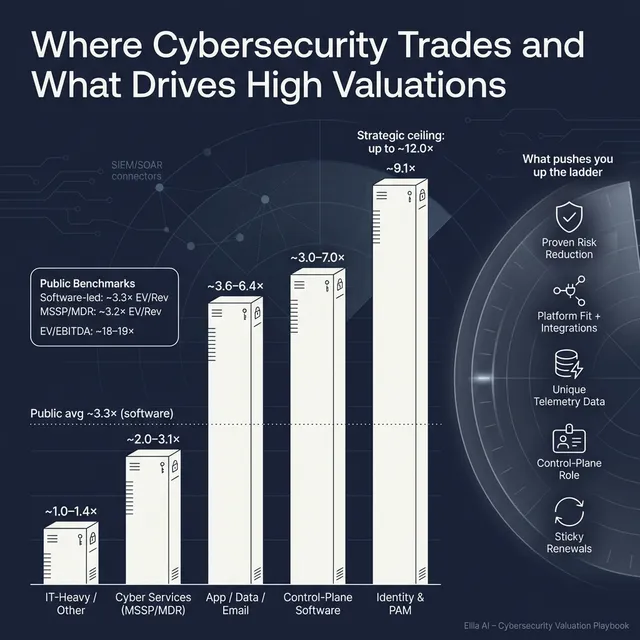
If you are a cybersecurity founder thinking about a sale in the next 1-12 months, valuation is not just a “multiple” question - it is a risk, trust, and strategic fit question.
Cybersecurity is also in a very specific moment: buyers are consolidating tools into platforms, CISOs are rationalizing vendor stacks, and acquirers are paying up for assets that reduce breach risk, shrink response time, or unlock cross-sell into an installed base. This playbook shows what businesses like yours actually sell for, what drives higher vs lower outcomes, and what you can do in the next 6-12 months to push toward the top end.
1. What Makes Cybersecurity Unique
Cybersecurity companies are not all the same - and buyers do not value them the same way. Most private cybersecurity businesses fall into a few “valuation archetypes”:
- Software-led platforms: exposure management, vulnerability management, identity and access, data security, application security, security analytics, and detection/response products.
- Services-led businesses: MSSPs/MDR providers, incident response, security consulting, compliance and governance services.
- Hybrid models: software plus heavy implementation, managed services bundled with tools, or consulting used to drive product adoption.
What makes cybersecurity valuations different from “normal SaaS” is that buyers are underwriting trust and downside risk as much as growth:
- A security product can create liability if it fails in a visible way, is breached, or is viewed as “snake oil.”
- Your outcomes matter: reducing dwell time, lowering false positives, improving detection, improving patch posture, passing audits faster - buyers want proof that your product changes customer risk.
- Your data can be a moat (or not): telemetry, threat intel, incident response learnings, and detection feedback loops can create compounding advantage.
- The ecosystem matters: integrations into SIEM, SOAR, XDR, cloud, identity, and ticketing often determine whether you are “nice to have” or “embedded.”
Key risk factors buyers will always check in cybersecurity:
- Product security and SDLC maturity (secure development lifecycle, vulnerability management, penetration testing, third-party dependencies).
- Customer concentration and renewal risk (especially if you sell into a few large enterprises or government buyers).
- Differentiation vs bundled suites (can your product survive platform consolidation?).
- Regulatory and data-handling exposure (privacy, data residency, government procurement constraints).
- Proof of efficacy (outcomes, benchmarks, reference customers, independent validation).
2. What Buyers Look For in a Cybersecurity Business
Buyers - both strategics and private equity - are trying to answer one core question:
“Will this business still be winning 3 years from now when the platform vendors and budgets shift again?”
The basics still matter (and they show up in price)
- Growth rate: healthy, durable growth supports higher revenue multiples.
- Revenue quality: recurring revenue, multi-year contracts, high retention.
- Gross margin: software-like margins tend to command higher multiples than services-heavy mixes.
- Customer stickiness: renewals, expansion, low churn, high usage.
- Clear positioning: “We win because…” must be simple and provable.
Cybersecurity-specific “buyer lens”
- Mission-critical placement: are you part of the control plane (identity, data, app security, detection) or an edge feature?
- Time-to-value and deployment friction: long deployments, heavy services, or complex integrations usually reduce valuation.
- Ecosystem readiness: buyers value assets that integrate cleanly (APIs, connectors, standard formats) into modern security stacks.
- Evidence over claims: case studies, detection metrics, posture improvement, breach simulations, audit outcomes.
How private equity thinks about your business
PE buyers usually model the deal as: buy at X, improve the business, sell at Y in 3-7 years.
They care about:
- Entry multiple vs exit multiple: if they buy at a high multiple, they need confidence the business will still deserve a high multiple later.
- Who they can sell to: a larger PE fund, a strategic platform buyer, or (rarely) public markets.
- Levers they expect to pull:
- Price increases (if value is clear and churn is low)
- Sales efficiency (repeatable pipeline, channel leverage)
- Cross-sell (especially if you have adjacent modules)
- Cost discipline (services mix, delivery efficiency, cloud costs)
- Add-on acquisitions (more common in services and niche tooling)
3. Deep Dive: “Control Plane” vs “Point Product” - Why Platform Fit Drives Valuation
In cybersecurity, valuation often comes down to whether buyers see you as a core control layer or a feature that will get bundled away.
A practical way to think about it:
- If you sit in a control plane (identity, data, application security, detection/response workflow), you influence big budgets and long-term architecture decisions.
- If you are a point product, you can still sell well - but buyers worry you will be displaced by suites, cloud-native defaults, or cheaper bundling.
This shows up clearly in deal outcomes: buyers have paid premium revenue multiples for assets that plug directly into major platforms and expand “core control plane” coverage (identity, data, application security), while services-heavy or less strategic assets tend to trade lower.
What buyers are really buying in a platform-fit asset:
- Attach potential: “We can sell this into our installed base.”
- Data synergy: “This improves our detections, response, or risk scoring.”
- Workflow ownership: “This becomes part of the daily security operating rhythm.”
How you move from “point product” to “control-plane-like” (without a 3-year pivot):
- Tighten the wedge: stop pitching “we do everything” and own one mission-critical workflow.
- Prove outcomes: show measurable reduction in risk, incidents, or time-to-response.
- Increase embedment: integrations, automation, and making your product hard to rip out.
- Package expansion: add 1-2 adjacent modules that increase share of wallet without becoming bloated.
Mini-profile comparison:
4. What Cybersecurity Businesses Sell For - and What Public Markets Show
Multiples are not a “price tag.” They are a language buyers use to express confidence (or doubt) about your growth, margins, stickiness, and strategic value.
The data below is most useful as a reference band:
- Private deals show what acquirers have actually paid.
- Public multiples show what the market rewards (and punishes) at scale.
- Your business will trade at a discount to most public comps because you are smaller and riskier - unless you are scarce and strategically critical.
4.1 Private Market Deals (Similar Acquisitions)
Across precedent cybersecurity transactions in the data, the overall average sits around 4.5x EV/Revenue (median also ~4.5x), with meaningful differences by segment.
A simple pattern shows up:
- Software categories tied to core security controls (identity/app/data security) tend to clear higher revenue multiples.
- Services and consulting tend to trade lower on revenue multiple, even when profitable, because growth is often tied to headcount and delivery capacity.
Illustrative private-market ranges by deal type:
Important: these are illustrative ranges from grouped deal data. Your multiple moves based on growth, margin structure, concentration, and strategic fit.
4.2 Public Companies
Public comps can look noisy because some micro-caps trade at extreme multiples. The more useful takeaway is the typical band for healthy, software-led cyber businesses versus services-heavy businesses.
From the grouped public data:
- Enterprise & national-scale software-led cyber platforms: average EV/Revenue ~3.3x (median ~2.7x), average EV/EBITDA ~18.5x (median ~14.9x).
- Cybersecurity services & MSSP/MDR: average EV/Revenue ~3.2x (median ~3.2x), average EV/EBITDA ~19.2x (median ~19.2x).
- A “specialized endpoint & cryptography” bucket shows very high public multiples (average ~41.2x EV/Revenue), but this appears driven by outliers and micro-cap effects, not a normal benchmark for most private businesses.
A simple founder-friendly reading: public markets (as of mid to end 2025) often reward scale, predictable growth, and strong margins - but smaller or less-profitable names can trade in a much lower band.
Public segment reference table:
How to use public multiples correctly:
- Use them as a reference band, not a direct valuation.
- Adjust downward for smaller scale, customer concentration, weaker margins, or product risk.
- Adjust upward only when you are scarce, strategic, and clearly improve a buyer’s platform outcomes.
5. What Drives High Valuations (Premium Valuation Drivers)
Premium outcomes in cybersecurity usually come from a few repeatable themes. The deals in the data highlight these patterns clearly - and buyers will pay more when you can prove them.
5.1 Unique data advantage: threat intelligence and incident response credibility
Buyers pay more when your product creates proprietary telemetry or a feedback loop that improves detections and outcomes over time.
What that looks like in practice:
- Your platform learns from real incidents, investigations, simulations, or customer environments.
- You can show measurable impact: faster detection, lower dwell time, fewer successful attacks.
- You have credible reference customers (enterprise, regulated industries, or government).
5.2 Clean platform fit and ecosystem synergies
Premium happens when an acquirer can say: “This plugs into our platform, and we can sell it immediately.”
Signals that drive this:
- Integration readiness (APIs, connectors, standard data formats).
- Clear attach points into SOC, SIEM, XDR, cloud security, identity, or governance workflows.
- A simple synergy story: cross-sell, upsell, or expanding coverage into a control plane.
5.3 Category leadership in a core control plane
Assets tied to identity, data, and application security often command scarcity premiums when they are viewed as category-defining or mission-critical.
To earn this premium as a private company:
- Own a clearly defined category wedge.
- Show enterprise penetration and “must-have” usage.
- Demonstrate defensibility (product depth, data, ecosystem, switching costs).
5.4 High-gross-margin, software-led delivery
The data reinforces a basic truth: software margin structures support higher revenue multiples than services-heavy mixes.
Practical ways buyers see “software-led”:
- Recurring subscriptions, clear packaging, low implementation dependency.
- Strong gross margins, efficient support, scalable onboarding.
- Expansion revenue that does not require proportional headcount.
5.5 Identity adjacency as a value multiplier (when real, not forced)
Identity and privileged access capabilities can increase strategic value because identity sits at the center of modern security architectures.
This helps when it is genuine:
- You integrate deeply into identity workflows.
- You validate identity control effectiveness (testing, monitoring, policy enforcement).
- You increase switching costs and platform relevance.
5.6 Scale and growth momentum in mission-critical segments
Buyers pay up when growth is both strong and believable:
- Clear ICP (ideal customer profile), repeatable pipeline, strong retention.
- Expansion inside existing customers.
- Proof that your budget line is “protected” even in tighter spending cycles.
Also include the “boring but expensive” premium drivers buyers love:
- Clean financials and reporting
- Diversified customer base
- Strong leadership bench beyond the founder
- Low legal, compliance, and security debt
6. Discount Drivers (What Lowers Multiples)
Most low-end outcomes are not because a buyer is “cheap.” They are because the buyer sees risk, friction, or a lack of strategic relevance.
Common discount drivers in cybersecurity:
- Services-heavy revenue mix: if growth depends on headcount, buyers tend to pay less on revenue.
- Weak retention or unclear renewals: churn, downgrades, or one-time revenue are valuation killers.
- Customer concentration: a few large customers can compress valuation fast, especially if one renewal is uncertain.
- Hard deployments and long time-to-value: heavy implementation, bespoke work, or fragile integrations reduce confidence.
- “Feature risk” from platforms: if buyers think you will be bundled away by suites or cloud-native defaults, they price that risk in.
- Thin differentiation: “We use AI” is not a moat. Buyers want proof, not slogans.
- Product security debt: weak SDLC, unmanaged vulnerabilities, or past incidents with poor handling can materially reduce value.
- Messy financials: unclear revenue recognition, weak cohort tracking, or inconsistent KPI reporting forces buyers to assume the worst.
The good news: many of these issues are fixable in 6-12 months - or at least explainable with a credible plan.
7. Valuation Example: A Cybersecurity Company (Fictional)
This is a worked example to show valuation logic - not investment advice, and not a formal valuation.
Step 1: The logic (plain English)
- Pick the most relevant comp set: for a software-led cybersecurity product, you anchor on software-led public cyber platforms and private software deals - not services/MSSP comps.
- Set a baseline multiple band using realistic comps (avoid micro-cap outliers): a defensible baseline for a healthy, smaller software-led cyber business is often ~3.0-7.0x EV/Revenue, depending on growth, margins, and risk.
- Apply premium uplift if you can prove the high-value drivers (data advantage, platform fit, control-plane relevance): uplift of +1.0-2.5x can be defensible when the evidence is real.
- Use a guardrail: even if identity/control-plane leaders can clear very high multiples, you cap your expectations unless you truly have that category leadership.
Step 2: Apply it to a fictional business
Meet Northstar Sentinel (fictional):
- Software-led cybersecurity platform combining threat intelligence management and breach simulation workflows.
- Open-source community driving top-of-funnel, with paid enterprise tiers.
- USD 10.0m last-twelve-month revenue (fictional).
- Still investing heavily (likely low or negative EBITDA).
- Strong integrations into SIEM and ticketing, early enterprise traction.
Illustrative valuation scenarios:
Step 3: What this means for you
Two companies with USD 10m revenue can be worth wildly different amounts because buyers are really pricing:
- How predictable and sticky the revenue is
- How scalable the margin structure is
- How strategic the asset is inside a platform ecosystem
- How much risk sits under the hood (security, delivery, concentration, churn)
If you want a higher outcome, you focus less on arguing “we deserve 10x” and more on building the proof that makes buyers comfortable paying it.
8. Where Your Business Might Fit (Self-Assessment Framework)
Use this as a simple diagnostic. Score each factor 0, 1, or 2:
- 0 = weak / unclear
- 1 = acceptable
- 2 = strong and proven
Self-assessment table
How to interpret your total:
- High band: you are closer to premium outcomes - your job is to run a competitive process and prove the story.
- Middle band: you can still sell well, but you should fix 2-3 high-impact gaps before going to market.
- Low band: consider delaying a sale if possible - or plan for a lower multiple and structure (earn-outs, retention, tighter terms).
This is not about “grading yourself.” It is about identifying which improvements have the biggest payoff.
9. Common Mistakes That Could Reduce Valuation
Rushing the sale
If you start a process before your numbers and story are ready, you force buyers to price uncertainty. In cybersecurity, uncertainty gets punished.
Hiding problems
Every issue will surface in diligence: churn, a security incident, weak margins, customer concentration, pipeline weakness. Hiding it destroys trust, slows the process, and usually reduces price.
Weak financial records
This is fixable faster than most founders think:
- Clean revenue reporting (recurring vs services)
- Cohorts, retention, expansion
- Gross margin clarity (especially services vs software)
- Pipeline and bookings hygiene
Not running a structured, competitive process
A structured process with an advisor typically leads to meaningfully higher purchase prices (often cited around 25% higher) because it creates competition, enforces timelines, and improves negotiating leverage.
Revealing what price you want too early
If you tell buyers “we want USD 50m,” you often kill price discovery. Instead of buyers showing what they would really pay, you get a set of offers narrowly clustered around your anchor.
Cybersecurity-specific mistake: weak proof of efficacy
Founders sometimes sell “features” instead of “outcomes.” Buyers pay more when you can show measurable impact in real deployments, not just product claims.
Cybersecurity-specific mistake: ignoring product security diligence
Buyers will assess your own security posture and SDLC maturity. If your product security story is weak, the buyer will either walk or demand price/terms protection.
10. What Cybersecurity Founders Can Do in 6-12 Months to Increase Valuation
Think in four workstreams: improve the numbers, reduce risk, increase strategic value, and improve the sale process.
10.1 Improve the numbers buyers pay for
- Increase recurring mix (reduce one-time services where possible).
- Improve retention and expansion (even small churn reductions can move your valuation band).
- Tighten pricing and packaging (make value obvious, reduce discounting).
- Build a repeatable enterprise motion (clear ICP, playbooks, proof-driven selling).
10.2 Reduce “buyer fear”
- Formalize product security: SDLC, pen testing cadence, vulnerability response, third-party risk.
- Clean up customer concentration where possible (or lock in longer contracts before a process).
- Create diligence-ready reporting: revenue, cohorts, gross margin, pipeline, CAC payback in plain English.
- Document key risks and your mitigation plan (buyers pay more when you are honest and prepared).
10.3 Increase platform fit and strategic pull
- Prioritize integrations that increase embedment: SIEM, SOAR, XDR, cloud, identity, ticketing.
- Quantify outcomes in customer language: reduced incidents, reduced response time, audit acceleration.
- Build a clear “control plane” narrative: what workflow do you own, and why does it matter?
10.4 Prepare for a real process (not “talks”)
- Build a crisp equity story: why you win, why now, why you are scarce.
- Create buyer-ready materials: teaser, deck, product proof, case studies.
- Line up references and proof points early (buyers will ask quickly).
11. How an AI-Native M&A Advisor Helps
An AI-native M&A advisor can improve outcomes in cybersecurity because the buyer universe is larger and more fragmented than founders expect. The best buyer for your business might not be the most famous platform vendor - it might be a focused strategic, a PE-backed platform, or a specialist consolidator hunting for a specific capability.
First, AI can drive higher valuations through broader buyer reach. By mapping deal history, synergy signals, and financial capacity, AI can expand the buyer universe to hundreds of qualified acquirers. More relevant buyers means more competition, stronger offers, and a higher chance the deal actually closes if one buyer drops.
Second, AI can help you reach initial offers in under 6 weeks. Buyer matching, outreach, marketing material creation, and diligence support move faster when the process is systematized rather than fully manual. Speed matters because it reduces distraction and keeps leverage on your side.
Third, you still need real humans - but AI can enhance them. You want expert advisory, enhanced by AI: experienced M&A advisors who can frame your story in the buyer’s language, build credible materials, run a competitive process, and negotiate terms - with AI doing the heavy lifting behind the scenes. The goal is Wall Street-grade execution without traditional bulge-bracket costs.
If you’d like to understand how our AI-native process can support your exit, book a demo with one of our expert M&A advisors at Eilla AI.
Are you considering an exit?
Meet one of our M&A advisors and find out how our AI-native process can work for you.


