
The Complete Valuation Playbook for Dealer Software Businesses
A practical guide to how dealer software businesses are valued and what drives high multiples.

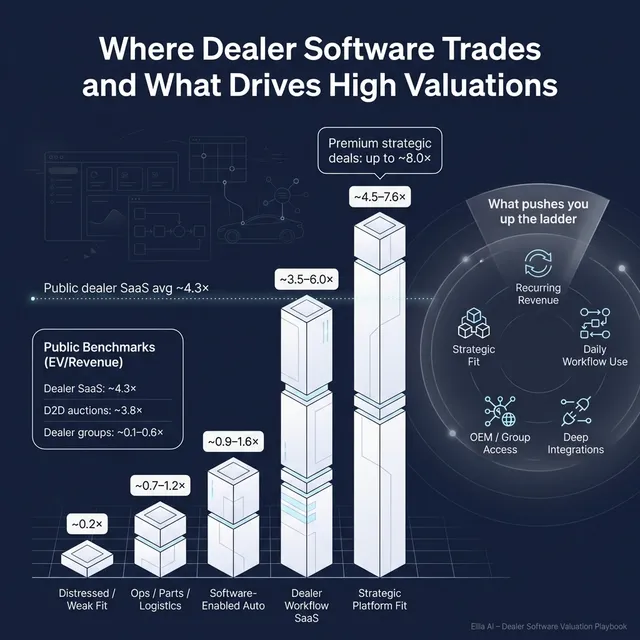
If you run a dealer software business and are thinking about a sale in the next 1-12 months, valuation is not just a finance question. It is a positioning question. The same USD 10m revenue business can be worth very different amounts depending on what buyers believe about your growth, stickiness, role in the dealer workflow, and how easy your business is to scale.
This matters even more now because automotive retail software is sitting in the middle of several big shifts - dealer digitization, OEM pressure for better customer experience, tighter dealer economics, and ongoing consolidation across auto retail and auto-tech. Buyers are still interested, but they are much more selective about what deserves a true software multiple.
This playbook is built to help you understand what dealer software businesses actually sell for, what drives higher and lower multiples, where your business may fit today, and what you can realistically do in the next 6-12 months to improve your outcome.
1. What Makes Dealer Software Unique
Dealer software is not one single category. It covers a wide set of business models, including OEM-to-dealer sales and retail platforms, CRM and lead management tools, inventory and merchandising systems, digital retail and online checkout, fixed ops and service scheduling, parts e-commerce, test-drive and showroom workflow tools, analytics and reporting, and dealer network management software.
That matters because buyers do not value all of those models the same way. A high-margin, recurring SaaS platform used daily by dealers and rolled out across OEM or dealer groups is very different from a services-heavy digital agency, a classifieds portal, or an operationally intensive logistics business. In the data you provided, software-like businesses and strategic platform modules achieved much stronger outcomes than automotive businesses that were digital only in name.
Dealer software also sits in a complicated part of the value chain. You may sell to OEMs, importers, dealer groups, single rooftops, or third-party partners. Each customer type changes your valuation story. OEM distribution can create scale and embedded access, but can also create concentration risk. Dealer-by-dealer sales can diversify revenue, but may be slower and harder to scale.
Buyers will always look hard at a few sector-specific risks. They will check how deeply your product is embedded into dealer workflows, whether your software is truly mission-critical or just nice to have, how much of your revenue is recurring, how exposed you are to auto sales cycles, whether you rely on a few OEM relationships, and whether your product integrates cleanly with the messy dealer technology stack already in place.
2. What Buyers Look For in a Dealer Software Business
At the simplest level, buyers care about five things: scale, growth, profitability, predictability, and strategic fit. They want to know whether your revenue is real, repeatable, and likely to keep growing after they buy the business.
For dealer software specifically, buyers also care about where you sit in the workflow. A platform tied to dealer operations like lead handling, vehicle merchandising, order flow, showroom activity, test-drive scheduling, service workflows, or parts transactions is usually more valuable than a lightweight reporting layer. The closer you are to daily activity and money-moving decisions, the more strategic you look.
They also look at how hard you are to replace. If your product is rolled out across many dealerships, tied into OEM programs, or embedded into processes that are painful to unwind, buyers see lower churn risk. If your product is mostly a standalone tool with weak usage and shallow integration, buyers get nervous fast.
Recurring revenue quality matters a lot. Buyers want subscription revenue, good gross margin, strong retention, low customer churn, and evidence that existing customers stay and expand. A business that needs constant custom work or implementation-heavy revenue to keep growing will usually be valued lower than one that can add customers without adding a lot of service cost.
How private equity buyers think
Private equity buyers are not just asking, "What is this worth today?" They are asking, "What can I buy it for, improve it over 3-7 years, and then sell it for later?"
That means they care about entry multiple versus exit multiple. If they buy you at a healthy price, they need to believe there is still room to grow revenue, improve margins, and make the business look more attractive to the next buyer. That next buyer could be a larger software company, a bigger private equity fund, or sometimes a strategic acquirer.
They also think in terms of levers. Can they raise prices? Sell more products into the same dealer base? Reduce service-heavy work? Build a broader platform through add-on acquisitions? Tighten costs without hurting growth? If the answers are yes, they can justify paying more.
3. Deep Dive: Workflow Depth and Distribution Access
One of the most important valuation questions in dealer software is this: are you a true workflow platform, or are you still just a tool?
This matters because the best outcomes in your source data came from businesses that either looked like real software with strong economics, or sat next to a larger ecosystem where the acquirer could distribute the product at scale. In other words, buyers paid more when the target was not just useful, but strategically placeable inside a much bigger customer base.
A dealer software product with real workflow depth usually has three characteristics. First, it is used frequently - daily or weekly, not once in a while. Second, it touches a real operational process such as lead flow, catalog management, orders, pricing, dealer reporting, service, or parts commerce. Third, removing it would create disruption. That is the point where a buyer starts treating you as infrastructure, not a feature.
Distribution access is the second half of the story. If your product can be sold through OEM programs, importer relationships, dealer groups, or existing channel partners, the buyer sees a path to cheaper growth. That is exactly why strategic adjacency showed up as such an important premium pattern in the deal data. Buyers pay more when they believe they can plug your product into a larger ecosystem and cross-sell it fast.
If your business looks more like the lower-value side today, the path upward is usually practical, not magical. Deepen integrations. Productize custom work. Move from optional reporting into operational workflow. Win broader rollouts rather than one-off pilots. Show that your customer base is not just using the software, but depending on it.
4. What Dealer Software Businesses Sell For - and What Public Markets Show
The data paints a clear picture. Dealer software businesses can command solid revenue multiples, but only when they genuinely look like software. Once a business drifts toward services, logistics, marketplace dependence, or low-margin operational models, valuation drops fast.
The right way to read the data is not to grab the highest multiple and apply it to your revenue. It is to understand which business models the market rewards, which it discounts, and where your own company really belongs.
4.1 Private Market Deals (Similar Acquisitions)
In the precedent transactions you provided, the overall average was about 2.2x revenue, with a median of about 1.2x. But those headline numbers hide a big divide. Software-like and strategically adjacent assets achieved much stronger outcomes, while services-heavy, distribution, classifieds, and operational automotive assets mostly sat at much lower revenue multiples.
The clearest premium private outcomes in the set came from software modules that plugged into larger platforms or had strong product economics. Meanwhile, non-software-heavy automotive deals often landed below 2.0x revenue, and sometimes much lower. That is the key lesson for founders: being in automotive does not create a premium by itself. Looking like scalable software does.
These ranges are illustrative, not formulaic. A strong dealer software business with recurring revenue, sticky customers, and strategic distribution can sit well above the overall private market average. A business with the same revenue but more services, weaker margins, or less product depth can fall back toward the lower bands.
4.2 Public Companies
The public market data gives a useful reference point as of mid to late 2025. Across the full public set, the average EV/Revenue multiple was about 3.5x, but the median was only about 0.8x. Average EV/EBITDA was about 19.3x, with a median of 9.3x. That spread tells you the same thing the private data does: not all automotive tech and automotive commerce businesses are alike.
The most relevant public group for dealer software is the automotive OEM-to-dealer digital retail, CRM, and inventory SaaS segment. That group traded around 4.0x-4.5x revenue in the data, with healthy EBITDA multiples as well. By contrast, dealer groups, distributors, retail networks, and used-car retail models traded mostly at much lower revenue multiples because they are lower-margin, more cyclical, and more operationally heavy.
Consumer marketplaces and some transaction-driven platforms sometimes traded at much higher revenue multiples, but those businesses often have different economics - stronger network effects, lead-gen monetization, transaction take rates, or payments-related upside. Founders should be careful not to borrow those multiples unless the business model truly fits.
Founders should use public multiples as a reference band, not a direct price tag. For a smaller private company, you usually adjust downward for scale, risk, customer concentration, and lower liquidity. But sometimes you adjust upward if the asset is scarce, highly strategic, or growing faster than mature public companies.
That is exactly why the worked logic in your source data anchored first to the most relevant public SaaS comps, then widened the range based on strategic scarcity and private M&A dynamics rather than drifting into unrelated marketplace or retail multiples.
5. What Drives High Valuations (Premium Valuation Drivers)
The data points to a simple truth: higher valuations come when buyers believe your business is both scalable and strategically important.
5.1 Strategic adjacency to a bigger platform
This was one of the strongest premium patterns in the source material. Buyers paid up when the target could slot into a larger platform and be distributed across an existing ecosystem. That is powerful because it lowers customer acquisition cost for the buyer and creates cross-sell opportunities.
In dealer software, this can mean being highly relevant to an OEM program, a dealer group stack, a commerce platform, a parts platform, or a core operating workflow. Buyers love products they can plug into thousands of existing dealer relationships.
A founder-friendly test is simple: if a bigger platform bought you tomorrow, could they rapidly roll your product out across a lot of customers with limited extra sales effort? If the answer is yes, that is a real premium driver.
5.2 Software-like economics
The deal data clearly favored businesses with true software characteristics - especially high gross margin and the ability to grow without adding cost in a straight line. Buyers pay more for that because future revenue is much more valuable when most of it falls through to profit.
For dealer software founders, that usually means pushing custom work down, standardizing onboarding, reducing manual account management where possible, and making analytics and workflow features part of the product rather than one-off services.
5.3 Deep and defensible customer footprint
A large, sticky installed base matters in this sector. If your product is embedded across many rooftops, dealer groups, or OEM programs, buyers see lower churn risk and higher replacement pain. That turns your customer base into an asset, not just a revenue line.
The strongest version of this is density. For example, strong share within a geography, brand network, dealer group, or workflow category. Buyers care less about a long logo list by itself and more about how entrenched you are in the places that matter.
5.4 Mission-critical workflow position
A business tied to real dealer operations usually gets more credit than a peripheral tool. If your product helps manage leads, orders, pricing, service activity, parts sales, dealer reporting, scheduling, or network performance, buyers see operational dependence. That improves retention and strategic value.
This is especially important in automotive because dealership technology stacks are messy, integrations are painful, and teams do not like ripping out systems that affect daily operations. Painful-to-remove software is valuable software.
5.5 Clear proof of growth and expansion
Buyers will pay more when growth is not just fast, but believable. They want to see that existing customers stay, expand usage, add modules, or roll out to more locations. That makes growth feel durable rather than promotional.
In practice, this means showing things like same-customer revenue growth, group rollouts, rising subscription mix, stronger renewal rates, and product adoption depth. Buyers care about whether customers stick around and pay more over time.
5.6 Clean, credible deal structure and leadership continuity
In the data, earn-outs appeared where buyers saw upside but wanted execution protection. That is not automatically negative. If your revenue is measurable, recurring, and tied to real operating goals, a structured earn-out can increase total value.
It also helps if there is management continuity below the founder. Buyers pay more when they believe the business can keep performing after closing. A leadership bench reduces transition risk and expands the buyer pool.
5.7 Basic M&A hygiene still matters
Some premium drivers are not glamorous, but they matter. Clean financials. Clear revenue breakdowns. Low customer concentration. Good contracts. Predictable renewal patterns. Strong KPI reporting. A business that is easy to understand and verify usually gets better bids than one buyers have to untangle.
6. Discount Drivers (What Lowers Multiples)
The main reason dealer software businesses miss premium outcomes is that they look less like software than the founder thinks.
A big discount driver is service-heavy revenue. If too much of your business comes from implementation, custom work, consulting, or manual support, buyers worry that growth will require adding headcount and that margins will stay capped. That usually pushes you toward lower multiples.
Another common problem is weak proof of software quality. If you cannot clearly show gross margin, recurring revenue mix, retention, expansion, and product usage, buyers will not give you the benefit of the doubt. They will assume more risk and lower scalability.
Customer concentration is another major issue in this sector. If a few OEMs, importers, or dealer groups drive most of your revenue, buyers worry that one lost relationship could materially damage the business. Concentration is not always fatal, but it needs a strong story and usually needs to be priced in.
Shallow product position also hurts. If you sit outside the core workflow, have weak integrations, or are easy to swap out, buyers see you as a budget line that can be cut rather than infrastructure that must be protected.
There are also the standard M&A discount factors. Messy financials, unclear contracts, churn that is higher than management admits, slow growth, inconsistent margins, key-person dependence on the founder, and legal or compliance issues all reduce confidence. Lower confidence means lower multiples.
The private deal data also warns against assuming that any "automotive plus digital" business deserves a premium. Many digital-looking automotive businesses in the dataset still traded like low-multiple operational assets because their economics, margins, or scalability did not hold up.
7. Valuation Example: A Dealer Software Company
Let’s build a simple worked example using a fictional company. Call it DriveStack. This company is fictional, and the USD 10m revenue figure is also fictional. The valuation range below is illustrative only - not investment advice and not a formal valuation.
DriveStack sells dealer network management and digital retail workflow software to OEMs, importers, and dealer groups. Its product includes dealer reporting, catalog and order workflows, test-drive scheduling, showroom lead handling, and analytics. Most revenue is subscription-based, but there is still some implementation and support revenue.
Step 1: Start with the right comp set
The first rule is to use the right category. DriveStack is not a dealer group, used-car retailer, distributor, auction operator, or logistics company. Those businesses trade on much lower revenue multiples and are the wrong benchmark for a software platform.
The best public anchor in your source data is the OEM-to-dealer digital retail, CRM, and inventory SaaS group, which traded at about 4.2x-4.4x revenue. That gives a logical starting band for a software business serving the dealer ecosystem.
The broader automotive public universe is too mixed to be used directly, and the high-multiple marketplace groups are not appropriate unless the business truly has transaction or take-rate economics. On the private side, some very low multiples in the dataset reflect weak-fit or non-comparable assets, so they should not drive the conclusion.
Step 2: Build a base range, then adjust for reality
At USD 10m revenue, a pure public-comp anchor of about 4.2x-4.4x implies an enterprise value of roughly USD 42m-44m.
For a private company, you do not stop there. You then ask whether the company deserves a premium or discount to that anchor. In the source logic, the most relevant SaaS public band was widened upward using a modest strategic scarcity and growth adjustment, producing an illustrative range of about USD 52m-80m EV.
That logic makes sense for a good dealer software business because scarce assets in a narrow category can sometimes sell above mature public trading levels - especially if buyers believe they can scale the product across a larger installed base. But that only works if the business can prove real software characteristics and strategic value.
Step 3: Apply that logic to DriveStack
Assume DriveStack has:
- USD 10m revenue
- Good product fit in dealer workflows
- Mostly recurring revenue
- Healthy but not perfect gross margin
- Several OEM and dealer-group relationships
- Some customer concentration
- Some services still mixed in
That would support something like the following:
The discounted case fits a company that has real software DNA but weaker proof points - maybe too much services revenue, weaker retention data, or concentration that makes buyers nervous.
The core range fits a strong, credible dealer software business with good recurring revenue, solid product depth, and believable growth. The premium scenario is for the business that looks scarce: deeply embedded, very sticky, strategically adjacent to larger buyers, and able to demonstrate true software economics.
The big lesson for founders is simple: two dealer software companies with the same USD 10m revenue can easily be worth USD 35m or USD 80m depending on quality, risk, and strategic fit. Revenue starts the conversation. It does not finish it.
8. Where Your Business Might Fit (Self-Assessment Framework)
Use this as a rough honesty test, not a scientific formula. Score each factor from 0 to 2.
- 0 = weak
- 1 = acceptable
- 2 = strong
Self-assessment table
How to interpret the score
- 21-28 points: You are closer to a premium profile. Buyers are more likely to see you as a strategic software asset.
- 13-20 points: You are in the fair-market middle. A good outcome is very possible, but some weaknesses will affect price or deal structure.
- 0-12 points: You likely have more work to do before selling if your goal is to maximize valuation.
The goal here is not perfection. It is to identify the few issues that most heavily move value. Usually, improving three or four high-impact areas matters more than polishing ten minor ones.
9. Common Mistakes That Could Reduce Valuation
One of the biggest mistakes is rushing the sale. Founders often decide to explore a process and then go to market before the numbers, story, and materials are ready. Buyers can feel that immediately. A rushed process usually leads to weaker first offers and less leverage later.
Another mistake is hiding problems. Churn issues, customer concentration, product gaps, contract weaknesses, or margin problems nearly always surface in diligence. When buyers discover them late, the issue is not just the problem itself. It is the loss of trust. That can reduce price, increase earn-out pressure, or kill the deal.
Weak financial records are a common value leak. If you cannot clearly separate recurring software revenue from services, show gross margin by revenue type, explain customer retention, or track important operating KPIs, buyers will assume the worst. The frustrating part is that many of these issues can be improved in 6-12 months.
A lack of a structured, competitive sale process is another expensive mistake. Research and market practice consistently show that a well-run competitive process with an advisor often produces meaningfully higher outcomes - often around 25% higher purchase prices than a loose, one-buyer discussion. Competition creates price discovery. Without it, buyers have little reason to stretch.
That leads to another mistake: telling buyers what price you want too early. If you say you want USD 10m of enterprise value, many buyers will come back with offers like USD 10.1m or USD 10.2m instead of showing you what they might really pay in a competitive setting. You cap your own upside.
There are also industry-specific errors. One is failing to present your business as software and letting buyers frame it as a service provider. Another is not being able to prove workflow depth and integration. In dealer software, vague claims about being a "platform" are not enough. Buyers need evidence.
10. What Dealer Software Founders Can Do in 6-12 Months to Increase Valuation
Improve the numbers buyers care about
Start by making your revenue quality obvious. Break out recurring subscription revenue from implementation, support, and other services. Show gross margin by revenue type. Track retention, churn, expansion, and customer concentration cleanly.
If you have easy margin wins, take them now. Productize custom work. Standardize onboarding. Reduce low-value service work that does not scale. Even modest improvement in software-like economics can change how buyers classify the business.
Improve the strategic story
Make it easy for a buyer to understand where you sit in the dealer workflow and why that matters. Map your product to real business processes. Show how often it is used, who uses it, and what goes wrong if it is removed.
Also sharpen your strategic adjacency story. Which larger buyers could distribute your product faster than you can alone? Why would your product be valuable inside their ecosystem? Founders often know this intuitively but fail to document it clearly.
Reduce obvious risk
If concentration is high, work to diversify. You may not fully solve it in 6-12 months, but even one or two meaningful new logos or one broader rollout across a different channel can help.
Tighten contracts where you can. Improve renewal mechanics, pricing clarity, and data rights. Reduce founder dependency by pushing more customer and product ownership into your leadership team.
Build proof, not just promises
Buyers pay for evidence. Create clean KPI dashboards. Show cohort retention. Show module adoption. Show gross margin trend. Show how OEM or dealer-group relationships are translating into repeatable growth.
If your strongest valuation angle is strategic distribution, prove it with rollout data, attach rates, expansion case studies, or pipeline depth. If your strongest angle is product depth, prove it with usage data and integration breadth.
Prepare for diligence before the process starts
Assemble financials, contracts, customer summaries, product documents, and KPI reporting before buyers ask. Buyers reward businesses that are easy to diligence because it reduces uncertainty and speeds the process.
This does not mean overbuilding a giant data room on day one. It means getting the basics right early so you control the narrative rather than reacting under pressure.
11. How an AI-Native M&A Advisor Helps
A strong exit process is not just about finding one buyer. It is about creating the right market around your business. An AI-native M&A advisor can expand the buyer universe far beyond the usual shortlist by identifying hundreds of relevant acquirers based on deal history, product fit, likely synergies, financial capacity, and other real signals. More relevant buyers means more competition, stronger offers, and more options if one buyer drops out.
It also helps move faster. With AI-driven buyer matching, faster creation of marketing materials, and better support through diligence, initial buyer conversations and offers can often be reached in under 6 weeks. Speed matters because momentum matters. Processes lose value when they drag.
The best model is not AI instead of human judgment. It is expert human advisors enhanced by AI. That gives founders both strategic advice and execution leverage: better buyer targeting, sharper positioning, better-prepared materials, and numbers presented in the language buyers understand. The result is Wall Street-grade advisory quality without traditional bulge bracket costs.
If you'd like to understand how our AI-native process can support your exit - book a demo with one of our expert M&A advisors.
Are you considering an exit?
Meet one of our M&A advisors and find out how our AI-native process can work for you.


