
The Complete Valuation Playbook for Document Management Businesses
A data-driven guide to what document management businesses really sell for - and how to boost your multiple by proving system-of-record stickiness, security, and measurable workflow ROI.

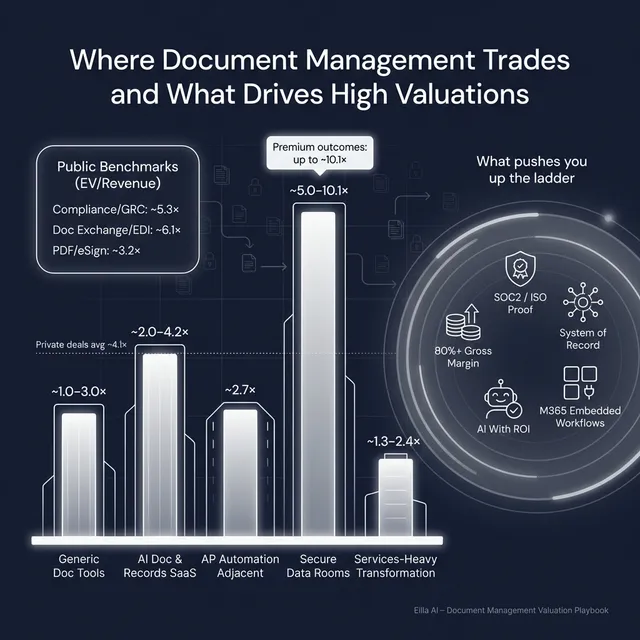
If you’re thinking about selling your document management business in the next 1-12 months, valuation is not just “a multiple times revenue.” In this sector, the same USD 10m revenue business can trade at radically different prices depending on whether buyers believe your product is a sticky system-of-record in a regulated workflow - or “just another tool” with replaceable features.
Right now is an especially important time to get serious about valuation because the category is consolidating across adjacent workflows (content management, secure collaboration, eSign, compliance, automation, and AI document intelligence). Strategic buyers and private equity are still active, but they are more selective - they want proof of durability and security, not slide-deck claims.
This playbook will show what document management businesses actually sell for, explain what drives higher vs lower multiples, and give you a practical self-assessment plus a 6-12 month action plan to move up the valuation range.
1. What Makes Document Management Businesses Unique
“Document management” is a deceptively broad label. In practice, buyers see several different business types - and they price them differently:
- Enterprise Content Management (ECM/DMS) suites: broad platforms for managing content across the enterprise.
- PDF editing, eSign, and agreement lifecycle: tools tied to document creation and signing.
- AI document intelligence / IDP: extraction, classification, search, and automation from unstructured documents.
- Secure collaboration and data rooms: board portals, due diligence, and high-trust sharing.
- Compliance, governance, and security (document-centric): archiving, retention, policy, audit trails, secure communications.
- Document exchange / EDI and transactional communications: business document flows (orders, invoices, statements).
- Services-heavy “document transformation”: scanning, imaging, managed services, and implementation-led models.
That mix matters because buyers aren’t buying “documents.” They’re buying one (or more) of these outcomes:
- A system-of-record for sensitive information.
- A workflow choke point (the place work must pass through).
- A compliance layer that reduces risk.
- A distribution advantage inside a dominant ecosystem (Microsoft 365, Google Workspace, major ERPs).
Unique valuation considerations in this sector:
- Trust is the product: security posture, auditability, and certifications can matter as much as features.
- Switching costs are everything: integrations, retention policies, workflows, and user habits drive stickiness.
- AI is not automatically a premium: buyers pay more only when AI creates measurable workflow gains (time saved, error reduction, faster cycle times) and ties into governance. This shows up directly in premium deal outcomes where AI is proven, not promised.
- Your revenue quality often matters more than your revenue size: recurring mix, churn/retention, and “who signs the check” (IT/security vs a department head) can change the buyer pool.
Key risks buyers will always check:
- Security gaps (SOC 2/ISO readiness, incident history, access controls).
- Compliance exposure (retention, legal hold, audit trails, regulated customer requirements).
- Customer concentration and “one big contract” dependency.
- Services dependency (custom work that’s hard to scale).
- Product overlap risk (buyers fear paying for something they already have in their suite).
2. What Buyers Look For in a Document Management Business
Most buyers start with familiar basics:
- Scale (revenue and customer count).
- Growth (especially steady, not spiky).
- Profitability (or a believable path to it).
- Recurring revenue (subscriptions and renewals beat one-time license spikes).
- Clean metrics (retention, churn, gross margin, cohort behavior).
But in document management, the “industry-specific” filters are often more decisive:
The document management buyer lens - what really gets underwritten
- Mission-critical usage: Do customers rely on you daily for a workflow they cannot break (signing, board reporting, audits, legal matters, regulated communications)? Premium deals cluster around unavoidable workflows with strong security/compliance posture.
- System-of-record positioning: Are you the trusted source of truth for content, with governance controls and integrations that make switching painful? Buyers pay up when you can prove you are the hub.
- Enterprise readiness: Certifications, security controls, and auditability can shorten procurement and expand your buyer universe. Cert gaps translate into longer sales cycles and more churn risk - which lowers bids.
- Ecosystem embed: Tight alignment with dominant platforms (especially Microsoft 365/Outlook) reduces change management and boosts seat expansion - a premium driver seen in high-multiple outcomes.
- Gross margin and scalability: In this sector, buyers consistently reward 80%+ gross margins and a credible path to operating leverage (more revenue without proportional headcount growth).
A quick note on strategic vs private equity (PE) buyers
Strategic buyers (software suites, security vendors, workflow platforms) care about:
- Filling product gaps and expanding wallet share.
- Cross-selling into an installed base.
- Owning a workflow choke point (especially regulated ones).
- Defensive moves (buying what could disrupt them).
PE buyers think differently:
- They care about what they pay today vs what they can sell for in 3-7 years.
- They want a clear “next buyer” story: a larger software company, a bigger PE fund, or a strategic acquirer.
- They look for levers they can pull without breaking the product:
- Price increases (where value is proven)
- Packaging and upsell to new modules
- Channel partnerships
- Reducing services intensity
- Improving sales efficiency and retention
If your business is “clean SaaS with proof of stickiness,” you open up both buyer types. If it’s “services with software on top,” strategics get picky and PE discounts the multiple.
3. Deep Dive: Why “System-of-Record + Trust” Beats “Features” in This Sector
Here’s the core question buyers ask in document management:
Are you a trusted system-of-record in a workflow where mistakes are expensive - or are you a feature that can be replaced?
This factor shows up clearly in the data. The highest private revenue multiples in the dataset cluster around secure collaboration/data room workflows (board and due diligence) with strong security posture and entrenched usage (often >5x and reaching ~10x EV/Revenue in standout cases). Meanwhile, more general document tools and services-heavy models sit much lower (often ~1x-3x). The pattern is consistent: the more you look like the “trusted hub,” the more buyers pay. (Private group multiples: data room/board collaboration ~7.4x average; services ~1.9x average; AI-enhanced doc/records SaaS ~2.9x average.)
Why buyers care:
- Switching costs: Systems-of-record have integrations, permissions, retention policies, and embedded workflows. Buyers believe churn risk is lower.
- Procurement defensibility: If you have certifications and governance baked in, the product becomes “approved infrastructure,” not a discretionary tool.
- Pricing power: Trusted hubs can charge more because the value is tied to risk reduction and operational continuity.
How to move from the lower-value profile to the higher-value profile in 6-12 months:
- Stop describing features. Start proving outcomes:
- “We cut document review cycle time by 35%.”
- “Audit prep time dropped from 10 days to 2.”
- “Policy enforcement reduced access violations by X%.”
- Make governance visible:
- Permissions model, audit logs, retention policies, legal hold, admin controls.
- Deepen integrations so customers can’t casually switch:
- Identity (SSO), M365/Google, ERP/CRM, eSign, ticketing, GRC tools.
- Close the certification gap if you sell to serious buyers (SOC 2, ISO 27001).
A simple mini-table:
4. What Document Management Businesses Sell For - and What Public Markets Show
Valuation in this space is best understood as a band, not a single number. The data shows two big ideas:
- Most “core” document software businesses cluster in a mid-range of revenue multiples.
- Premium outcomes happen when you combine workflow criticality + trust + scalability.
Below, I’ll separate private deal evidence (what businesses sold for) from public market reference points (what similar businesses trade at).
4.1 Private Market Deals (Similar Acquisitions)
At a group level, private precedent transactions in this dataset show an overall average EV/Revenue around 4.1x (median also 4.1x), but the range by segment is wide.
The most notable spread is between:
- Secure collaboration / board / due diligence platforms: high revenue multiples (average ~7.4x, median ~7.8x), with examples reaching around 10x in the dataset.
- AI-enhanced document and records management SaaS: lower, more “normal SaaS” outcomes (average ~2.9x, median ~2.1x), with some deals in the ~2x-5x neighborhood depending on profile.
- Services-heavy digital transformation / managed services: materially lower (average ~1.9x, median ~1.8x).
A founder-friendly summary table:
These ranges are illustrative. The same segment can trade higher or lower depending on growth, margins, retention, customer concentration, and security posture.
4.2 Public Companies
Public markets provide a reference band, but you should treat it as a temperature check, not your “price tag.” Public multiples are influenced by market sentiment, scale, liquidity, and investor expectations - and those are different from a private sale.
From the grouped public data (as of mid/end 2025), the average EV/Revenue varies sharply by segment:
- Compliance/governance/security (document-centric) is among the highest (average ~5.3x, median ~5.4x), with select public names showing higher peaks in the dataset.
- Document exchange / EDI platforms show a high average (~6.1x) but a much lower median (~3.4x), which tells you the category has outliers.
- Legal/professional document solutions average ~3.9x (median ~2.9x) with very high average EV/EBITDA driven by mix and profitability dispersion.
- PDF editing / eSign / agreement platforms average ~3.2x (median ~2.5x).
- Other document-centric tools are much lower (average ~1.0x, median ~0.6x).
Table view:
How to use public multiples correctly:
- Use them as upper and lower reference bands.
- Adjust downward for smaller scale, lower growth, higher customer concentration, or weaker enterprise readiness.
- Adjust upward only when you are scarce and strategic - for example, a trusted, certified hub in a regulated workflow with strong retention.
5. What Drives High Valuations (Premium Valuation Drivers)
The data shows seven recurring premium themes in document management. Think of these as the “reasons a buyer stretches” - not because they like you, but because they believe your cash flows are more durable and you have more pricing power.
5.1 AI and metadata that measurably improves a core workflow
Premium outcomes show up when AI is not a buzzword but a measurable productivity gain - like faster findability, fewer errors, reduced review cycles, and better compliance. Buyers discount AI claims that are not quantified.
What to do:
- Track “before vs after” metrics (cycle time, error rate, time saved per user).
- Tie AI to governance (auditability, lineage, policy enforcement).
5.2 Mission-critical vertical focus with security/compliance baked in
Premium deals cluster where the product is unavoidable in sensitive workflows and compliance is a feature, not an add-on. Certifications and clear policy controls raise buyer confidence in durability and retention.
What to do:
- Go deeper in one or two verticals where documents are high-stakes (legal, finance, healthcare, government).
- Turn compliance into product: retention, legal hold, audit trails, access governance.
5.3 System-of-record positioning in a “content hub”
Being the primary source of truth creates switching costs. Buyers pay for entrenched workflows and integrations because they reduce churn risk and support pricing power.
What to do:
- Prove you are the hub: mandated usage, governance rules, workflows built around you, deep integrations.
- Show retention and expansion (customers paying more over time).
5.4 Embedded adoption inside dominant ecosystems
Products that are native/adjacent to platforms like Microsoft 365 can win because they reduce friction. Buyers love this because it supports seat expansion and lowers implementation risk.
What to do:
- Deepen platform-native workflows (SSO, admin controls, Outlook/Teams/SharePoint patterns).
- Capture usage telemetry to prove daily engagement.
5.5 Cross-sell into adjacent compliance modules
Multi-module compliance suites increase ARPU (revenue per customer) and retention. In the data, regulated workflow adjacency supports strong revenue multiples even when profitability is not yet perfect - because buyers believe in future monetization.
What to do:
- Build or package adjacent modules: onboarding/KYC, policy management, retention, audit, eSign, secure sharing.
- Track attach rates and expansion revenue.
5.6 Enterprise readiness that shortens procurement
Certifications and proven security posture reduce buyer anxiety. The valuation uplift can be disproportionate to the cost because it expands the buyer pool and reduces perceived risk.
What to do:
- Close gaps: SOC 2 Type II, ISO 27001, penetration testing, incident response.
- Make security posture easy to understand (one clear security deck beats 50 scattered documents).
5.7 High gross margins and scalable SaaS economics
High gross margins (often ~80%+) signal scalability, and buyers underwrite future profitability. This premium shows up strongly in high-multiple outcomes where SaaS economics are clear.
What to do:
- Separate services vs software margin reporting.
- Show a believable path to operating leverage (revenue growth faster than headcount growth).
Also remember the “boring” premiums that still matter:
- Clean financials and consistent revenue recognition.
- Diversified customer base.
- A leadership bench that can run the business post-close.
- Predictable pipeline and renewal process.
6. Discount Drivers (What Lowers Multiples)
Most valuation disappointments in this sector come from predictable red flags. None are fatal, but each one shrinks the buyer pool or increases perceived risk - which lowers the multiple.
6.1 “Replaceable tool” positioning
If a buyer thinks your product is a feature inside a larger suite (or easy to replicate), they will price you like a tuck-in - or pass.
Fix: tighten your wedge. Become the hub, the compliance layer, or the workflow choke point.
6.2 Weak proof of retention and stickiness
Document tools can look great on demos but struggle with adoption. If buyers can’t see that customers stick around and expand, they price defensively.
Fix: clean retention metrics (logo retention and net retention), cohort charts, usage data.
6.3 Security and certification gaps
In document workflows, security is rarely optional. Missing certifications can slow enterprise sales, increase churn risk post-acquisition, and trigger valuation haircuts.
Fix: start the certification journey now. Even “in progress” with a clear timeline helps.
6.4 Services-heavy delivery and custom work
If revenue depends on bespoke projects, buyers see lower scalability and higher execution risk. This pulls you toward services multiples, not SaaS multiples.
Fix: productize implementation, standardize integrations, reduce customization.
6.5 Customer concentration or single-channel risk
If one customer or one partner drives your revenue, buyers worry about the “one phone call” downside.
Fix: diversify revenue, or lock key accounts with longer contracts and renewals.
6.6 Messy financials and unclear unit economics
If you can’t cleanly separate software revenue from services, or you have inconsistent reporting, buyers assume the worst.
Fix: simplify reporting now. It’s one of the highest ROI pre-sale improvements.
7. Valuation Example: A Document Management Company (Fictional)
Important: The company below is fictional, and the USD 10m revenue figure is fictional. The valuation ranges are illustrative to show how the logic works - not investment advice or a formal valuation.
Step 1 - The valuation logic
A practical approach in this sector is:
- Start with public market reference bands by segment. In this dataset, the middle of the market for many document-centric software categories sits around ~2.0-4.0x revenue, while compliance/governance can stretch higher (peaks up to about ~7.5x in public comps).
- Cross-check with private precedents. Private SaaS data shows “baseline” AI doc/records SaaS around ~2.0-4.2x, while secure collaboration/data rooms can be ~5.0-10.1x.
- Choose a core range based on what you truly are (not what you wish you were), then adjust:
- Up if you have proof of system-of-record positioning, enterprise readiness, high margins, and workflow criticality.
- Down if you lack certifications, have weak retention proof, or rely on services/custom work.
This is consistent with the provided worked logic that a 3.0-5.0x revenue range is often defensible for a solid software-like document management business at USD 10m revenue, with higher tiers reserved for clear compliance/certification + hub positioning.
Step 2 - Apply it to a fictional company
Meet ClearVault (fictional):
- USD 10.0m last-twelve-month revenue
- SaaS document management for mid-market legal and compliance teams
- 82% gross margin
- 90% recurring revenue, average contract USD 18k
- Integrations: Microsoft 365, SSO, and two common legal practice tools
- No SOC 2 Type II yet (in progress), good security practices but limited formal proof
- Retention: strong logo retention, but limited tracked expansion metrics
Now three scenarios:
Why the differences:
- Discounted case: buyers worry ClearVault is “a tool,” certifications aren’t done, expansion and usage proof is weak, and they price risk.
- Core case: solid SaaS economics and credible workflow value justify a normal software band.
- Premium case: ClearVault finishes SOC 2 Type II, proves measurable ROI, shows strong net retention (customers expanding spend), and becomes a clear hub in regulated workflows. Now buyers underwrite durability and pricing power.
Step 3 - What this means for you
Two businesses with the same USD 10m revenue can realistically be worth USD 20m or USD 70m in this sector. The difference is not “storytelling.” It’s whether buyers believe your revenue is durable, defensible, and scalable - and whether your product sits in a workflow that cannot break.
8. Where Your Business Might Fit (Self-Assessment Framework)
Use this as a quick gut-check. Give yourself a 0/1/2 score on each factor:
- 0 = weak / not proven
- 1 = okay / partially proven
- 2 = strong / clearly proven
How to interpret your total:
- Top band: you look closer to the profiles that win premium outcomes (strong buyer competition).
- Middle band: fair-market outcomes - you can still sell well, but you need a crisp story and process.
- Lower band: buyers will price risk. Often worth delaying 6-12 months if you can fix the biggest gaps.
The point isn’t to “score high.” It’s to identify the 2-3 levers most likely to move your multiple.
9. Common Mistakes That Could Reduce Valuation
9.1 Rushing the sale
If you start a process before your numbers and narrative are ready, buyers will anchor low and stay there. In document management, this is especially painful because diligence will focus heavily on security, retention, and revenue quality.
9.2 Hiding problems
Security gaps, churn issues, customer concentration - these will surface. When buyers feel misled, they don’t just reprice the deal; they lose trust, slow down, or walk.
9.3 Weak financial records
Founders often underestimate how much value is lost when buyers can’t trust the data. Common issues:
- Not separating software vs services revenue
- Confusing churn/retention reporting
- Inconsistent revenue recognition
- No clean gross margin reporting by product line
The good news: most of this is fixable in 6-12 months.
9.4 Not running a structured, competitive process with an advisor
A structured competitive process typically produces meaningfully higher outcomes because it creates tension and forces buyers to put real offers on the table. Research is often cited that good, competitive processes with an advisor can drive materially higher pricing - on the order of around 25% in many contexts - because the market, not one buyer, sets the price.
9.5 Revealing the price you want
If you tell buyers “we’re looking for USD 10m,” you kill price discovery. Many buyers will come back at USD 10.1m or USD 10.2m even if they might have paid far more. Your job is to let them compete toward the maximum they can justify.
9.6 Industry-specific mistake: treating security as a checklist, not a product
In this sector, security posture and auditability are part of the value proposition. If it’s only in your IT folder (and not in your product, messaging, and proof), you’ll lose premium buyers.
9.7 Industry-specific mistake: selling “AI” without ROI proof
AI differentiation can be a premium driver, but only when you can prove workflow gains. Without measurement, buyers treat it as parity and discount it.
10. What Document Management Founders Can Do in 6-12 Months to Increase Valuation
Here’s a realistic plan that doesn’t require reinventing your business.
10.1 Improve revenue quality and proof (highest ROI)
- Tighten retention reporting: logo retention, net retention (customers expanding), cohort trends.
- Instrument product usage: active seats, workflow volume, time saved.
- Reduce customer concentration risk where possible (or lock key accounts into longer terms).
10.2 Build enterprise trust faster than your competitors
- Start (or finish) SOC 2 Type II / ISO 27001 depending on your buyer base.
- Create a clean security narrative: controls, audits, incident response, roadmap.
- Productize governance: permissions, audit logs, retention, legal hold, admin controls.
10.3 Move up the “system-of-record” ladder
- Deepen integrations into daily systems (Microsoft 365/Outlook/Teams, identity, ERP/CRM, eSign).
- Make switching harder by embedding workflows, not just storing files.
- Show that you are the hub: “customers must use us for X process.”
10.4 Improve margins in ways buyers trust
- Separate services from software in reporting and pricing.
- Standardize implementations and integrations.
- Show operating leverage: revenue growth outpacing headcount growth.
10.5 Upgrade your story without exaggerating
- Replace feature lists with buyer-relevant outcomes:
- risk reduced, audits simplified, cycle times cut, compliance enforced.
- Be clear about who buys you and why (IT/security vs department budgets).
- Build a credible roadmap tied to attachable modules (compliance, onboarding, secure sharing).
11. How an AI-Native M&A Advisor Helps
Selling well is not only about having a good business. It’s about running a process that creates buyer competition, tells the story clearly, and moves fast without breaking trust.
An AI-native advisor helps you get higher valuations through broader buyer reach. AI can expand the buyer universe to hundreds of qualified acquirers based on deal history, product fit, synergies, and financial capacity. More relevant buyers means more competition, stronger offers, and more options if a buyer drops late in the process.
It also helps you reach initial offers in under 6 weeks by speeding up buyer matching, outreach, marketing materials, and diligence support. In a market where buyer attention is scarce, speed - paired with preparedness - can directly improve outcomes.
Finally, you still need real expertise. The best model is expert advisory, enhanced by AI: seasoned M&A advisors driving the process, building credibility with acquirers, and framing the business in buyer language - with AI making the work faster, broader, and more consistent. That can deliver “Wall Street-grade” process quality without traditional bulge-bracket costs.
If you’d like to understand how our AI-native process can support your exit, book a demo with one of our expert M&A advisors.
Are you considering an exit?
Meet one of our M&A advisors and find out how our AI-native process can work for you.


