
The Complete Valuation Playbook for Ecommerce Solutions Businesses
A valuation guide to what Ecommerce Solutions businesses sell for and what drives better outcomes.

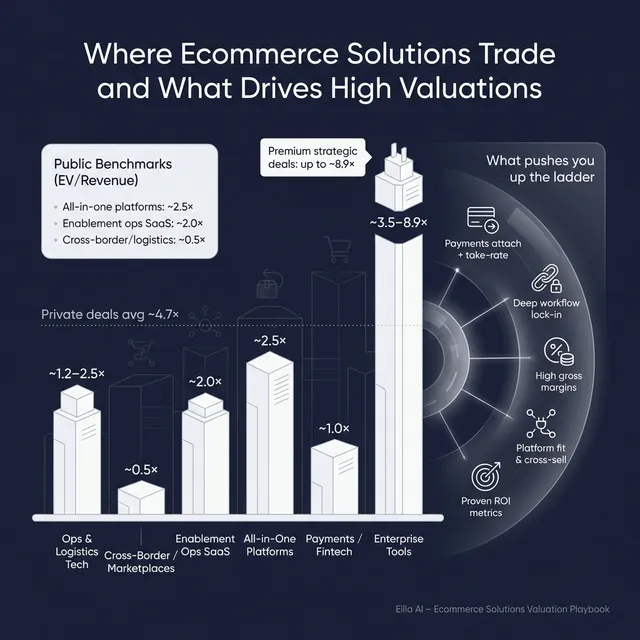
If you run an Ecommerce Solutions business (software, agencies, enablement tools, operations platforms) and you are considering a sale in the next 1-12 months, your valuation is not just a “multiple.” It is a story the buyer can underwrite - with proof.
This playbook is built for founders and CEOs in this sector. It will show what Ecommerce Solutions businesses actually sell for, what drives higher vs lower multiples, and how to self-assess and improve your valuation in the next 6-12 months.
A big reason to think about this now: ecommerce infrastructure keeps consolidating. Platform buyers want to add modules (feeds, marketplaces, returns, payments, OMS), and financial buyers want assets with recurring revenue and clear “professionalization” upside. That mix creates opportunity - but only if you show the right evidence.
1. What Makes Ecommerce Solutions Businesses Unique
“Ecommerce Solutions” is not one business model. Buyers value each sub-type differently because the risks and margins are very different.
The main types you see in this sector
- Commerce platforms (SaaS storefronts, headless, omnichannel): recurring subscriptions, app ecosystems, platform switching risk.
- Enterprise commerce tools (marketplace management, product feeds, wholesale/B2B ordering): workflow-heavy software with deeper integrations.
- Operations enablement (OMS, WMS, inventory, shipping, returns) and commerce logistics tech: value tied to operational outcomes; often more services and lower gross margins.
- Website builders and SMB digital presence + marketing automation: large SMB bases; often higher churn; growth and scale matter.
- Payments and fintech adjacency: monetization can shift from subscriptions to take-rate (a slice of payment volume), which can be extremely valuable when proven.
Unique valuation considerations in this sector
- “Where you sit in the workflow” matters. Tools that sit in the transaction path (checkout, payments, ordering) or in the “system of record” (orders, inventory) are typically stickier than nice-to-have add-ons.
- Gross margin is a loud signal. Software-led businesses (high gross margin, low services) usually command higher revenue multiples than ops-heavy models.
- Integration depth is a moat - and a risk. Deep integrations create switching costs, but platform dependency (Shopify, Amazon, ad platforms) can create concentration risk.
Key risk factors buyers will always check
- Dependency on a single platform or channel partner (and what happens if that partner changes terms).
- Revenue quality: subscription vs usage vs services; churn; contract length; renewals.
- Services and implementation load: do you scale with code, or with people?
- Product and security maturity: uptime, data handling, fraud exposure (especially if payments touches your product).
- Founder dependence: can the business run without you day-to-day?
2. What Buyers Look For in an Ecommerce Solutions Business
Buyers are usually underwriting one simple question: “Is this a durable engine that will still grow when we own it?”
The obvious factors (still matter a lot)
- Revenue scale and growth trend (not just last month - the last 12-24 months).
- Profitability (or a believable path to it).
- Customer concentration (how painful is it if your top 1-3 customers leave?).
- Retention: do customers stick around and expand?
Sector-specific nuances buyers care about
- Recurring vs project revenue mix. Even a “services-looking” business can get strong value if services drive sticky software subscriptions - but the buyer needs to see it clearly in your numbers.
- Workflow criticality. Are you “must-run” (orders, inventory, checkout, returns) or “nice-to-have” (dashboards, minor add-ons)?
- Integration footprint. Number of meaningful integrations is less important than how deeply embedded they are (and how hard you are to replace).
- Proof of ROI. Buyers pay more when you can show measurable improvements: conversion lift, lower returns cost, lower shipping cost, higher GMV, fewer manual hours.
How private equity (PE) buyers think (in plain English)
PE buyers are professional optimizers. They care about:
- Entry multiple vs exit multiple: they want to buy at a fair price and sell later at a similar or higher multiple.
- Who they can sell to in 3-7 years: bigger PE funds, strategics (platform buyers), or occasionally public markets.
- Levers they expect to pull:
- Tighten pricing and packaging.
- Reduce churn.
- Increase attach rate (sell more modules to each customer).
- Improve gross margin by reducing services load.
- Build a repeatable go-to-market motion (so growth is not founder-driven).
3. Deep Dive: “Software-Led vs Services-Led” Is a Valuation Multiplier
In Ecommerce Solutions, two companies can have the same revenue - and wildly different valuations - largely because of one thing: does your growth scale with software, or with headcount?
How this shows up in deal outcomes
- Software-led, high gross margin assets have achieved very strong revenue multiples in this sector, especially when they sit in core commerce workflows.
- Ops-heavy and fulfillment-like models (lower gross margin, people-intensive delivery) tend to trade at much lower revenue multiples.
Why buyers care
- Software scales: you can add customers without doubling your cost base.
- Services do not scale the same way: delivery capacity becomes the bottleneck, and margins are harder to defend.
How to move from “services-led” to “software-led” in 6-12 months
- Productize onboarding: templates, automated setup, “guided” implementation.
- Create a clear boundary: what is included in subscription vs paid implementation.
- Track gross margin by customer cohort: prove newer customers are more profitable due to better product.
- Reduce custom work: say “no” more often, or charge properly for it.
4. What Ecommerce Solutions Businesses Sell For - and What Public Markets Show
The cleanest way to think about valuation in this sector is to triangulate:
- Private deal multiples (what similar businesses actually sold for)
- Public market multiples (what investors pay for scaled peers)
- Your risk and quality adjustments (size, growth, margins, stickiness, dependency)
4.1 Private Market Deals (Similar Acquisitions)
Across relevant precedent transactions, the overall average/median in the dataset is ~4.7x EV/Revenue and ~15.1x EV/EBITDA, but the spread by segment is the real story.
- Enterprise ecommerce software assets (marketplace management, feeds, B2B ordering, product discovery) have shown higher revenue multiples, especially when they are software-led and embedded in core workflows.
- Ops enablement and logistics-heavy models have shown lower revenue multiples, with value often showing up more in EBITDA multiples (when margins are strong).
Illustrative private multiple ranges by segment (from the dataset)
Important: these are not price tags. They are reference bands that still move a lot based on growth, margins, and risk.
4.2 Public Companies
Public comps are useful because they show what the market pays for scaled businesses - but you should treat them as an upper/lower reference band, not a direct comp to a private company.
One key takeaway from the public dataset: averages are skewed by outliers (a few huge winners), so medians often look more like what most businesses can realistically anchor to.
Public group multiples (as of mid-to-end 2025 in the dataset)
How to interpret public multiples as a founder
- Public multiples are often higher than private because public companies have scale, liquidity, and disclosure.
- For smaller private companies, buyers typically adjust down for:
- smaller scale
- customer concentration
- platform dependency
- less proven profitability
- But buyers can adjust up for scarcity: a unique, strategic asset that plugs into a larger platform can attract premium bids.
5. What Drives High Valuations (Premium Valuation Drivers)
Below are the premium drivers that show up repeatedly in real deals in this sector, plus how buyers talk about them in practice.
5.1 Payments adjacency (touching the transaction)
If your product sits near checkout, ordering, invoicing, or payment routing, buyers may see a second revenue stream: monetizing payment volume.
What buyers want to see:
- payment volume routed
- attach rate (how many customers use payments)
- take-rate economics (how much you earn per dollar processed)
- churn and loss rates on that revenue
5.2 Clear strategic fit into larger platforms
Platform buyers pay more when they can cross-sell your product into an existing base quickly.
Signals that help:
- strong partner channel (app marketplaces, agency partners, OEM relationships)
- evidence of cross-sell velocity (customers buying multiple modules)
- integrations that make your product “plug and play” for a large platform
5.3 High gross margins and software-led delivery
This is one of the cleanest patterns in the data: buyers pay more for scalable software economics, and less for ops-heavy models.
What helps:
- high gross margin that stays high as you grow
- low implementation burden
- repeatable deployment
5.4 Category-critical data infrastructure
Businesses that power product feeds, syndication, marketplace connectivity, and performance reporting can become “infrastructure,” not a tool.
Buyers pay more when:
- you are embedded in merchandising and demand generation decisions
- customers rely on your data to make money (and can prove it)
5.5 Returns and logistics orchestration that improves unit economics
If you reduce return costs, shipping costs, or manual work, buyers value you as an efficiency engine - especially if outcomes are measurable.
What helps:
- before/after metrics (cost per return, time to refund, shipping savings)
- operational KPIs tied directly to customer ROI
5.6 Multi-channel connectivity at scale
Breadth matters less than impact: integrations that actually drive incremental GMV or reduce complexity get valuation credit.
Proof beats claims:
- number of active channels per customer
- GMV influenced/routed
- conversion or sell-through improvement
5.7 AI-driven merchandising and pricing (when real)
AI features get premium attention when they affect revenue-critical decisions (search, recommendations, pricing) and you can prove uplift.
What buyers want:
- controlled tests, uplift metrics, and adoption
- defensibility (data, models, workflow lock-in), not “AI marketing”
5.8 Vertical depth + enterprise relationships
A strong niche can outperform a generic platform if you own the workflows and relationships in that niche.
Buyers love:
- repeatable playbook in one vertical
- high switching costs
- enterprise references and long contracts
6. Discount Drivers (What Lowers Multiples)
These are the patterns that push you toward the low end of the range - and what to do about them.
- Services-heavy revenue with unclear product value
- Fix: separate subscription vs services cleanly, and show services shrinking as a percent of revenue over time.
- Low or unstable gross margins
- Fix: reduce custom work, price implementation properly, and track margin by customer type.
- Churn you cannot explain
- Fix: cohort retention analysis and a clear “why customers stay” narrative.
- Customer concentration
- Fix: diversify pipeline, and show repeatable acquisition channels.
- Platform dependency (one ecosystem controls your destiny)
- Fix: multi-platform roadmap, or contractual protections, or deep defensibility inside the platform.
- Weak product or security posture
- Fix: uptime reporting, security practices, clear roadmap, and visible customer feedback loops.
- Founder dependence
- Fix: build a leadership bench and document playbooks for sales, onboarding, and support.
- Messy numbers
- Fix: clean revenue recognition, consistent KPI reporting, and clear gross margin definitions.
7. Valuation Example: A Fictional Ecommerce Solutions Company
To show how valuation logic works, here is a worked example. The company is fictional, and the valuation ranges are illustrative - not investment advice or a formal valuation.
Step 1: Build a sensible multiple range from the data
For a software-led ecommerce solutions business, a practical way to anchor is:
- Public peers often cluster around ~1-4x revenue for many credible companies (with some premium outliers).
- Private software deals in enterprise ecommerce tools show ~3.5x-8.9x revenue in the dataset, but smaller companies usually cannot claim the top end without strong proof.
A reasonable base case range used in the provided logic is ~2.5x-4.5x EV/Revenue, reflecting a smaller scale business without fully proven premium drivers.
Step 2: Apply it to a fictional company (USD 10m revenue)
Meet HarborCart, a fictional ecommerce solutions company:
- USD 10.0m annual revenue (fictional)
- Software-led platform with headless integrations + multi-channel tooling
- Gross margin: solid and improving
- Limited services revenue
- Some payment integrations, but monetization is only partially proven
Illustrative valuation outcomes
Step 3: What this means for you
Two USD 10m revenue businesses can be worth 2-3x apart because buyers are not buying revenue - they are buying:
- durability (retention and switching costs)
- scalability (software vs headcount)
- strategic leverage (cross-sell, platform fit, transaction monetization)
8. Where Your Business Might Fit (Self-Assessment Framework)
Use this to get a rough sense of whether you are building toward discounted, base, or premium outcomes.
Score each factor:
- 0 = weak / not proven
- 1 = decent / partially proven
- 2 = strong / consistently proven
How to interpret your score (simple bands)
- High total: you are closer to premium narratives and likely to attract multiple serious buyers.
- Mid total: you are in “fair market” territory - process and positioning will matter a lot.
- Low total: you may still sell, but you will be negotiating from weakness unless you fix 2-3 key items.
9. Common Mistakes That Could Reduce Valuation
These are avoidable, but they show up constantly.
- Rushing the sale
- If your numbers, story, and buyer list are not prepared, you will accept a “good enough” bid instead of discovering the best bid.
- Hiding problems
- Issues always surface in diligence. Hiding them destroys trust and usually reduces price or adds painful terms later.
- Weak financial records
- In this sector, buyers want clean splits: subscription vs services, gross margin clarity, churn, cohort retention, and consistent KPIs.
- Not running a structured, competitive process (often with an advisor)
- Competitive tension is one of the few reliable ways to increase price and improve terms. Some advisor and practitioner write-ups commonly cite sale price improvements of around 25% or more when a professional, competitive process is run instead of a single-buyer negotiation. (IT ExchangeNet)
- Revealing what price you want (too early)
- If you say “we want USD 10m,” you often get USD 10.1m and USD 10.2m bids - instead of learning what the market would have paid.
Two sector-specific mistakes that often hurt Ecommerce Solutions deals
- “We have integrations” without proof of adoption: buyers care about active usage, retention impact, and switching costs.
- Calling yourself a platform when you are really a service layer: if services drive the economics, price it and present it that way - or productize fast.
10. What Ecommerce Solutions Founders Can Do in 6-12 Months to Increase Valuation
Think in three buckets: improve the numbers, reduce buyer fear, and increase competitive tension.
10.1 Improve the numbers buyers pay for
- Make retention undeniable: produce cohort retention charts and clear churn reasons.
- Shift mix toward recurring revenue: push more value into subscription packages; charge properly for services.
- Improve gross margin visibly: automate onboarding, reduce custom work, standardize delivery.
- Tighten pricing: raise prices where value is proven; simplify packaging so buyers see expansion paths.
10.2 Reduce risk (and make diligence painless)
- Clean financial reporting: subscription vs services, gross margin definitions, consistent KPI dashboards.
- Document platform dependencies: show mitigation (multi-platform strategy, partner contracts, product moats).
- Harden product operations: uptime reporting, support SLAs, security posture, incident history.
10.3 Build the premium narrative with proof
Pick 1-2 premium drivers that fit your reality and go deep:
- Payments adjacency: prove attach rate and economics (even if early).
- Data infrastructure: show ROI (conversion lift, fewer errors, faster time-to-market).
- Workflow criticality: show how painful it is to replace you.
- Vertical strength: dominate one niche with references and repeatable playbooks.
10.4 Run a process that creates leverage
- Start buyer mapping early (strategics + PE).
- Build materials that sell the business clearly (what you do, why you win, what is proven).
- Orchestrate timing so multiple buyers engage in parallel - that is where better pricing and better terms come from.
11. How an AI-Native M&A Advisor Helps
Selling an Ecommerce Solutions business is a matching problem as much as a valuation problem: the “right” buyer can justify a very different price because they see cross-sell, payments monetization, or platform fit that others do not.
Higher valuations through broader buyer reach: AI can expand the buyer universe to hundreds of qualified acquirers based on deal history, synergies, and financial capacity. More relevant buyers creates more competition, stronger offers, and more backup options if one buyer drops.
Initial offers in under 6 weeks: AI-driven buyer matching, faster outreach, and automation around marketing materials and diligence workflows can compress timelines dramatically versus manual-only processes.
Expert advisory, enhanced by AI: you still want experienced human M&A advisors running the process - credibility, negotiation, and positioning matter. AI makes the execution faster and broader, while senior advisors ensure the story and the process are buyer-grade.
If you’d like to understand how our AI-native process can support your exit, book a demo with one of our expert M&A advisors.
Are you considering an exit?
Meet one of our M&A advisors and find out how our AI-native process can work for you.


