
The Complete Valuation Playbook for Farm Management Businesses
A valuation playbook for farm management founders to dunderstand what drives multiples.

If you might sell your farm management business in the next 1-12 months, valuation stops being an abstract finance topic and becomes a practical operating plan.
This is a sector where buyers are actively consolidating capabilities - software, agronomy workflows, compliance, equipment data, and procurement - but the gap between “okay” outcomes and “great” outcomes is wide.
This playbook is built to help you (1) understand what similar businesses actually sell for, (2) decode what pushes multiples up or down, and (3) walk away with a simple self-assessment plus a realistic 6-12 month action plan.
1. What Makes Farm Management Unique
“Farm management” sounds simple until you try to value it. Buyers quickly realize they are not just buying software or services - they are buying a role in a farm’s operating system.
The main business types buyers see
Most farm management businesses fall into a few recognizable models (many companies are hybrids):
- Farm management SaaS (core operations): planning, field records, inputs, labor, traceability, audits, task management, inventory.
- Tech-enabled agronomy + services: advisory plus tools, often bundled with implementation, support, and seasonal field work.
- Data and telemetry adjacencies: integrations into equipment data, remote sensing, scouting, machine logs, or fleet/asset telemetry.
- Produce and supply chain workflow touchpoints: procurement, packing, quality, compliance documents, and buyer reporting.
Unique valuation considerations (why this isn’t “just software”)
- Seasonality and “crop-year cycles” matter. A farm can love you in-season and churn quietly in the off-season. Buyers will test retention across full annual cycles, not just “last quarter.”
- Outcomes are partly biological. Weather volatility, input price spikes, and yield swings can affect customer behavior and your own revenue stability.
- Trust and compliance are a moat. If your system is the system of record for audits, certifications, spray logs, labor records, and traceability, you can become hard to replace.
- Services mix changes the multiple. The more your revenue depends on people-hours (implementation, agronomy services, custom reporting), the more buyers treat you like a services firm, not a scalable software product.
Key risk factors buyers always check
- Customer concentration (one large farm group can make your valuation fragile).
- Retention through full seasons and across commodity cycles.
- Product reliance on key individuals (founder-led advisory, “only one person knows the workflows”).
- Data rights and security (who owns the farm data, how it is stored, and whether contracts permit transfers on change of control).
- Integration dependencies (if a major platform or OEM changes APIs, does your product break?).
2. What Buyers Look For in a Farm Management Business
Valuation is not only about revenue size. Buyers are underwriting a story: “Will this company keep its customers and grow profits under new ownership?”
The universal drivers (in plain English)
- Growth: Are you adding customers and expanding revenue per customer year over year?
- Profitability (or a credible path): Even if you are not profitable today, can buyers see operating leverage as you scale?
- Revenue quality: Recurring subscriptions and contracted revenue generally beat one-off projects.
- Customer stickiness: If you disappeared tomorrow, how painful would it be for customers to replace you?
Farm management specifics buyers focus on
- Workflow ownership: Do you sit in daily decisions (planning, tasks, compliance logs), or are you a “nice-to-have” reporting layer?
- Compliance and audit readiness: Features tied to certifications, traceability, labor rules, and record-keeping often create real switching costs.
- Multi-farm and multi-region suitability: Buyers pay more when the product works across crops, geographies, and operating styles.
- Integrations that matter: Accounting, procurement, equipment telemetry, and supply chain systems can turn you from “tool” into “infrastructure.”
How private equity (PE) thinks about your business
PE buyers usually view your company as a 3-7 year value creation project:
- Entry multiple vs exit multiple: They care what they pay today and what they can sell it for later. If your business can “graduate” into a higher-quality category (more recurring revenue, better margins, stronger retention), they may underwrite a higher exit multiple.
- Who is the buyer after them: Another PE fund, a strategic acquirer (OEM, ag platform, supply chain player), or occasionally a public market path.
- Levers they expect to pull:
- Pricing discipline (raising prices where value is clear)
- Expansion revenue (selling more modules, more seats, more acres)
- Cost efficiency (repeatable onboarding, better support efficiency)
- Selective add-on acquisitions (if the platform can absorb bolt-ons)
3. Deep Dive: The Valuation Nuance That Matters Most - “System of Record” vs “Nice-to-Have Tool”
Here is the question that shows up in almost every buyer conversation:
Are you a system of record that farms run on, or a tool they can swap out with minimal pain?
This single point quietly drives big valuation differences because it drives retention, pricing power, and buyer confidence.
How it shows up in the deal data
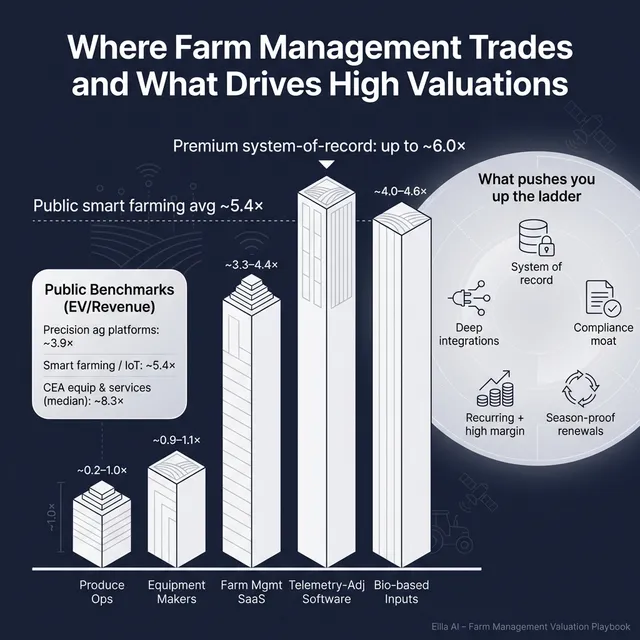
Across comparable ag software transactions, a recurring, operationally embedded software profile tends to cluster in a mid-single-digit EV/revenue range in private markets, while services-heavy or less sticky models price lower. Private agri SaaS deals in the dataset cluster around ~3.3x-4.4x EV/revenue, which is a useful “anchor band” for many farm management SaaS businesses. (More on this in Section 5.)
Separately, deals tied to mission-critical telemetry-style workflows show that “embedded operations + high gross margin recurring revenue” can support premium valuation narratives (even if the headline multiples vary by deal type). (PwC)
Why buyers care so much
Buyers are trying to avoid two bad outcomes:
- You churn customers after the sale because the product is not truly embedded.
- You need a lot of services labor to keep revenue alive (making profit improvement harder).
When you are a system of record, you usually get:
- Higher renewal rates
- Longer customer lifetimes
- The ability to charge more (because replacement risk is painful)
- Lower support burden as workflows standardize
How to move from “tool” to “system of record” in 6-12 months
You do not need to rebuild everything. The upgrades are usually specific:
- Turn compliance into a product pillar: audits, certifications, spray logs, worker records, traceability packages, export documentation.
- Own the “weekly rhythm”: planning, task assignments, completion, exception handling, and season rollovers.
- Make integrations real: not “we connect,” but “we reconcile and close the loop” (equipment data, accounting, procurement, packing/quality).
Lower-value vs higher-value profile (quick diagnostic)
4. What Farm Management Businesses Sell For - and What Public Markets Show
This section is intentionally data-first. Private deals show what buyers have actually paid. Public market multiples show what scaled platforms trade at - and set a “reference band,” not a price tag.
4.1 Private Market Deals (Similar Acquisitions)
In the provided deal set, the most relevant private bucket for farm management software is Agri SaaS & Operational Management Software, which clusters around ~3.3x-4.4x EV/revenue. A nearby reference bucket - Precision Agriculture Hardware & Telematics - clusters around ~3.2x-4.7x EV/revenue (useful when your product is deeply integrated with equipment/telemetry workflows).
By contrast, businesses that look more like equipment manufacturing or commodity-linked operations transact at much lower EV/revenue multiples (often because revenue is less “repeatable” and margins are structurally different).
Illustrative private EV/revenue ranges by deal type (from the dataset):
These ranges are illustrative. Your actual outcome depends on growth, margins, retention, customer concentration, and deal competitiveness.
4.2 Public Companies (Reference Multiples, as of late 2025)
Public markets show how different ag-tech segments are valued at scale. In the dataset, the relevant public groupings are:
- Precision ag hardware & measurement platforms: average EV/revenue ~3.9x, average EV/EBITDA ~19.7x (median EV/revenue 4.7x, median EV/EBITDA 21.9x).
- Smart farming & IoT software solutions: average EV/revenue ~5.4x, average EV/EBITDA ~40.6x (median EV/revenue 5.3x).
- Controlled environment ag equipment & services: average EV/revenue is distorted by outliers (average 33.0x, median 8.3x), and EV/EBITDA also varies widely (average 56.3x, median 20.4x).
How to use this as a founder: public multiples are a reference ceiling and floor. Smaller private companies often trade at a discount to public comps because they have higher customer concentration, less liquidity, and more execution risk. But scarce, strategically important assets can sometimes earn a premium if multiple buyers “need” the capability.
5. What Drives High Valuations (Premium Valuation Drivers)
Below are the premium drivers that show up in the deal narratives and the dataset patterns - translated into what you can actually do.
Theme 1: Mission-critical workflows that farms cannot pause
Buyers pay more when your product is essential during the season and painful to replace.
Practical examples:
- You are the official logbook for spray applications, labor, compliance, and certification audits.
- Your system is used weekly (or daily) by multiple roles: manager, agronomist, crew lead, accountant.
- You power “close the loop” workflows: planned vs actual, inventory consumption, task completion, exceptions.
Theme 2: Recurring revenue plus strong gross margins
Premium outcomes are consistently associated with a software-like economic profile: recurring contracts and gross margins that prove scalability.
What this looks like:
- Subscription-heavy revenue (not one-off setup projects)
- Clear packaging (tiers, modules, seats, acres) instead of bespoke pricing
- Support and onboarding that become more efficient over time
Theme 3: Proof of stickiness (retention + expansion)
Even without fancy metrics, buyers want evidence your customers stay and grow.
Founder-friendly proof points:
- Multi-year renewals and low churn through full crop cycles
- Expansion revenue (more acres, more modules, more farms per customer)
- Case studies where customers standardized on you across regions
Theme 4: Strategic integrations that increase “right-to-win”
Some acquisitions get premium narratives because the asset fits cleanly into a bigger platform or OEM ecosystem.
In practice:
- Integrations that tie you into equipment data, accounting, procurement, or packing-house workflows
- A clear “attach story” where a strategic buyer can sell your product into their installed base
- Clean APIs and reliable data pipelines (not fragile custom integrations)
Theme 5: Clean financials and operational readiness
This is unglamorous, but it moves deals.
Premium-ready basics:
- Monthly financials that tie to bank statements
- Clear separation of subscription revenue vs services revenue
- Cohort retention views (even if simple)
- Documented processes for onboarding, support, and renewals
Theme 6: Leadership bench beyond the founder
If buyers believe growth depends on you personally, they discount. If they see a team that can run without you, they pay more.
6. Discount Drivers (What Lowers Multiples)
This is the “why did a similar company sell low?” section. Discounts usually come from buyer fear, not buyer cruelty.
The most common valuation discounts in farm management
- Too much services revenue: If implementation and advisory hours are the real product, buyers see lower scalability.
- Seasonality without proof of renewals: Farms may “come back later,” but buyers want contracted renewals and clear retention.
- Customer concentration: One large farm group can create a single-point-of-failure risk.
- Negative profitability with no operating leverage story: Losses are not fatal, but “we’ll figure it out later” is.
- Weak data and reporting: If you cannot answer basic questions quickly (churn, AR aging, gross margin by product line), the deal slows and price drops.
- Integration fragility: If revenue depends on one partner API or one channel relationship, buyers discount risk.
Deal-structure discounts you can accidentally trigger
- Overly aggressive forecasts that collapse in diligence (buyers respond with earnouts, holdbacks, and price cuts).
- Unclear working capital dynamics (especially if you have seasonal billing and support costs).
7. Valuation Example: A Farm Management Company (Fictional)
This example is designed to show the logic. The company and numbers are fictional. The multiples and ranges are illustrative based on the dataset patterns, not a formal valuation.
Step 1: The valuation logic (plain English)
- Start with the most comparable private transactions for your business model.
- Cross-check with public multiples as an “outer reference band,” then adjust for your scale and risk.
- Set a base range.
- Apply judgment: premium drivers can push you up; discount drivers can push you down.
- Sanity-check that the implied valuation is still believable given your growth and profitability profile.
For a farm management SaaS business, the strongest anchor in the dataset is the private Agri SaaS & Operational Management Software range: ~3.3x-4.4x EV/revenue.
Step 2: Apply it to a fictional company at USD 10m revenue
Meet FieldLedger (fictional):
- USD 10.0m annual revenue (subscription-led)
- 65% gross margin
- Mixed customer base: mid-sized farms + a few farm groups
- Moderate growth and improving retention
- Not fully profitable yet, but trending toward breakeven
Illustrative valuation scenarios:
Step 3: What this means for you
Two businesses with the same USD 10m revenue can be worth wildly different amounts because buyers are buying confidence:
- Confidence customers will stay
- Confidence margins will improve
- Confidence the business does not fall apart without the founder
Your job in the next 6-12 months is to make that confidence easy to underwrite.
8. Where Your Business Might Fit (Self-Assessment Framework)
Use this to get an honest “rough position” on the valuation spectrum. Score each factor 0 / 1 / 2:
- 0 = weak or unclear
- 1 = acceptable
- 2 = strong and provable
Scoring table
How to interpret your total
- High band: Mostly 2s in high-impact factors - you are closer to premium outcomes.
- Mid band: Mixed 1s and 2s - fair market outcomes if you run a good process.
- Low band: Too many 0s in high-impact factors - consider fixing the biggest risks before selling.
The point is not to grade yourself. It is to identify the 2-3 improvements that most directly change buyer belief.
9. Common Mistakes That Could Reduce Valuation
These are painful because they are avoidable.
Rushing the sale
If you start outreach before your numbers and narrative are ready, you burn buyer attention. Many buyers will not “come back later” with the same enthusiasm.
Hiding problems
Due diligence will surface issues. If buyers feel surprised, they assume there are more surprises and protect themselves with price cuts, earnouts, or tougher terms.
Weak financial records
Farm management businesses often have messy mixes of subscription, services, seasonal billing, and deferred revenue. If you cannot clearly show:
- revenue split (subscription vs services)
- gross margin by line
- churn/retention over time…buyers will discount and delay.
Not running a structured, competitive process with an advisor
Structured processes create competition. Competition raises price and improves terms. Major advisory and industry sources repeatedly note that auctions and competitive dynamics can “fetch higher prices” relative to one-off negotiations. (PwC)A common practitioner rule-of-thumb is that a real competitive process can improve price by around 25% versus a single-buyer negotiation - not guaranteed, but directionally true when multiple credible buyers engage.
Revealing what price you want instead of letting the market bid
If you tell buyers “we want USD 30m,” many will anchor at USD 30m and negotiate pennies above it. You kill price discovery - and you never learn what the strongest buyer might have paid.
Two farm-management-specific mistakes
- Over-indexing on “features” instead of workflow adoption: Buyers value usage and retention more than roadmap breadth.
- Not proving retention through a full season: If you cannot show renewals across crop-year cycles, buyers assume churn risk.
10. What Farm Management Founders Can Do in 6-12 Months to Increase Valuation
Think of this as a focused pre-sale operating plan.
A) Improve the numbers (without fantasy projects)
- Tighten pricing and packaging: remove overly custom deals; introduce clearer tiers.
- Reduce services drag: productize onboarding, standardize playbooks, and separate “required setup” from optional consulting.
- Clean revenue reporting: monthly revenue by product line, subscription vs services, churn and expansion (even if simple).
- Improve gross margin where it is leaking: support efficiency, implementation efficiency, and hosting/data costs.
B) Prove stickiness (make it undeniable)
- Track renewals and churn by cohort (start with quarterly cohorts if needed).
- Document “season-to-season retention”: show customers who renewed after harvest and came back for the next cycle.
- Create 3-5 concrete case studies focused on outcomes and workflow adoption (not features).
C) Become more “system of record” in targeted ways
- Build or strengthen compliance and audit outputs (export-ready records, certification packets, traceability logs).
- Improve the weekly operating rhythm: planning - execution - exception handling - reporting.
- Deepen 1-2 integrations that matter, and show usage (not just “we integrate”).
D) Reduce buyer fear
- Diversify revenue away from your top customers where possible.
- Document key processes and move responsibilities off the founder.
- Make data governance clean: contracts, permissions, security posture, and transferability.
E) Prepare the sale narrative (the buyer story)
Your story should answer:
- Why customers buy and stay
- Why you win vs alternatives
- How a buyer can scale it (without heroics)
- What risks exist and how they are controlled
11. How an AI-Native M&A Advisor Helps
Selling a farm management business is not only about finding “a buyer.” It is about finding the right set of buyers, creating competitive tension, and running a clean process so value is not lost in delays and uncertainty.
Higher valuations through broader buyer reach: AI can expand your buyer universe to hundreds of qualified acquirers based on real signals like deal history, synergy fit, and financial capacity. More relevant buyers creates more competition, stronger offers, and more options if one buyer drops late.
Initial offers in under 6 weeks: AI-driven buyer matching, faster outreach, and rapid creation of buyer-ready materials can compress timelines. With the right preparation, you can often reach initial conversations and early offers much faster than manual-only processes.
Expert advisory, enhanced by AI: The best outcome still needs experienced human judgment - positioning, negotiation, and credibility with acquirers. AI strengthens that work by improving speed, coverage, and consistency, delivering Wall Street-grade process quality without traditional “bulge bracket” costs.
If you’d like to understand how an AI-native process can support your exit, book a demo with one of our expert M&A advisors.
Are you considering an exit?
Meet one of our M&A advisors and find out how our AI-native process can work for you.


