
The Complete Valuation Playbook for Food Delivery Businesses
A practical, data-backed guide to how food delivery businesses are valued and the drivers behind premiums.

If you are thinking about selling your food delivery business in the next 1-12 months, valuation is not just a math exercise - it is a story about risk, durability, and whether a buyer believes your unit economics can hold up at scale.
Food delivery is also in a consolidation era. Big platforms, regional champions, and restaurant-tech ecosystems keep looking for route density, better margins, and a stronger position in local commerce. That makes some assets unusually strategic - and leaves others getting valued like “marketing-heavy logistics businesses.”
This playbook shows what food delivery businesses actually sell for, what drives higher vs lower multiples, and how to self-assess your position and improve it in the next 6-12 months.
1. What Makes Food Delivery Unique
Food delivery is not one industry - it is several business models that often get lumped together. Buyers value them differently because the underlying economics are different.
The main types of food delivery businesses you see in M&A:
- Marketplace + logistics (commission/transaction-led platforms): You connect diners and restaurants, and you may also run delivery for restaurants that do not deliver themselves (a “hybrid” model).
- Multi-vertical “local commerce” platforms: Food plus groceries, pharmacy, convenience, and other categories inside one app.
- Prepared meals and meal subscriptions: You produce or source food and deliver direct-to-consumer (more like a consumer brand + supply chain business).
- Restaurant and QSR brands with delivery exposure: Owned kitchens, franchises, brand-driven demand (very different valuation logic).
- Foodservice tech enablement: Software and workflow tools that make kitchens and delivery more efficient (sometimes valued like software, not like delivery).
Unique valuation considerations in food delivery:
- Your “revenue” is not the same as a software business’s revenue. A buyer wants to understand what portion is commission, fees, promotions, ads, subscriptions, and whether that revenue is durable.
- Logistics can be an advantage or a liability. Owning last-mile can improve experience and density, but it can also amplify cost volatility.
- Scale matters in a non-linear way. Hitting a certain order density can make margins improve quickly; missing it can keep you stuck in expensive customer acquisition and thin contribution margins.
Key risk factors buyers will always check:
- Take rate sustainability (can restaurants tolerate your commission and fee structure?)
- Courier economics (batching, utilization, reliability, cost per order)
- Customer repeat behavior (do users order weekly or monthly, and do they churn when promos stop?)
- Regulatory and labor exposure (courier classification, wage floors, insurance requirements)
- Concentration risk (one city, one restaurant group, one channel, one promo-driven cohort)
2. What Buyers Look For in a Food Delivery Business
Most buyers - strategic acquirers and private equity alike - are underwriting one core question: “Will this business produce predictable cash flow in a market where customers and couriers can switch easily?”
They typically evaluate:
- Scale and liquidity: Order volume, active users, restaurant partners, and whether your marketplace “feels alive” without heavy discounting.
- Growth quality: Buyers prefer growth that is repeat-driven (frequency and retention), not growth that disappears when you pull back promotions.
- Margin trajectory: Not just today’s EBITDA, but whether there is an improving trend. In this sector, margin inflection can materially change how buyers price risk.
- Moat and defensibility: Local brand, best-in-class delivery times, exclusive supply (restaurant relationships), or operational advantage in dispatch and batching.
Industry-specific nuances buyers care about:
- Route density by micro-market (neighborhood-level density beats city-level averages)
- Category mix (dinner-only food tends to be spiky; multi-vertical increases order frequency)
- Restaurant quality and selection (selection drives consumer pull; strong partners reduce churn)
- Reliability metrics (late orders, cancellations, refunds - these show up in economics fast)
2.1 How private equity (PE) thinks about your business
PE is usually buying with a 3-7 year resale in mind. Their “math” tends to look like this:
- Entry vs exit multiple: They want confidence they can sell at a similar or higher multiple later. If your performance is volatile, they assume the exit multiple might shrink.
- Who can buy it later: A larger platform, a strategic restaurant-tech ecosystem, or a bigger PE fund - but only if the business becomes more predictable and less promotion-dependent.
- Levers they expect to pull:
- Improve contribution margin via batching, utilization, and dispatch optimization
- Rationalize marketing spend and shift toward retention programs
- Expand into convenience/grocery to boost frequency and reduce courier idle time
- Tighten pricing, fees, and restaurant terms without destroying supply
In plain terms: PE likes food delivery businesses that are already showing they can become “boring” - predictable cohorts, improving margins, and a clear playbook to scale.
3. Deep Dive: The Valuation Nuance That Matters Most - Logistics Density and Margin Inflection
In food delivery, the biggest valuation divider is often whether your operations are approaching (or have reached) a density threshold where margins improve structurally. Buyers pay for “momentum toward profitability,” not just growth.
Here’s how this shows up in real deal narratives:
- Premium outcomes are associated with logistics control or logistics enablement that improves unit economics, especially when it clearly reduces variable cost per order and improves service levels (batching, faster pickup-to-drop, fewer failed deliveries). This theme is explicit in premium deal rationales in the data.
- Separately, buyers also pay up when they see a turnaround to positive EBITDA and expanding margins - because it de-risks future cash flow and reduces the fear that growth requires endless subsidy.
Why buyers care:
- A dense network reduces the marginal cost of each additional order.
- Better density tends to improve delivery times and reliability, which improves retention, which improves density again (a flywheel).
- If you do not have density, you can get trapped: you spend on discounts to keep demand, which hurts margin, which limits reinvestment in supply quality and ops.
Practical ways to move from “lower-value” to “higher-value” profile in 6-12 months:
- Concentrate, then expand: Push density in fewer zones before launching new ones.
- Operate to a reliability target: Reduce cancellations, lateness, and refunds; buyers treat these as a hidden tax on margin.
- Prove batching and utilization improvements: Even simple operational dashboards showing higher batch rates or lower cost per delivery can change underwriting.
- De-risk peak hours: Demonstrate consistent performance during weekends and dinner peaks - buyers worry about operational fragility.
A simple way to think about it:
4. What Food Delivery Businesses Sell For - and What Public Markets Show
Food delivery valuations vary widely because the category includes very different models: marketplaces, groceries/quick commerce, meal subscriptions, restaurant brands, and food tech enablement. The cleanest way to use valuation data is to compare yourself to the right business model, not the loudest headline multiple.
4.1 Private Market Deals (Similar Acquisitions)
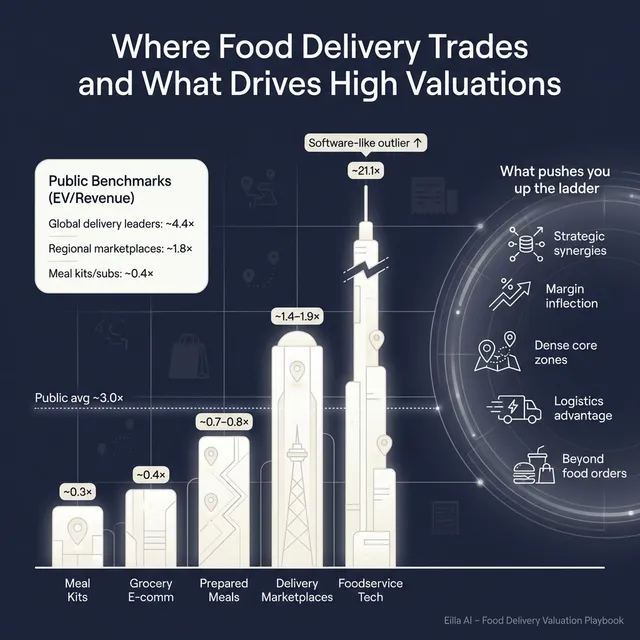
From the private precedent transactions in the data, the average EV/Revenue multiple across deals is about 4.7x, but that headline number is distorted by very different deal types. When you isolate by segment, the picture gets more usable:
- Online food delivery marketplaces & super-apps cluster around ~1.7x EV/Revenue on average in the private data.
- Prepared meals (ready-made) are around ~0.7x–0.8x EV/Revenue.
- Meal kits/subscription boxes cluster around ~0.3x EV/Revenue.
- Foodservice technology & supply chain tech can print very high EV/Revenue (the dataset includes ~21.1x average), which is not comparable to a delivery marketplace because it behaves more like software.
A simple private comps view:
Important: these are illustrative reference points, not a price tag. Your specific multiple moves based on margin trajectory, growth quality, and strategic fit.
4.2 Public Companies
Public markets provide a “reality check” band, but private deals usually trade at a discount to public leaders because private businesses are smaller, riskier, and less liquid.
In the provided public multiples (as of mid/end 2025), the grouped averages show:
- Global food & local commerce delivery marketplaces: around 4.4x EV/Revenue on average (median ~3.9x), with very high EV/EBITDA averages in the dataset because some players are early in profitability cycles.
- Regional food delivery marketplaces and last-mile specialists: around 1.8x EV/Revenue average (median ~1.1x).
- Grocery-focused marketplaces & quick commerce: around 1.4x EV/Revenue average.
- Meal kits and subscriptions: around 0.4x EV/Revenue average.
- Restaurant discovery platforms: around 0.5x EV/Revenue average.
- The overall public universe in the dataset averages ~3.0x EV/Revenue and ~20.6x EV/EBITDA.
A public comps snapshot:
How to use public multiples correctly:
- Treat them as reference rails, not a direct valuation for your company.
- Adjust down for smaller scale, weaker margins, heavier promo dependence, or higher regulatory risk.
- Adjust up only when you have something scarce: unique local dominance, clear margin inflection, or strategic synergies that a buyer can realize quickly.
5. What Drives High Valuations (Premium Valuation Drivers)
The premium outcomes in the data tend to cluster around a few repeatable themes. Use these as a checklist of what buyers will pay extra for - and what you should prove before you go to market.
5.1 Strategic fit and ecosystem synergies
When a buyer can plug your platform into an existing portfolio, they can justify paying more. The data explicitly highlights strategic buyer synergies and ecosystem fit as a driver of outsized outcomes.
What “synergy” means in plain terms:
- They can lower cost per order by combining courier networks.
- They can cross-sell across categories (food to grocery to convenience).
- They can port playbooks (pricing, retention, partner tooling) from one market to another.
Founder-friendly proof points:
- Show overlap with the buyer’s existing regions or verticals.
- Show how your density can improve their density (and vice versa).
- Demonstrate quick wins: shared dispatch, shared customer base, shared restaurant tools.
5.2 Margin inflection and credible path to profitability
The data highlights turnaround to positive EBITDA and expanding margins as a catalyst for better pricing. Buyers pay more when they believe the business is de-risking.
What buyers want to see:
- A trend of improving margins, not just one good quarter.
- Evidence it comes from structural improvements (dispatch efficiency, pricing discipline), not temporary promo cuts that kill demand.
5.3 Logistics control or logistics enablement that improves economics
Premium narratives repeatedly show up when the asset improves last-mile economics - either by owning logistics well or enabling it via technology.
Practical ways to frame it:
- “We can deliver faster with fewer couriers per order.”
- “Our dispatch system increases batching and utilization.”
- “Our restaurant tooling reduces prep-time variability.”
5.4 Brand and local market leadership
The data calls out brand and market leadership with defensible scale as a premium driver. In food delivery, local leadership can be more defensible than founders expect, especially in smaller countries or dense cities.
What to prove:
- Share in your core zones, not just national PR metrics.
- Restaurant partner breadth and quality.
- Retention without heavy discounting.
5.5 Expanding beyond food to increase frequency
The data shows regional category expansion beyond food can deepen order frequency and improve courier utilization - which feeds margins and defensibility.
What buyers like:
- Multi-occasion demand (not just dinner).
- Categories with repeat behavior (convenience, staples).
- Operational readiness (inventory-light models can be easier than full grocery).
5.6 Control premium and the ability to act fast
Some deals include a clear control premium where the buyer wants governance and flexibility (especially for restructuring, investment cycles, and integration).
You can help this by:
- Having clean corporate structure and shareholder alignment.
- Demonstrating that the business can be integrated without chaos (systems, contracts, data).
5.7 Basics that still matter (even when the sector is “strategic”)
Even in strategic sectors, buyers pay more when fundamentals are clean:
- Clean financials with consistent definitions of revenue, promos, and gross profit
- Diversified demand (not one channel, not one city)
- Leadership bench beyond the founder
- Clear KPIs and consistent reporting
6. Discount Drivers (What Lowers Multiples)
Discounts happen when buyers see “fragile economics” - meaning the business works only under perfect conditions (cheap marketing, high promos, abundant couriers, and forgiving restaurants).
Common deal-level discount drivers in food delivery:
- Promo-dependent demand: If demand collapses when discounts stop, buyers assume your “real” profitability is lower than reported.
- Weak margin visibility: If you cannot clearly explain contribution margin by cohort, city, or category, buyers assume the worst.
- Operational volatility: Late deliveries, cancellations, refunds, and inconsistent service create hidden costs and damage retention.
- Regulatory exposure: Courier classification and labor rules can change your cost base quickly.
- Concentration risk: One city, one restaurant group, one channel partner, or one category can cap valuation.
- Poor data integrity: If your metrics do not reconcile, buyers lower price or add earnouts to protect themselves.
The key: discount factors do not just lower price - they often change deal structure (more earnouts, more holdbacks, tougher indemnities).
7. Valuation Example: A Food Delivery Company
This is a worked example to show how the logic works. The company and revenue are fictional, and the valuation is illustrative - not investment advice or a formal valuation.
7.1 The fictional company
“MetroBite” is a regional food delivery marketplace with hybrid logistics:
- USD 10.0m annual revenue (fictional)
- Operates in two dense cities and one smaller satellite city
- Commission + delivery fee revenue, with a small subscription program
- Recently improved delivery reliability and reduced refunds
- Still uses promotions, but retention is improving
7.2 Step 1 - Build a sensible multiple range from comps
For a regional marketplace at this scale, the most relevant reference points in the provided data are:
- Regional delivery/last-mile public comps that can trade as low as ~0.9x–2.3x EV/Revenue in the example logic’s comp set.
- Private deals for delivery marketplaces & super-apps clustering around ~1.4x–1.9x EV/Revenue in the provided comp framework.
- Global leader marketplace public comps can be higher (roughly ~3.7x–5.4x EV/Revenue in the example comp band), but those are usually larger, multi-country platforms - use as an upper reference only.
So a practical starting point for a USD 10m revenue regional marketplace is:
- Base anchor range: ~1.8x–4.0x EV/Revenue (a blend of private regional comps with upside for strong strategic fit)
7.3 Step 2 - Apply scenarios to MetroBite
What pushes you into each scenario:
- Discounted case if MetroBite shows promo dependency, unclear cohort retention, weak reliability, or regulatory overhang.
- Base case if MetroBite is a solid regional business with stable demand, decent density in core zones, and credible economics but no “must-have” strategic story.
- Premium case if MetroBite can prove: margin improvement trend, strong density in core zones, logistics advantage, and clear synergy for a strategic buyer (e.g., plugging into a larger local commerce ecosystem).
7.4 What this means for you
Two businesses can both have USD 10m revenue and be worth very different amounts because buyers are pricing risk and durability, not just topline.
If you want a higher outcome, your job is not to “argue a higher multiple.” Your job is to remove the reasons buyers discount you and prove the drivers that justify paying up.
8. Where Your Business Might Fit (Self-Assessment Framework)
Use this as a quick, honest self-check. Score each factor 0-2:
- 0 = weak or unclear
- 1 = decent but not proven
- 2 = strong and provable with data
How to interpret your total:
- High band: You have evidence that supports premium positioning. You can credibly target the upper end of your peer set.
- Middle band: You are “fair market,” but likely need tighter proof (or a stronger process) to avoid buyers anchoring low.
- Low band: You may still sell, but you should expect more structure (earnouts/holdbacks) unless you fix the biggest risk flags first.
9. Common Mistakes That Could Reduce Valuation
9.1 Rushing the sale
If you go to market before your numbers and story are clean, buyers will price the uncertainty - and they will not pay you for “potential” they cannot verify.
9.2 Hiding problems
In food delivery, issues always surface: refund rates, promo dependency, courier churn, and messy accounting. Hiding problems destroys trust, and trust is a valuation multiplier.
9.3 Weak financial records
This is a common self-inflicted discount. Clean up:
- Revenue definitions (commission vs fees vs ads vs promos)
- Marketing normalization (what happens when you reduce incentives?)
- Cohort reporting and contribution margin by market
9.4 Not running a structured, competitive process with an advisor
Founders often underestimate how much price comes from process, not just performance. Research frequently cited in M&A circles suggests that running a structured, competitive process with an advisor can drive materially higher outcomes (often referenced around ~25% higher purchase prices), largely because more buyers and better process discipline improves leverage.
9.5 Revealing what price you’re after instead of letting the market bid
If you tell buyers “we want USD 10m,” you often get USD 10.1m and USD 10.2m - not the true maximum they might have paid. Price discovery works best when you let multiple credible buyers compete.
9.6 Industry-specific mistakes that hurt food delivery valuations
- Expanding too many zones too fast: You dilute density and worsen unit economics right before a sale.
- Over-reliance on one promo mechanic: Buyers fear your demand is “rented,” not earned.
10. What Food Delivery Founders Can Do in 6-12 Months to Increase Valuation
You do not need to reinvent the business. You need to make the business easier to underwrite.
10.1 Improve the economics buyers actually price
- Show margin inflection: Document a 2-4 quarter trend of improving contribution margin and EBITDA (even if small).
- Prove density improvements: Concentrate resources on core zones and show better batching/utilization and faster delivery times.
- Reduce refunds and cancellations: These are margin killers and trust killers. Fixing them is a double win.
10.2 De-risk growth quality
- Reduce promo dependency: Start reporting “organic repeat” metrics: repeat rate, frequency, retention with and without incentives.
- Build a retention engine: Subscription, loyalty, and reactivation flows that show repeat behavior without constant discounting.
10.3 Strengthen your strategic narrative
- Map buyer-specific synergies: If a strategic buyer can densify routes, expand categories, or roll out your operational tech, make that explicit.
- Show a credible category expansion plan: Even limited pilots in convenience or grocery can demonstrate frequency upside - if economics are disciplined.
10.4 Make diligence painless
- Clean revenue and promo accounting: Buyers want confidence your revenue is real and repeatable.
- Codify KPIs: Cohort retention, order frequency, take rate, courier utilization, delivery time distribution, refund rates.
- Build a second line of leadership: Buyers discount “founder-only” operations.
11. How an AI-Native M&A Advisor Helps
An AI-native M&A advisor can improve outcomes in food delivery because the buyer universe is wider than founders expect - and the right buyer can change the multiple. AI can map hundreds of credible acquirers based on actual deal history, synergy patterns, financial capacity, and strategic priorities, which increases competitive tension and gives you more options if one buyer drops late.
Speed also matters. AI-driven buyer matching, outreach, and workflow support can compress the time to get into real conversations. Combined with fast creation of process materials and diligence support, it can help you reach initial offers in under 6 weeks in many cases - which is valuable when market conditions or competitor moves are changing quickly.
The best outcome is still driven by expert judgment. The advantage is not “AI instead of bankers” - it is experienced M&A advisors supported by AI that can help you frame the deal in the buyer’s language, prepare professional materials, and run a disciplined, competitive process without the traditional bulge-bracket cost structure.
If you would like to understand how our AI-native process can support your exit, book a demo with one of our expert M&A advisors.
Are you considering an exit?
Meet one of our M&A advisors and find out how our AI-native process can work for you.


