
The Complete Valuation Playbook for Health and Safety Training Businesses
A guideshowing what health and safety training businesses sell for and what drives higher multiples.

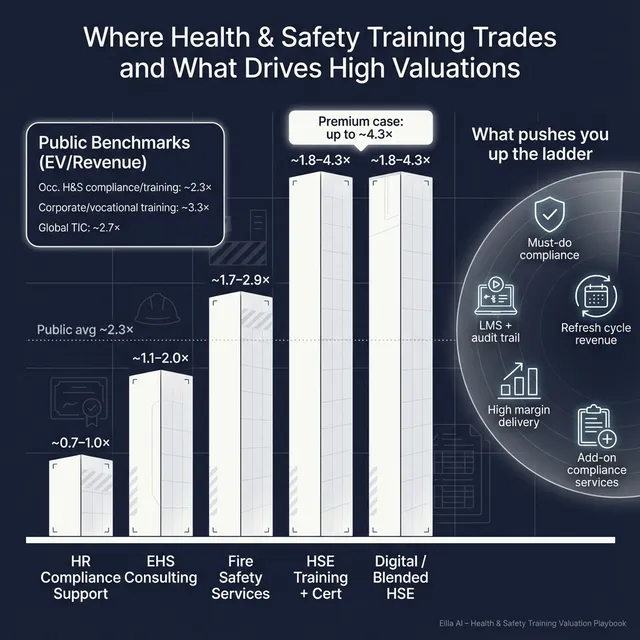
If you run a health and safety training business and you’re considering a sale in the next 1-12 months, valuation is not just a number - it’s the output of how buyers perceive the quality and durability of your revenue.
This playbook is built for your sector specifically. It will (1) show what similar businesses have sold for, (2) explain what actually drives higher vs lower multiples in health and safety training, and (3) give you a simple self-assessment and a realistic 6-12 month action plan to improve your outcome.
1. What Makes Health and Safety Training Unique
Health and safety training looks simple from the outside - “courses in, certificates out” - but buyers know it can be very different businesses under the same label. Your valuation depends heavily on which version you are.
The main business models buyers see in this sector
- Accredited qualification providers (internationally recognized certifications, regulated syllabi, exam delivery, refreshers).
- Corporate HSE training partners (multi-year programs, onboarding, refresher cycles, tailored content, on-site delivery).
- Open-enrollment course businesses (public calendars, individuals paying per seat, more marketing-driven demand).
- Blended/digital training platforms (LMS + e-learning + virtual classrooms + assessments, sometimes with subscriptions).
- Integrated compliance bundles (training plus audits, inspections, documentation support, or advisory services).
Why valuation is different here (vs generic services)
Buyers are underwriting three things that matter more in this sector than most:
- Regulatory pull: Is the spend “must-do” (mandated training, refreshers, statutory requirements), or “nice-to-have”?
- Recurring cadence: Do customers come back because they have to (annual refreshers, role-based recertification), or do you constantly re-sell?
- Proof and defensibility: Can you show consistent quality and outcomes without depending on a few star instructors?
The risk checks buyers always do
Expect detailed diligence on:
- Accreditation and licensing (status, audit history, renewal dates, instructor qualifications).
- Delivery capacity and quality control (standardization, trainer onboarding, moderation, pass rates where relevant).
- Customer concentration and contract terms (how “repeatable” your revenue truly is).
- Compliance and liability exposure (claims history, content accuracy, recordkeeping).
- Data and systems (LMS reliability, exam integrity, GDPR/data privacy, security controls).
2. What Buyers Look For in a Health and Safety Training Business
Buyers are not buying your past. They’re buying a future stream of cash flows they can trust - with as few surprises as possible.
The obvious fundamentals still matter
- Scale: Revenue size and consistency across months/quarters.
- Growth: Buyers will pay more when growth is steady and explainable (not one-off spikes).
- Profitability: Strong gross margin and EBITDA margin signal operating leverage, not just busy trainers.
- Customer diversification: Many repeat customers beats a few large ones.
The sector-specific “valuation lens”
Buyers typically ask:
- Are you embedded in compliance (customers must train to operate), or are you “optional learning”?
- How much of revenue is repeatable (renewals, refreshers, multi-site corporate programs)?
- How standardized is delivery (curriculum, assessments, instructor playbooks), and how fast can you scale new cohorts?
- Do you have a distribution advantage (partner channels, enterprise procurement relationships, trade association funnels)?
- Are you digitally enabled (LMS + reporting + scheduling + compliance documentation) in a way that increases stickiness?
How private equity (PE) thinks about your business
PE buyers are modeling an exit in 3-7 years. They care about:
- Entry multiple vs exit multiple: They want a believable story that the business will be worth more later, not just bigger.
- Who buys it next: A larger training platform, a compliance services group, a TIC-style buyer, or a broader “workplace safety” services consolidator.
- Levers they expect to pull:
- Price increases (especially for corporate programs with clear ROI and low switching)
- Cross-sell (add compliance support, audits, inspections, or software modules)
- Digital conversion (shift more delivery to scalable online/blended formats)
- Operational efficiency (utilization, scheduling, instructor productivity, venue economics)
3. Deep Dive: The Highest-Impact Nuance - “One-Off Courses” vs “Recurring Compliance Engine”
In health and safety training, two businesses can both have “USD 10m revenue” and look similar on the surface - but one sells for a dramatically higher price because it behaves like a recurring compliance engine.
Why this matters
Buyers pay up for certainty. If your revenue is tied to recurring regulatory cycles and corporate renewal behavior, buyers can underwrite future performance with more confidence - and that confidence shows up directly in the multiple.
How this shows up in deal outcomes and comps
Across relevant deal groupings, higher valuations cluster around businesses that are regulatory-critical and have entrenched, non-discretionary demand (buyers treat them as recession-resistant). This shows up in the premium driver patterns observed in comparable compliance-heavy service deals. (Examples include acquisitions in occupational health, HSE training, fire safety, and compliance support categories in the provided dataset.)
What buyers are really testing
They’ll try to answer:
- “If we stop marketing tomorrow, how much revenue repeats anyway?”
- “If a competitor discounts pricing, do customers still stick because switching is painful or risky?”
- “Is the training inside a process (onboarding, annual refreshers, role-based certification), or is it a one-time event?”
How to move from lower-value to higher-value profile
If you’re more one-off today, you can shift meaningfully within 6-12 months:
- Convert top customers into master service agreements (MSAs) with defined refresher cadence.
- Bundle training with compliance reporting, audit trails, and reminders (even simple automation helps).
- Standardize delivery and assessments so corporate clients trust you across sites and managers.
Mini-table: what buyers see
4. What Health and Safety Training Businesses Sell For - and What Public Markets Show
This is the part founders usually want first: “What multiple should I expect?”
The honest answer is: there isn’t one number. But the data gives real boundary lines - and your job is to position your business toward the top of the range by improving revenue quality and reducing buyer risk.
4.1 Private Market Deals (Similar Acquisitions)
What the private deal data suggests for training-heavy businesses
For HSE Training & Certification Providers, the precedent transaction band in the provided dataset shows:
- Typical EV/Revenue ranges of ~1.8x-4.3x (25th-75th percentile style banding from the example logic)
- Group averages around ~3.1x EV/Revenue and median around ~2.9x EV/Revenue
Those are training-and-certification oriented deals, which is the closest match for most health and safety training businesses.
Adjacent categories matter as “gravity” on your multiple:
- If your business behaves like HR/workplace compliance support (advice line, documentation-heavy, lower training intensity), multiples skew lower (sub-1.0x EV/Revenue in the dataset averages).
- If your business behaves like technical compliance/testing/inspection cadence, the market often uses a different lens (more like TIC/advisory services, often anchored by EBITDA multiples).
Private comps table (illustrative bands from the provided data)
These ranges are illustrative - buyers will adjust them based on growth, margins, contract structure, and risk profile.
4.2 Public Companies
Public markets give a “reference band,” not a direct price tag. Public companies are larger, more diversified, and more liquid - so private businesses usually trade at a discount unless they have unusually strong strategic value.
Using the public group multiples provided (as of mid-to-end 2025), the closest public reference sets look like:
- Occupational health, safety compliance, certification and training services: average ~2.3x EV/Revenue and ~9.0x EV/EBITDA (median ~1.6x and ~6.5x).
- Corporate and vocational training (non-medical): average ~3.3x EV/Revenue and ~7.9x EV/EBITDA.
- Global TIC (testing, inspection, certification): average ~2.7x EV/Revenue and ~15.2x EV/EBITDA.
Public comps table (group averages from the provided data, mid-to-end 2025)
How to use these public multiples
- Treat them as guardrails: a sanity check on what “quality compliance services” trade for at scale.
- Expect downward adjustments for smaller size, customer concentration, owner dependence, and weaker systems.
- In rare cases, expect upward pressure if you’re a scarce asset (unique accreditation, strong brand, high-margin digital delivery, or a buyer has a clear strategic gap).
5. What Drives High Valuations (Premium Valuation Drivers)
Here’s what the deal narratives consistently reward in compliance-heavy services and training businesses, based on the premium patterns observed in the dataset - plus what buyers typically pay up for in this sector.
Theme 1: Regulatory-critical, non-discretionary demand
Buyers pay more when your revenue is tied to “must-do” compliance, not optional learning.
What this looks like in practice:
- Training tied to statutory requirements and periodic refreshers
- Clear mapping from customer obligations to your course catalog (“If you operate X, you need Y every Z months”)
- High renewal rates and strong repeat purchasing behavior
Theme 2: Recurring cadence and visibility
“Recurring” in training is not always subscription. Buyers still love it when you can show predictable cycles:
- Corporate customers with annual training plans
- Multi-site rollouts that repeat as sites add headcount
- A measurable pipeline of upcoming recertifications
Theme 3: Platformability - ability to cross-sell adjacent services
The dataset’s premium patterns show buyers value platforms that can bolt on adjacent compliance services (even if you are not “software-first”).
Examples:
- Training + compliance documentation support
- Training + audits/inspections referrals
- Training + learning management/reporting modules
Buyers underwrite “attach potential”: if you can reliably sell additional services to the same customer, you’re more valuable.
Theme 4: High gross margin and scalable expert delivery
Health and safety training can be extremely attractive when gross margin is high and delivery scales without quality dropping.
What buyers want to see:
- Standardized course content and assessments (less custom work)
- Strong instructor utilization and predictable scheduling
- Evidence that growth does not require linear headcount growth
Theme 5: Dense delivery capability (multi-site, on-site/mobile, fast response)
Even for training businesses, “coverage” matters:
- Ability to deliver quickly across regions
- Enough instructors (or partner instructors) to support large clients without rescheduling pain
- Consistent service levels that reduce customer downtime
Theme 6: Software-enabled workflows that improve stickiness
Tech doesn’t need to be a standalone SaaS product to matter. Buyers pay more when your systems make you hard to replace:
- LMS with customer portals, audit trails, certificates, reminders
- Scheduling and compliance reporting that lives inside the client’s process
- Clear adoption across customers (not “we have an LMS,” but “80% of corporate clients actively use the portal weekly”)
6. Discount Drivers (What Lowers Multiples)
Discounts usually come from one of two things: revenue fragility or execution risk. Here are the most common red flags.
Revenue fragility
- Too much one-time revenue (no clear renewal cadence, weak repeat behavior)
- Customer concentration (one customer represents a scary percentage of revenue)
- Channel dependence (one partner drives most leads, with no contract protection)
- Price sensitivity (discounting is common, competitors can win easily)
Execution risk
- Founder or star-instructor dependency (buyers fear churn when you step back)
- Inconsistent delivery quality (complaints, refunds, uneven outcomes across instructors)
- Weak systems (manual recordkeeping, poor audit trails, messy scheduling)
- Accreditation risk (audit issues, unclear instructor qualification records)
Financial and reporting issues
- Revenue recognition and deferred revenue not cleanly tracked (common in training)
- Mixing delivery costs and admin costs in ways that hide true margins
- No cohort-level view of profitability by course type or customer segment
7. Valuation Example: A Health and Safety Training Company
This example is fictional. The company, revenue level, and valuation ranges are illustrative and meant to show how the logic works - not investment advice or a formal valuation.
Step 1: The logic
To value a health and safety training business, buyers typically triangulate:
- Private training and certification deals as the closest “what people actually paid” anchor.
- Public comps in occupational safety/compliance and training as reference guardrails.
- Adjustments for your business’s recurring cadence, margins, and risk.
A practical way to do this is:
- Start with a core multiple range based on training/certification precedent bands.
- Move up if you show premium drivers (recurring compliance engine, strong margins, software-enabled stickiness).
- Move down if you show discount drivers (one-off revenue, instructor dependence, messy reporting).
Step 2: Apply it to a fictional business (USD 10m revenue)
Company: “SafeHarbor Training Group” (fictional)
- USD 10.0m revenue
- Mix: 55% corporate programs, 30% online/blended accredited courses, 15% open-enrollment
- Strong renewal cadence: 70% of corporate revenue tied to annual refreshers
- LMS portal used by most corporate clients for tracking and audit trails
- EBITDA margin: 18% (healthy for a training-led business)
Illustrative valuation scenarios (EV on USD 10m revenue)
Why these ranges are grounded in the provided data:
- Private HSE training/certification precedent bands support roughly ~1.8x-4.3x EV/Revenue for similar providers.
- Public reference groups show compliance/training services often cluster in the low-to-mid single-digit revenue multiple range, with higher levels typically requiring scale and quality.
Step 3: What this means for you
Two businesses with the same USD 10m revenue can land in wildly different outcomes because buyers are paying for:
- Predictability (repeatable compliance cadence)
- Profitability (how much cash the business throws off)
- Transferability (can it run without you and without hero instructors?)
If you’re selling within 12 months, the biggest “multiple movers” are usually not flashy strategy shifts - they’re making revenue more repeatable, proving margins, and reducing key-person risk.
8. Where Your Business Might Fit (Self-Assessment Framework)
Use this to locate yourself roughly on the valuation spectrum. Score each factor 0-2:
- 0 = weak / unclear
- 1 = decent but inconsistent
- 2 = strong and well-proven
Scoring table
Interpreting your score
- Top band: You look like a recurring compliance engine. You’ll usually be closer to premium outcomes.
- Middle band: Fair market profile. Solid business, but buyers will price in risk or “work to do.”
- Lower band: Likely discounted outcomes unless you fix the core issues (repeatability, margins, transferability).
9. Common Mistakes That Could Reduce Valuation
Mistake 1: Rushing the sale
A rushed process makes you accept the first “reasonable” offer rather than discovering what the market would really pay. In training businesses, buyers also need time to get comfortable with accreditation, course quality, and revenue recognition.
Mistake 2: Hiding problems
Accreditation issues, instructor turnover risk, customer churn, or messy deferred revenue will surface in diligence. When buyers feel you hid something, they protect themselves with price
- Report gross margin and EBITDA by segment (corporate programs vs open calendar vs online).
- Track instructor utilization and delivery economics (days delivered per instructor, cohort profitability).
- Standardize where possible: fewer custom courses, more repeatable modules.
Group 3: Reduce key-person risk (transferability is value)
- Create instructor playbooks: delivery standards, assessment guidelines, quality checks.
- Build a second layer of leadership (ops lead, sales lead, delivery lead) so buyers see continuity.
Group 4: Strengthen your “buyer story” with proof
- Show the compliance engine: renewal rates, refresh cadence, average customer lifespan, net revenue retention if you can.
- Quantify customer outcomes where possible (reduced incidents, audit readiness improvements, fewer downtime events).
- Build a clean KPI pack that a buyer can trust in 30 minutes.
11. How an AI-Native M&A Advisor Helps
In this sector, the biggest driver of outcome is often not “the multiple you deserve” - it’s how many credible buyers you get in the process, and how well your story is proven with data.
An AI-native M&A advisor expands your buyer universe beyond the usual suspects. Instead of relying on a small list, AI can map hundreds of qualified acquirers based on deal history, adjacency logic, financial capacity, and synergy signals. More relevant buyers creates real competition, stronger offers, and more options if one buyer drops late in the process.
AI also compresses timelines. With AI-driven buyer matching, faster outreach, and systematic creation of marketing materials and diligence support, you can often reach initial conversations and early offers much faster than manual-only approaches - including timelines under 6 weeks in many processes when the business is prepared.
Most importantly, you still need expert humans. The best model is expert M&A advisors (who know how buyers think and negotiate) enhanced by AI: stronger positioning, clearer materials, better buyer targeting, and tighter execution - with “Wall Street-grade” process quality without traditional bulge-bracket cost structures.
If you’d like to understand how our AI-native process can support your exit, book a demo with one of our expert M&A advisors.
Are you considering an exit?
Meet one of our M&A advisors and find out how our AI-native process can work for you.


