
The Complete Valuation Playbook for Industrial Automation Businesses
A practical, data-backed guide to how industrial automation businesses are valued and what drives high multiples.

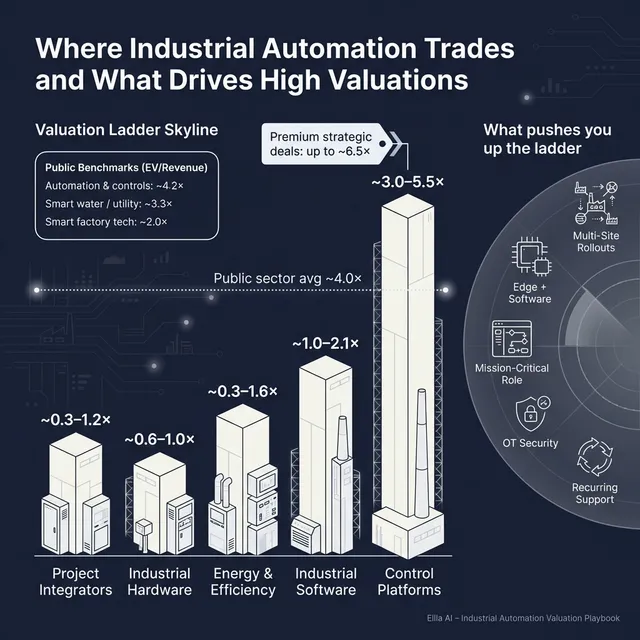
If you run an industrial automation business and are thinking about a sale in the next 1-12 months, this is a good time to get serious about valuation. The market is active, buyers are still consolidating capabilities across controls, industrial software, edge connectivity, cybersecurity, and energy efficiency, and acquirers are increasingly selective about what deserves a premium.
This playbook is built for founders and CEOs of privately held industrial automation businesses. It shows what businesses in and around this sector actually sell for, explains what drives higher and lower multiples, and gives you a practical way to assess where your own company may fit.
The goal is not to pretend there is one exact answer. It is to help you understand how buyers think, what the data actually suggests, and what you can still improve before going to market.
1. What Makes Industrial Automation Unique
Industrial automation is not one simple category. It covers several business types that can look similar on the surface but get valued very differently in a sale process.
The main groups include hardware-led control and automation suppliers, system integrators, industrial software platforms, smart factory and manufacturing digitalization providers, building and energy automation platforms, water and utility monitoring businesses, industrial edge and compute providers, and specialized niches such as OT cybersecurity, remote monitoring, and predictive maintenance. Some are product businesses. Some are service businesses. Many are a blend.
That blend matters a lot. Buyers do not just ask, "How much revenue do you have?" They ask what part of that revenue is product, what part is recurring software or support, what part is project work, and how dependent delivery is on your engineers. A business with PLC integration, monitoring software, and repeatable deployments across many sites often looks more valuable than a business with similar revenue built mostly from custom engineering hours.
Industrial automation also sits inside mission-critical environments. Your systems may affect uptime, quality, safety, energy use, compliance, or labor efficiency. That can be a huge positive for valuation because buyers love mission-critical products. But it also means they will inspect risk very closely.
The key risks buyers always check in this sector are straightforward:
- How repeatable your deployments really are
- How dependent the business is on a handful of technical people
- Whether revenue is mostly one-off project work or sticky support/software revenue
- How exposed you are to capex cycles, delayed plant upgrades, or a few major customers
- Whether you have real productization, or just clever engineering sold as a product
- Whether your systems are secure, compliant, and proven in real industrial environments
In short, industrial automation valuation is really about one question: are you a scalable, trusted control layer in critical operations, or are you still mainly a custom project shop?
2. What Buyers Look For in a Industrial Automation Business
At a high level, buyers care about the same things they care about in most acquisitions: growth, margin, customer retention, market position, and management quality. But in industrial automation, they apply that lens in a more practical way.
They want to know whether your revenue is dependable. A buyer will usually pay more for software subscriptions, support contracts, monitoring, maintenance, and repeat programmatic rollouts than for large one-time integration projects. Recurring revenue lowers risk. It also makes future cash flow easier to believe.
They also care about how your product sits in the customer environment. If your offering touches PLCs, SCADA, edge devices, energy systems, vision systems, or plant-level operations, and you are hard to replace once installed, that helps. High switching costs matter. So does proof that your system works across multiple sites, plants, or customer environments rather than only in one highly tailored use case.
Growth quality matters more than raw growth. Buyers will ask whether growth comes from repeatable expansion, such as rolling out from one site to five, or from founder-led heroics and one-off large wins. They will also look at gross margin carefully. A business that says it is "software-led" but still needs a heavy services layer to deliver every project will not be valued like a clean software company.
Customer quality matters too. Founders often focus on logo count. Buyers focus on concentration, retention, wallet share, and strategic relevance. Ten well-retained industrial customers who use your system across multiple plants can be more valuable than fifty customers who buy once and disappear.
How private equity buyers think
Private equity buyers usually think in three simple steps.
First, they think about the price they pay today versus the price they might get when they sell in 3-7 years. If they buy you at a healthy multiple, they need a believable plan to grow revenue, improve margins, and make the business more attractive to the next buyer.
Second, they think about who that next buyer could be. In this sector, that is often a larger strategic acquirer, a larger private equity fund, or less commonly a public market path if the business becomes scaled and software-heavy enough.
Third, they think about the levers they can pull. In industrial automation, those levers often include expanding across existing customer sites, adding recurring support or monitoring revenue, improving pricing discipline, reducing delivery friction, acquiring smaller niche players, and lifting gross margins through more standardized deployments.
That means PE buyers love businesses that already show the early signs of that story: repeatable rollout patterns, sticky customer relationships, a leadership team that is not just the founder, and clear evidence that the company can scale without breaking.
3. Deep Dive: Productized, Multi-Site Platforms vs Custom Project Shops
This is one of the most important valuation splits in industrial automation. Two businesses can both say they do automation, analytics, optimization, or controls - but the one that behaves like a product platform usually gets far more buyer interest than the one that behaves like a custom engineering contractor.
The deal data strongly points in that direction. The premium patterns in the source set repeatedly highlight multi-site deployment footprints, hardware-software integration at the edge, and strategic value in digital systems, cloud integration, and monitoring layers. In contrast, project-driven integrators in the precedent transaction set mostly trade at much lower revenue multiples, often below 1.0x revenue and only sometimes above that, depending on profitability, scale, and strategic fit. (Source: precedent transactions and premium driver set provided.)
Why buyers care is simple. A custom project shop is harder to scale, harder to hand over after acquisition, and more exposed to key-person risk. A productized platform with standardized integrations, repeatable deployment playbooks, and recurring monitoring or support revenue is easier to scale, easier to cross-sell, and easier to believe in as a long-term asset.
This is especially true when you "own the edge" in some way - meaning you are not just delivering a dashboard, but are connected to industrial data flows, control logic, monitoring, or on-site compute. The source data specifically points to stronger strategic value for businesses that combine software with OT connectivity, monitoring, or embedded edge capability rather than selling a narrow point solution. (Source: premium driver set provided.)
You do not have to become a pure software company to benefit from this. Most successful industrial automation businesses are not pure software businesses. But you do need to show that your services support a scalable platform rather than substitute for one.
A practical way to think about it:
If your business looks more like the left side today, the path forward is not mysterious. Standardize integrations. Document deployment steps. Turn reporting and monitoring into recurring services. Package vertical solutions by end market. Make the business easier to scale without relying on the founder or a few senior engineers.
4. What Industrial Automation Businesses Sell For - and What Public Markets Show
The first thing to understand is that industrial automation does not trade on one neat sector multiple. Public markets value different parts of this ecosystem very differently, and private transactions are usually lower than public trading levels unless the target has unusually strong strategic value.
The public comp set you provided shows a broad range, and the private transaction set shows that many real deals clear at much more modest levels. That gap is normal. Public companies are larger, more diversified, more liquid, and usually better capitalized. Private companies get adjusted up or down from those reference points based on scale, growth, margins, recurring revenue, customer quality, and strategic importance.
4.1 Private Market Deals (Similar Acquisitions)
The precedent transaction data suggests that many private deals in and around industrial automation clear at relatively conservative revenue multiples. The overall average in the transaction set is about 0.9x EV/Revenue, with a median of about 0.6x, and average EV/EBITDA of about 11.6x with a median around 8.4x. (Source: precedent transaction set provided.)
But that average hides an important split. Project-heavy integrators and service-led businesses often transact below 1.0x revenue. More software-led or strategically adjacent assets can move higher, especially where buyers see a wedge into digital systems, cloud integration, energy optimization, or a repeatable industrial software layer. The source logic for a software-led industrial control platform supports a much higher illustrative band of roughly 3.0x-5.5x revenue when the company is clearly more productized and scalable than the average private comp. (Source: specific company logic at fictional USD 10m revenue provided.)
These are not price tags. They are rough market markers. A strong company can outperform the average transaction set. A weak company can fall below it.
4.2 Public Companies
The public comp set as of mid to late 2025 paints a much broader and higher range. Across the full set, the average EV/Revenue is about 4.0x and the median is about 3.4x. Average EV/EBITDA is about 32.8x, with median around 20.0x. (Source: public company set provided.)
But again, the averages hide important differences by segment. Hardware-centric automation and control OEMs often trade around the low-to-mid single digits of revenue. Smart water and building automation groups tend to sit in a similar broad zone, though profitability and growth matter a lot. The richest public valuations in the data appear in capital equipment and highly differentiated industrial technology niches where margins, growth, or market position are unusually strong. On the other side, some project-heavy smart factory and digital transformation names trade much lower, especially when margins are weak or revenue is less predictable. (Source: public company set provided.)
*The EV/EBITDA average in smart factory is distorted by very low EBITDA bases in some names. It should be handled carefully.
The right way to use public multiples is as a reference band, not a direct answer. If you are smaller, less profitable, less diversified, and more services-heavy than public companies, your valuation will usually be lower. If you own a scarce capability, sit in a mission-critical workflow, and have unusual strategic value to a buyer, you can sometimes close part of that gap.
A good founder should use public comps as a "ceiling guide" and private transactions as a "reality check." Your actual outcome depends on where you sit between those two worlds.
5. What Drives High Valuations (Premium Valuation Drivers)
The source data gives a useful clue: buyers are willing to pay more when an industrial automation business feels less like a contractor and more like a scalable operating platform.
Repeatable multi-site deployments
Buyers pay more for proof that success is repeatable. A company deployed across many sites, plants, or facilities is easier to believe in than one with a few bespoke installations. The premium driver set explicitly flags multi-site footprint as a de-risking factor because it shows scalability and maturity across different customer environments. (Source: premium driver set provided.)
In practical terms, this means:
- You can show a repeatable rollout from site one to site five
- You have standard onboarding and deployment methods
- You can present outcome data by vertical or use case
Hardware-software integration that increases switching costs
Industrial automation businesses can become more valuable when they are not just an app sitting on top of someone else's system. The data points to premium value when a business combines software with OT connectivity, monitoring, compute, or edge architecture. Buyers like bundled system value because it creates stickier customer relationships and can support recurring service revenue. (Source: premium driver set provided.)
A founder can see this in plain English:
- A control layer tied into plant data is more valuable than a reporting-only layer
- Remote monitoring plus field integration is more valuable than one-time setup work
- Being part of the operating workflow is better than being a nice-to-have tool
Mission-critical security and compliance
Cybersecurity and compliance matter more in OT than many founders realize. The premium driver set specifically calls out OT cybersecurity, standards alignment, and compliance-grade capability as factors that can lift a business from a normal services profile into a more strategic, tech-like profile. (Source: premium driver set provided.)
Why buyers care is obvious. If your system touches industrial operations, the cost of failure is high. A buyer will pay more for a business that helps customers reduce risk, pass audits, secure infrastructure, and deploy safely.
Strategic adjacency to larger transformation budgets
Some assets get premium attention because they open doors to bigger budgets. The source set highlights value where the target helps the acquirer move into digital systems, cloud integration, decision support, or broader transformation programs. (Source: premium driver set provided.)
That means your company can become more valuable if buyers see you as:
- A bridge from plant operations into software budgets
- A wedge into energy, water, utility, or manufacturing transformation
- A capability that expands their scope inside existing customer accounts
Scaled revenue with believable profitability
Scale alone does not guarantee a premium, but scale with credible profitability helps a lot. The source set notes that buyers are more willing to underwrite premium EBITDA multiples when the business is large enough and profitable enough for earnings durability to feel real. (Source: premium driver set provided.)
For founders, that usually means:
- Clean margin reporting
- Clear separation of product, services, and support economics
- Evidence that the business can grow without crushing margins
Recurring revenue and aftermarket pull-through
Even if the business started as project-led, recurring support, monitoring, maintenance, analytics, and software layers improve valuation. Buyers pay more when lifetime value is not limited to the initial install.
You do not need 100% subscription revenue. But if you can show that installations naturally lead to sticky support revenue, license renewals, remote monitoring, optimization services, or multi-site expansion, buyers will usually view the revenue base as safer and more scalable.
Clean business fundamentals
Some premium drivers are not glamorous, but they matter in almost every deal:
- Clean financial records
- Low customer concentration
- Strong retention
- A management team beyond the founder
- A credible pipeline
- A clear value story backed by numbers
These things do not create magic. They create trust. Trust is often what lets a buyer stretch.
6. Discount Drivers (What Lowers Multiples)
Low valuations are not random. They usually reflect a buyer's view that the business is harder to scale, riskier to own, or less durable than the headline story suggests.
The biggest discount driver in this sector is usually services intensity without productization. If revenue depends heavily on custom engineering, site-by-site tailoring, or founder-led technical delivery, buyers worry that growth requires hiring more people in lockstep. That limits operating leverage and makes integration harder.
Another common discount driver is weak revenue quality. This includes one-off projects, inconsistent reorder patterns, no real recurring support revenue, or a pipeline that depends on a few relationships rather than a repeatable go-to-market model. Buyers will not usually pay a software-like multiple for revenue that behaves like consulting.
Customer concentration can also drag value down quickly. If one or two industrial clients account for a large share of revenue, or if one channel partner effectively controls access to the market, buyers will discount for risk. The same applies if revenue is tied to one end market that is especially cyclical, such as a narrow manufacturing niche or delayed capital projects.
Margin quality matters too. In the source data, several lower-valued public and private businesses show weak or volatile profitability, low gross margin, or negative EBITDA. Buyers are cautious when they cannot tell whether margins are temporarily depressed or structurally weak. If the economics are messy, the buyer assumes more risk.
Key-person dependence is another big issue in industrial automation. If the founder, CTO, or a small group of engineers holds the client relationships, product knowledge, and deployment know-how in their heads, buyers worry about what happens the day after closing. This is one reason earn-outs and staged deal structures appear repeatedly in the precedent set: buyers want protection when execution depends on people staying and performing. (Source: premium driver set provided.)
Two sector-specific red flags are worth calling out.
First, "fake product" risk. That is when a business is marketed as a platform, but under diligence the buyer discovers heavy customization, long deployment cycles, and poor gross margin discipline.
Second, weak OT security or compliance readiness. If your system touches industrial operations and you cannot answer basic questions on cybersecurity, access controls, resilience, or standards alignment, a sophisticated buyer may either discount the business or walk away.
The good news is that most discount drivers are at least partly fixable. The earlier you identify them, the more time you have to improve the story before buyers do it for you.
7. Valuation Example: A Industrial Automation Company
Let us make this concrete with a fictional example.
Assume a fictional company called ForgeGrid Automation. It provides PLC-integrated optimization and monitoring software for industrial sites, with support for energy efficiency, remote visibility, and plant-level control improvement. The company has USD 10.0m of annual revenue, a meaningful installed base across multiple customer sites, and a mix of software, support, and implementation revenue. This company is fictional, and the valuation below is illustrative only. It is not investment advice or a formal valuation.
Step 1: How the valuation logic works
The source logic for a software-led industrial control layer at USD 10m revenue suggests that an enterprise value of roughly USD 30m-55m, or 3.0x-5.5x revenue, can be defensible for the right company profile. That range is built by looking at both public and private reference points. (Source: specific company logic at fictional USD 10m revenue provided.)
Why is the range so much higher than many private industrial automation transactions? Because not all private deals are for the same kind of asset. The average private comp set includes many services-heavy, hardware-led, or lower-growth businesses. A more software-led company with real deployment scale, repeatable outcomes, and stronger strategic fit can sit above that average private set, even if it still trades below large public software or automation leaders.
So the logic is:
- Start with public comp ranges as a broad reference band
- Cross-check against private deals, which tend to be lower
- Adjust for your business model - software-led vs project-led
- Adjust for footprint, recurring revenue, margins, growth, and strategic relevance
- Apply a realistic range, not a single number
Step 2: Apply it to the fictional company
Assume ForgeGrid Automation has:
- USD 10.0m revenue
- Good gross margins for a software-led automation business
- Moderate but credible growth
- Multi-site deployment proof
- Sticky support and monitoring revenue
- Some implementation intensity, but not a pure services model
A reasonable valuation framework might look like this:
What pushes the business into each band?
Discounted case - USD 20m-30mThis is where the company lands if implementation work is still too custom, recurring revenue is thinner than expected, margins are messy, or the business depends heavily on a few customers or a few engineers. Same revenue, lower confidence.
Core range - USD 30m-55mThis fits a company that is genuinely software-led, proven in real OT environments, deployed across many sites, and valuable enough to earn a clear premium over standard project-heavy private comps. This is the range most closely aligned with the source logic. (Source: specific company logic at fictional USD 10m revenue provided.)
Premium case - USD 55m-65mThis becomes possible if the company has unusually strong proof of repeatability, high customer retention, growing recurring revenue, strong OT security positioning, strong vertical specialization, and clear strategic relevance to larger acquirers. You should not assume this case. You need the facts to support it.
Step 3: What this means for founders
Two industrial automation companies with the same USD 10m of revenue can be worth very different amounts. One may be viewed as a people-intensive engineering business. The other may be viewed as a scarce software-led control platform with real strategic value.
That gap is exactly why preparation matters. Valuation is not only about current size. It is about what kind of future a buyer believes they are buying.
8. Where Your Business Might Fit (Self-Assessment Framework)
A simple self-assessment can help you estimate whether you are closer to the low end, middle, or upper end of the valuation range.
Score each item 0, 1, or 2:
- 0 = weak / not present
- 1 = decent / partly present
- 2 = strong / clearly present
Self-assessment table
How to interpret the score
8-10 total pointsYou likely look more like a premium industrial automation asset. You may still not get a premium outcome unless you run a strong process, but the core ingredients are there.
5-7 total pointsYou are probably in the fair-market middle. Buyers should be interested, but your valuation will depend heavily on how well the business is positioned and how the weak spots are handled.
0-4 total pointsYou may still be sellable, but you are more exposed to lower multiples, earn-outs, or buyer caution. This usually means there is a real case for spending 6-12 months improving the business before launching a process.
The point of this exercise is not to flatter yourself. It is to identify where one or two focused improvements could move the valuation meaningfully.
9. Common Mistakes That Could Reduce Valuation
The first big mistake is rushing the sale. Founders often decide to sell after a stressful period, a buyer inbound, or a personal turning point. But if your numbers are not organized, your story is not sharp, and you have not thought through buyer fit, you usually leave money on the table.
The second mistake is hiding problems. In almost every deal, the real issues come out in diligence anyway - weak margins, customer concentration, security gaps, messy revenue recognition, delivery bottlenecks, or dependence on one technical leader. Hiding these issues rarely works. It usually destroys trust late in the process, which is exactly when buyers gain leverage.
The third mistake is weak financial records. Many industrial automation businesses have much better underlying economics than their reporting shows. Product revenue, project revenue, support revenue, and gross margins often get mixed together. If you can separate them cleanly, show cohort behavior, and explain how margins improve over time, you make the business easier to underwrite.
The fourth mistake is not running a structured, competitive sale process with an advisor. A good process does not just "find buyers." It creates competitive tension, keeps momentum, manages diligence, and frames the business correctly. Research often shows that a well-run competitive process with an advisor can lead to meaningfully higher purchase prices - often around 25% higher than a poorly run or single-buyer process. That is not guaranteed, but the direction is real.
The fifth mistake is telling buyers what price you want too early. If you say you are hoping for USD 10m, many buyers will simply anchor around that number. Instead of discovering what the market might truly pay, you invite narrow bids at USD 10.1m or USD 10.2m. Good sale processes protect price discovery.
Two industry-specific mistakes matter here as well.
One is calling a services-heavy business a software platform without proof. Serious buyers will test deployment effort, customization, gross margins, and renewal behavior. If the facts do not match the story, valuation falls fast.
The other is ignoring OT security and compliance readiness. In industrial environments, this is no longer a side issue. Weak answers here can reduce buyer appetite even if the commercial story is strong.
10. What Industrial Automation Founders Can Do in 6-12 Months to Increase Valuation
You do not need to reinvent the company in a year. The best pre-sale work usually comes from tightening the model you already have.
Improve the quality of revenue
Push harder on recurring support, monitoring, software licensing, and multi-site expansion. If you already land one site first, build a formal rollout program for the next three or five sites. Buyers pay more when expansion looks systematic rather than accidental.
You should also review pricing. Many industrial automation businesses underprice support, remote monitoring, analytics, and uptime-related value. If your system clearly saves energy, labor, downtime, or process loss, package that value more clearly.
Reduce services drag without hurting delivery
Document deployment steps and standardize as much as possible. Build templates by vertical, customer type, or use case. The goal is not to eliminate services - it is to show that services support scale instead of limiting it.
Also track implementation effort by project. If one customer type consistently takes too much engineering time, fix the process or reprice it. Better implementation efficiency can improve both margins and valuation narrative.
Strengthen proof of repeatability
Case studies matter more when they show measurable outcomes. Build a clean set of evidence around energy savings, uptime, yield improvement, reduced alarms, better monitoring, or faster deployment. Even better if you can show similar results across multiple sites.
Organize the evidence by segment. Buyers love to see that "this works in water utilities," "this works in food manufacturing," or "this works in energy-intensive industrial plants."
De-risk the business for a buyer
Reduce customer concentration where you can. Make sure contracts, renewals, support obligations, and intellectual property ownership are clear. Cross-train your team so the business is not dependent on one founder or a few senior engineers.
If OT security is not yet a strength, improve it. You do not need to claim perfect compliance, but you should be ready to show that security, access controls, architecture, and resilience are taken seriously.
Improve the numbers and the story
Build reporting that separates product, software, support, and services revenue. Show gross margin by category if possible. Track retention, expansion, deployment time, and customer concentration in a simple dashboard.
Then connect the story to buyer logic. Do not just say, "We are growing." Say, "We have built a repeatable, multi-site industrial control platform with sticky support revenue and documented deployment economics." The best valuation narratives are both true and easy to understand.
Prepare for diligence before the process starts
A lot of value gets lost because founders prepare after buyers ask. Start earlier. Clean up contracts. Organize financials. Build a sensible forecast. Gather customer case studies, product documentation, cybersecurity materials, org charts, and key KPI packs.
The smoother diligence feels, the easier it is for buyers to stay aggressive on price.
11. How an AI-Native M&A Advisor Helps
Selling an industrial automation business is not just about finding one interested buyer. The strongest outcomes usually come from reaching a much broader set of relevant buyers and running a disciplined process around them. An AI-native M&A advisor can expand the buyer universe to hundreds of qualified acquirers based on deal history, strategic fit, synergies, financial capacity, and other signals. More relevant buyers means more competition, stronger offers, and a better chance the deal still closes if one buyer drops out.
Speed matters too. AI can help accelerate buyer matching, outreach, preparation of marketing materials, and support across diligence. That means initial conversations and first offers can often be reached much faster than in a manual-only process - in many cases in under 6 weeks.
The point is not to replace experienced advisors. It is to make them better. The best AI-native firms combine senior human M&A judgment with AI-enhanced execution. You still get expert advisors who know how to frame the business, manage buyers, and negotiate terms - but with better market coverage, faster process execution, and Wall Street-grade quality without traditional bulge bracket costs.
If you'd like to understand how our AI-native process can support your exit, book a demo with one of our expert M&A advisors.
Are you considering an exit?
Meet one of our M&A advisors and find out how our AI-native process can work for you.


