
The Complete Valuation Playbook for Influencer Marketing Businesses
A valuation guide for influencer marketing founders - selling soon comes down to revenue quality, measurable impact and a scalable delivery engine.

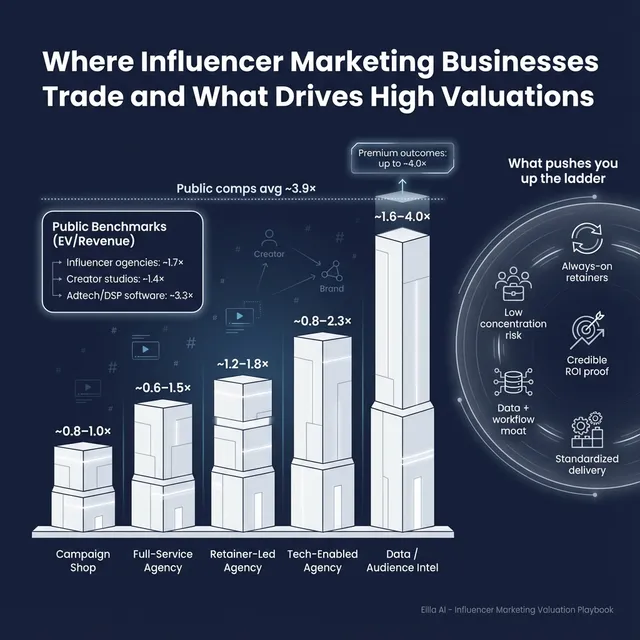
If you run an influencer marketing business and you might sell in the next 1-12 months, your valuation will be driven less by “how hot the creator economy is” and more by revenue quality, proof of impact, and how scalable your delivery engine really is.
This playbook is built for founders like you. It uses real market data to show what influencer marketing businesses actually sell for, what pushes multiples up or down, and what you can realistically do in 6-12 months to improve your outcome.
1. What Makes Influencer Marketing Unique
Influencer marketing businesses sit in an unusual middle ground between “agency services” and “software-like platforms.” Some companies are mostly managed services (campaign strategy, creator sourcing, production, reporting). Others look more like a marketplace or a workflow tool with a services layer. Most are a blend.
That blend is exactly what makes valuation tricky - and why buyers ask different questions than they would for a pure ad agency or a pure SaaS company.
The main business types buyers see in this sector
- Full-service influencer agencies: campaign ideation, creator matchmaking, contracts, production coordination, reporting.
- Platforms and marketplaces: self-serve discovery, workflow, payments, compliance, measurement - sometimes with managed services.
- Creator/talent and studio models: content houses, talent management, production monetization.
- Performance, affiliate, and social commerce hybrids: influencer plus trackable conversion and commission.
- Data and audience intelligence adjacencies: first-party signals, measurement, audience insights that sit “above” execution.
Unique valuation considerations
- Pass-through spend and gross margin optics: Many influencer businesses book creator fees or paid media as revenue. Buyers will normalize for what’s truly value-add vs pass-through.
- Repeatability vs one-off campaigns: Buyers pay more for recurring relationships and repeatable delivery, not “one great quarter.”
- Measurement credibility: If your results are hard to trust, buyers discount your revenue - even if it’s growing.
- Platform risk: Algorithm shifts, disclosure rules, and changes in creator economics can break fragile models fast.
Key risks buyers will always check
- Client concentration (one or two big logos driving the P&L)
- Brand safety and compliance (FTC/ASA-style disclosure, usage rights, contracts)
- Creator supply stability (are you dependent on a few “star” creators or a durable network?)
- Delivery scalability (does growth require linear headcount growth?)
- Data integrity (can you prove performance without “trust me” reporting?)
2. What Buyers Look For in an Influencer Marketing Business
Buyers care about the basics - growth, margins, retention - but in this category they translate those basics into a few very specific questions.
2.1 The strategic buyer lens (agencies, media groups, commerce platforms, adtech)
Strategic acquirers pay for one of three things:
- Capability expansion: “This instantly adds influencer to our offering.”
- Distribution: “We can sell this to our existing client base.”
- Data/tech advantage: “This improves measurement, targeting, or conversion.”
They will look hard at whether your offering is additive (new revenue streams) or duplicative (something they already do).
2.2 The private equity lens (and why it feels different)
Private equity buyers are usually underwriting a 3-7 year plan. Their valuation logic often comes down to:
- Entry multiple vs exit multiple: They want confidence they can sell later at an equal or higher multiple.
- Who the next buyer could be: a larger agency group, a marketing roll-up, a commerce platform, or (rarely) a public market story.
- Levers they expect to pull:
- Improve gross margin by tightening creator pricing and reducing pass-through leakage
- Standardize delivery to reduce “custom work”
- Add higher-margin services (creative, paid amplification, community management)
- Build a more recurring base (retainers, always-on creator programs)
- Bolt-on acquisitions (small agencies, niche platforms, creator networks)
If you can’t tell a believable story for how margins and revenue become more predictable, PE interest drops fast - even if top-line growth looks good.
3. What Buyers Look For in an Influencer Marketing Business
In plain English: buyers pay for reliable cash flow and lower risk, and they discount anything that looks volatile, founder-dependent, or hard to verify.
Here’s what they tend to prioritize most:
- Revenue that repeats: retainers, always-on programs, multi-quarter scopes, and strong renewal behavior.
- Proof that your work drives outcomes: not just reach and engagement, but conversion, lift, or measurable business impact (with credible methodology).
- A scalable operating model: growth that doesn’t require hiring 1 new person for every 1 new client.
- A differentiated “why you”: vertical specialization, unique creator access, proprietary workflows, or data-driven measurement.
- A durable go-to-market engine: inbound + outbound that doesn’t rely on the founder’s personal network.
- Healthy profitability (or a clear path): buyers like influencer, but they don’t like messy margins and cash surprises.
4. Deep Dive: Why Revenue Quality Matters More Here Than Almost Anywhere
Most influencer businesses can show a strong case study deck. Fewer can show predictable, repeatable revenue quality. That gap is one of the biggest drivers of valuation dispersion in this sector.
4.1 The core question buyers ask
“Is this a repeatable revenue engine, or a project shop that had a good year?”
Two companies can both do USD 10m in revenue. One sells at a strong multiple because it has recurring programs, durable client relationships, and measurable impact. The other sells cheap because revenue resets every quarter.
4.2 How this shows up in the market data
In the private market data for influencer-focused agencies, typical EV/Revenue outcomes cluster around ~0.9x median and ~1.3x average, with premium outcomes when the model looks more scalable and defensible. Meanwhile, software-like or data-moated marketing businesses can trade materially higher on revenue when buyers believe the revenue is higher quality.
In the “football field” logic from the data, a reasonable private-market band for a tech-enabled influencer agency tends to cluster around ~0.7x-2.3x revenue, with the high end requiring real proof of differentiation and/or profitability.
4.3 What “low-value” vs “high-value” revenue profiles look like
4.4 How to move right in 6-12 months
You don’t need to become a SaaS company. You need to make your services feel more predictable:
- Productize retainers (clear tiers, scope boundaries, add-ons)
- Build renewal triggers (quarterly business reviews, performance roadmaps)
- Tighten measurement (consistent definitions, third-party tools, clean attribution logic)
- Improve gross margin visibility (separate pass-through, show true contribution margin)
5. What Influencer Marketing Businesses Sell For - and What Public Markets Show
Here’s the honest takeaway from the data: there is no single “influencer marketing multiple.” Multiples vary massively based on how services-heavy vs tech-enabled you are, how profitable you are, and whether buyers see a defensible edge.
5.1 Private Market Deals (Similar Acquisitions)
At a sector level, precedent transactions show overall average EV/Revenue around ~1.3x and average EV/EBITDA around ~9.7x across the broader set of comparable marketing deals. Within influencer-focused agencies specifically, the data shows ~1.3x average EV/Revenue and ~0.9x median, with ~13.2x EV/EBITDA where EBITDA is meaningful and trusted.
A practical way to use the private data is to think in “model bands,” not exact numbers. Services-heavy agencies tend to anchor the lower-to-mid range. Tech-enabled, integrated, or data-differentiated models push higher.
Illustrative private market ranges by deal type (based on the provided deal set and clustering):
These are illustrative ranges, not a price tag. Your specific outcome depends on growth, margins, revenue quality, and risk.
5.2 Public Companies
Public market multiples matter because they set the “gravity” for valuation - even for private deals. Buyers won’t pay you a multiple that can’t be justified against comparable public alternatives, unless you are a scarce strategic asset.
Across the provided public comp groups, overall averages sit around ~3.9x EV/Revenue and ~22.2x EV/EBITDA - but influencer and services-heavy groups are meaningfully lower than software-like adtech.
How to use this as a founder:
- Treat public multiples as reference bands, not a direct valuation method for your business.
- Private companies are usually adjusted down for smaller scale, customer concentration, and key-person risk.
- But private deals can be adjusted up if you are truly differentiated (data, tech, distribution fit) or if competition among buyers gets intense.
6. What Drives High Valuations (Premium Valuation Drivers)
The data shows a consistent pattern: premium outcomes happen when buyers believe your revenue is more durable, more scalable, and more defensible than a typical agency.
Here are the valuation drivers that show up most clearly.
6.1 Integrated “360” capability that expands wallet share
Buyers pay more when you can own more of the social funnel - not just creator activation.
- Example: strategy + creator activation + creative production + paid amplification + community management
- What buyers want to see: % of clients buying multiple services, and whether that increases retention
6.2 Vertical focus where creators drive outsized budgets
Premium deals cluster in verticals like gaming and entertainment where creators are a primary distribution channel.
- What buyers want to see: clear vertical positioning, repeatable playbooks, and a vertical P&L that proves profitability
6.3 Technology and data embedded in delivery (not just a dashboard)
When measurement and workflow are truly integrated, buyers underwrite higher “revenue quality.”
- Examples: proprietary creator scoring, campaign forecasting, conversion tracking, rights management, payment automation
- What buyers want to see: switching costs (clients stick because your system becomes part of their workflow)
6.4 Credible synergy story for a strategic acquirer
Premium valuations often come from a clear synergy case:
- You unlock cross-sell into their client base
- Your creator network boosts their commerce or media product
- Your data improves their targeting, measurement, or monetization
6.5 Durable profitability (or a very clear path)
Across agency-style deals, strong EBITDA margins and earnings visibility tend to support higher EV/EBITDA outcomes and reduce deal risk.
- What buyers want: stable gross margin, disciplined delivery, and clean financial reporting
6.6 Deal structures that let you “earn into” upside
Earn-outs and performance-linked consideration are common when buyers believe in the upside but want proof.
- If you want upside, you need: pipeline visibility, believable forecasting, and clear performance definitions
6.7 “Boring but powerful” fundamentals
Even in influencer marketing, the basics matter:
- Clean financials and consistent revenue recognition
- Diversified customer base
- A leadership bench beyond the founder
- Documented processes (so the business survives the handover)
7. Discount Drivers (What Lowers Multiples)
This is where many influencer businesses get surprised. Buyers don’t discount you because influencer marketing is “risky.” They discount you because specific risk signals show up again and again.
Common discount drivers in this sector
- Project-based revenue with weak renewals: “We have to re-win the business every quarter.”
- Unclear performance measurement: if ROI is hard to validate, revenue feels fragile.
- High pass-through revenue with thin true gross margin: buyers pay for value-add, not money that flows through you.
- Client concentration: one big client equals one big valuation haircut.
- Creator concentration: a few creators account for the results, and they can leave.
- Founder dependence: founder sells, founder delivers, founder is the relationship.
- Volatile margins: pricing inconsistency, creator fee inflation, weak scope control.
- Compliance and brand safety gaps: unclear usage rights, disclosure sloppiness, weak contracting.
- No clear differentiation: if you’re one of many agencies, buyers behave like procurement.
The good news: most of these are fixable in 6-12 months if you prioritize the right few.
8. Valuation Example: A Fictional Influencer Marketing Company
This is a worked example to show how valuation logic works. The company and numbers are fictional. The multiples and ranges are illustrative, grounded in the market patterns in the provided data, not a formal valuation or investment advice.
8.1 The fictional company: “Beacon Influence”
- Revenue: USD 10.0m (fictional)
- Model: tech-enabled influencer agency (managed services with internal tooling)
- Mix: 65% retainers / always-on programs, 35% campaigns
- Gross margin (true, excluding pass-through): ~40%
- EBITDA margin: ~12% (USD 1.2m)
- Customer concentration: top client 14%, top 5 clients 42%
- Differentiation: strong measurement process and repeatable vertical playbook (e-commerce wellness)
8.2 Step 1 - Build a base range from comps
From the private and public clustering for services-led influencer models, a defensible base revenue multiple range is often ~0.7x-2.0x for a private agency-like business, with the upper end requiring proof of margin and repeatability.
That implies a starting EV range on USD 10m revenue of:
- 0.7x = USD 7m
- 2.0x = USD 20m
8.3 Step 2 - Triangulate with EBITDA (sanity check)
Agency-style deals in the data show EV/EBITDA outcomes that often land in the high single digits to low-to-mid teens when earnings are durable (and higher when the story is exceptional).
If Beacon Influence has USD 1.2m EBITDA:
- A 10x-14x EV/EBITDA lens implies USD 12m-17m EV
This triangulates nicely with the revenue range and helps you avoid over-anchoring to revenue alone.
8.4 Step 3 - Apply scenarios (same revenue, very different outcomes)
What this means for you:
- Two influencer businesses can both be “USD 10m revenue companies” and be worth 2-3x different amounts.
- The gap is rarely branding. It’s repeatability, measurement credibility, and risk.
9. Where Your Business Might Fit (Self-Assessment Framework)
Use this as a simple diagnostic. Give yourself a 0/1/2 score per factor:
- 0 = weak / not proven
- 1 = okay / mixed
- 2 = strong / proven and consistent
9.1 Scoring table
9.2 Interpreting your total
- Top band (mostly 2s): closer to the upper end of typical influencer agency ranges
- Middle band (mix of 1s and 2s): fair market outcomes, but you’ll need a strong process to push premium
- Lower band (many 0s): you may still sell, but you’re more likely to land in the lower end unless you fix the biggest risk flags first
The goal isn’t to “score high.” It’s to identify the 2-3 changes that will move valuation the most.
10. Common Mistakes That Could Reduce Valuation
10.1 Rushing the sale
If you start a process before your numbers, story, and risks are organized, buyers will set the narrative for you. And buyers default to conservative assumptions.
10.2 Hiding problems
Issues will surface in diligence anyway. When buyers find surprises late, they either:
- reduce price,
- add harsh terms (escrows, holdbacks, earn-outs),
- or walk away.
10.3 Weak financial records
In influencer marketing this is especially painful because pass-through costs, creator fees, and timing can make reporting messy.
- Clean up revenue recognition
- Separate pass-through from value-add
- Track gross margin by service line and client cohort
10.4 Not running a structured, competitive process (often with an advisor)
A structured competitive process tends to create more buyer competition and better terms. Industry research often shows that running a competitive process with experienced advisory support can materially increase purchase price - commonly cited around ~25% improvement vs single-buyer negotiations.
10.5 Revealing what price you’re after too early
If you tell a buyer “I want USD 10m,” you kill price discovery. You’ll often get offers clustered just above your number instead of what the market would have paid.
10.6 Influencer-specific mistakes that hurt value
- Over-reliance on vanity metrics: if your reporting is mostly reach and engagement, buyers assume the revenue is fragile.
- Loose rights and compliance discipline: unclear usage rights, disclosure gaps, and weak contracting create real legal risk - and buyers price that risk in.
11. What Influencer Marketing Founders Can Do in 6-12 Months to Increase Valuation
Think in three buckets: improve the numbers, improve revenue quality, and reduce buyer-perceived risk.
11.1 Improve revenue quality (the biggest multiple lever)
- Convert repeat clients into always-on retainers with clear tiers and add-ons
- Build a renewal system: quarterly business reviews, performance roadmaps, expansion offers
- Reduce concentration: target a plan where no single client is “make or break”
11.2 Improve margins without breaking delivery
- Separate pass-through cleanly and show true gross margin
- Standardize scopes and pricing so you stop “custom-building” every project
- Build reusable assets: creator briefs, templates, playbooks, production workflows
11.3 Make measurement feel credible
- Use consistent definitions for results (and document them)
- Improve attribution where possible (promo codes, tracked links, lift studies, platform integrations)
- Show performance by cohort: how clients perform and renew over time
11.4 Build a buyer-friendly operating model
- Reduce founder dependence: put senior leaders in front of key clients
- Document delivery and compliance processes
- Build a clean “data room” mindset early: contracts, creator agreements, rights, policies
11.5 Position for strategic value
- Clarify your “why you” in one sentence (vertical edge, creator access, measurement strength, commerce conversion)
- Build partnerships or integrations that matter to likely acquirers (commerce platforms, measurement tools, affiliate tracking, payments)
12. How an AI-Native M&A Advisor Helps
Selling an influencer marketing business is not just about finding “a buyer.” It’s about finding the right set of buyers - strategics who see synergies, and financial buyers who believe they can scale what you built. The more relevant buyers you reach, the more leverage you have in price and terms.
Higher valuations through broader buyer reach. AI can expand the buyer universe to hundreds of qualified acquirers based on deal history, strategic fit, and capacity. More relevant buyers creates more competition - and it also increases the chance the deal closes because you have options if one buyer drops.
Initial offers in under 6 weeks. AI-driven buyer matching and faster creation of marketing materials and diligence support can compress timelines dramatically, helping you reach initial conversations and offers far faster than manual-only outreach.
Expert advisory, enhanced by AI. The best outcomes come from strong positioning, clean numbers, and a process that holds buyers accountable. An AI-native approach pairs experienced human M&A advisors with AI workflows to deliver “Wall Street-grade” materials and execution without traditional bulge bracket costs.
If you’d like to understand how an AI-native process can support your exit, book a demo with one of our expert M&A advisors.
Are you considering an exit?
Meet one of our M&A advisors and find out how our AI-native process can work for you.


