
The Complete Valuation Playbook for Marketing Tech Businesses
A data-driven guide to how marketing tech businesses are valued today and what drives high multiples.

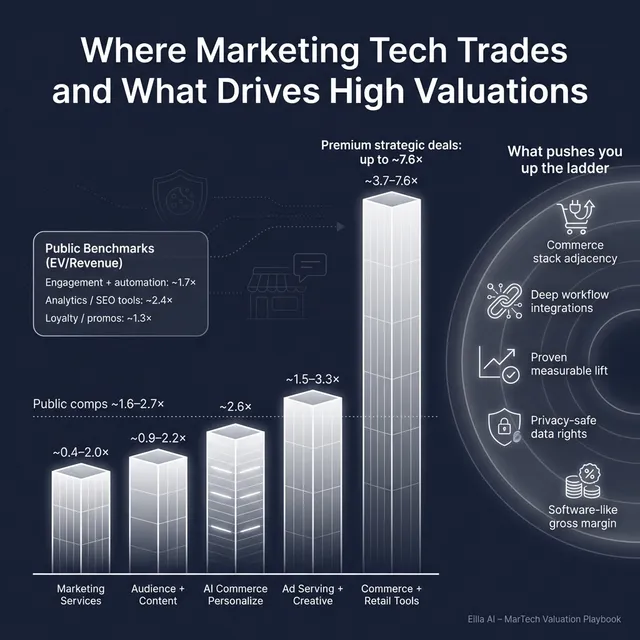
If you are considering a sale in the next 1-12 months, valuation is not just a number - it is the output of a buyer’s risk assessment, growth belief, and “strategic need” story.
Marketing Tech (MarTech) is in a phase where buyers are both picky and active: budgets are under scrutiny, privacy rules keep reshaping the data landscape, and many platforms are consolidating to offer “more in one place.” That mix creates big gaps between the businesses that get premium outcomes and the ones that get priced like commodity tools or agencies.
This playbook shows what MarTech businesses actually sell for (based on the deal data you provided), explains what pushes multiples up or down, and gives you a practical self-assessment plus a 6-12 month action plan to improve your exit odds and price.
1. What Makes Marketing Tech Unique
MarTech is not one industry - it is a family of business models that look similar on the surface (marketing software) but price very differently in M&A because the underlying economics and risks vary a lot.
The main types of MarTech businesses (and why they price differently)
Most privately held MarTech companies you’ll see in deal comps fall into a few buckets:
- Omnichannel engagement and automation SaaS (customer data, journeys, email/SMS, orchestration)
- Analytics, SEO, content, and product analytics tools (measurement, experimentation, insights)
- Adtech platforms (media buying, demand-side tools, ad serving, CTV, creative personalization)
- Commerce and retail enablement software (feeds, marketplaces, pricing, retail media tooling)
- Loyalty, promotions, and rewards platforms (software, managed programs, network-based rewards)
- Services-heavy marketing providers (performance marketing agencies, managed services)
These categories matter because buyers underwrite different “value engines”:
- Software value engine: recurring subscriptions + high gross margins + operating leverage.
- Network / take-rate value engine: revenue tied to media spend or transaction volume (often more cyclical).
- Services value engine: revenue tied to people and delivery capacity (usually lower multiples).
Unique valuation considerations in MarTech
- Revenue quality beats revenue size. Two businesses with the same revenue can get wildly different outcomes depending on how recurring, sticky, and scalable that revenue is.
- Data and privacy risk is valuation risk. If your performance depends on identifiers, third-party data, or fragile tracking methods, buyers haircut your multiple.
- “Where you sit in the stack” matters. Tools that become embedded in a larger platform (commerce, retail ecosystems, messaging channels) tend to attract more strategic bidding than nice-to-have point solutions.
- Gross vs net revenue definitions can confuse buyers. Especially in adtech or anything with pass-through spend, buyers will push hard to understand what portion of revenue is real value creation vs “money that flows through you.”
Key risk factors buyers will always check
- Customer concentration and budget exposure: Are you dependent on a few brands, one vertical, or one channel?
- Retention and expansion: Do customers renew and grow, or churn when budgets tighten?
- Attribution credibility: Can you prove impact without “hand-wavy” ROI claims?
- Data rights and compliance: Consent, privacy posture, vendor contracts, and data provenance.
- Platform dependency: Are you one API change away from revenue loss (Google, Meta, Shopify, Amazon, TikTok, etc.)?
- Implementation burden: If every deal requires heavy services, buyers price you more like an agency even if you call it SaaS.
2. What Buyers Look For in a Marketing Tech Business
Buyers typically fall into two groups: strategic acquirers (platforms and larger software companies) and financial buyers (private equity). They often want similar things, but the “why” differs.
The universal checklist
Buyers pay more when they believe:
- Your revenue is predictable (subscriptions, renewals, multi-year contracts).
- Your customers stick around (low churn) and spend more over time (expansion).
- Your margins are structurally strong (software-like gross margins, not labor-heavy delivery).
- You have believable growth that does not require heroic sales efforts.
- Your product is hard to replace because it is integrated into workflows or data pipelines.
- The business can run without you (team depth, repeatable process, clean reporting).
The industry-specific nuances that matter in MarTech
- Proof of incremental impact: Buyers want to see lift that is measurable and repeatable, not just “engagement improved.”
- Integration depth: Plug-ins are nice; being embedded in the buyer’s ecosystem is better.
- Channel resilience: If your results depend heavily on one ad platform or one tracking method, buyers price in volatility.
- Data advantage: Unique first-party data partnerships or defensible data assets can change the whole narrative.
- Revenue definition clarity: Especially in adtech and managed programs, clean separation of pass-through vs software revenue improves valuation confidence.
How private equity thinks about your valuation
Private equity usually asks three simple questions:
- What multiple am I paying today - and can I sell at the same or higher multiple later?They care about “exit multiple risk.” If you look like a fragile point solution or a services-heavy model, they assume the exit multiple could be lower.
- Who will buy this in 3-7 years?They want a believable set of future buyers: larger strategics, bigger PE funds, or a roll-up platform in your niche.
- What levers can I pull to improve earnings?Common PE levers in MarTech:
- Price increases and packaging
- Cross-sell into the customer base
- Reducing services delivery cost
- Improving retention and renewals process
- Building a more efficient sales engine
If your story includes clear levers and clean data, PE gets more comfortable paying up.
3. Deep Dive: The Most Important Valuation Nuance in MarTech - “Where You Sit in the Stack”
In MarTech M&A, one question quietly drives huge valuation differences:
Are you a “feature” or are you infrastructure?
A feature can be swapped. Infrastructure is embedded. Buyers pay very differently for those.
Why this matters (and how it shows up in the data)
The deal data shows premium outcomes when the target can be embedded into a broader platform and used to drive cross-sell, retention, or ecosystem lock-in. In your precedent set, commerce and retail-adjacent capabilities showed premium revenue multiples (for example, a commerce feed management platform acquired at ~7.6x revenue). In contrast, services-heavy or media-like models often transact closer to ~1.0-1.3x revenue on average. The market is telling you: the closer you are to “system-of-record” or “system-of-action,” the more strategic you become.
Why buyers care
Infrastructure-like MarTech:
- becomes a workflow dependency (hard to rip out)
- creates data gravity (your platform becomes the place where customer data, audiences, or decisions live)
- improves the buyer’s attach rate (bundling into a suite)
- reduces churn (switching costs rise when integrations are deep)
Feature-like MarTech:
- is easier to replicate
- can be competed away on pricing
- is often discretionary spend
- creates weak switching costs
How to move from “feature” to “infrastructure” in 6-12 months
You don’t need to rebuild your product. You need to change what you can prove.
Practical moves:
- Deepen 2-3 integrations that customers depend on daily (CRM, commerce platform, ad platforms, data warehouse).
- Create measurable workflow dependence: dashboards that drive decisions weekly, automated actions, approval flows, alerts, or budget controls.
- Package around a business outcome, not a tool: “Increase repeat purchase rate” beats “better segmentation.”
- Make switching painful (ethically): better data history, better reporting continuity, better automation rules.
Mini-table: lower-value vs higher-value profile
4. What Marketing Tech Businesses Sell For - and What Public Markets Show
Here’s the clean way to read multiples: public markets set a reference band, private deals show what buyers actually paid, and your company’s profile determines where you land inside (or outside) those bands.
A major trap: founders anchor to the highest multiple they see. A better approach: start with the “core” cluster for your subsector, then adjust based on premium and discount drivers.
5. What Marketing Tech Businesses Sell For - and What Public Markets Show
5.1 Private Market Deals (Similar Acquisitions)
Your precedent transactions show clear clustering by business model:
- Software/Platforms tied to commerce enablement: higher revenue multiples, especially when the capability is a strategic bolt-on.
- Ad serving / creative personalization software: a broad range, with some deals showing high headline EBITDA multiples (often influenced by deal structure).
- Audience intelligence / content promotion platforms: generally lower revenue multiples, with EBITDA multiples often more relevant.
- Performance marketing agencies / services: lower revenue multiples on average, closer to “services math.”
A simple way to interpret the private deal landscape from your dataset:
Important: these are illustrative ranges based on your dataset, not rules. But the pattern is consistent: software and platform adjacency raise multiples; services and spend-linked models compress them.
5.2 Public Companies
Public markets (as of mid-to-end 2025) show a similar pattern: categories with more software-like predictability and stronger margins generally trade higher than spend-linked or cyclical models.
From your grouped public multiples:
A reality check: some individual public names in your table trade around ~2-3x revenue in engagement SaaS, while others are much lower. That dispersion is your reminder that “MarTech” is not one multiple.
How to use public multiples as a founder
Use public multiples as a reference band, not a price tag.
- Adjust down for smaller scale, customer concentration, weak retention, or messy financial reporting.
- Adjust up (sometimes) when your asset is scarce and strategically important (for example, a commerce/retail-adjacent capability that unlocks distribution or bundling).
- Remember that public markets can swing on sentiment. A buyer in M&A will focus more on what your cash flows could look like and how risky those are.
6. What Drives High Valuations (Premium Valuation Drivers)
Below are the premium drivers that show up in your deal set, combined with the buyer logic behind them. Think of these as the “headline multiple unlockers.”
6.1 Strategic adjacency to commerce and retail ecosystems
When your product can be embedded into a broader commerce or retail stack, strategic buyers pay more because it helps them:
- cross-sell into a bigger base
- increase platform stickiness
- lock in merchants or brands through integrations
In your dataset, commerce enablement platforms achieved premium revenue multiples when they were clearly “infrastructure” for selling across channels (product feeds, retail media tooling, or commerce-adjacent performance systems).
Founder takeaway: if you can credibly say, “Our product increases outcomes for merchants and becomes part of their daily revenue engine,” buyers listen differently.
6.2 Channel dominance or platform-specific specialization
Specialization around a high-intent channel can be valuable because it puts you in a critical “go-to-market surface area.” Your data includes platform-specific automation (for example, tied to a major messaging channel) as a theme.
This is not about being “multi-channel.” It’s about being essential in one channel where budgets flow.
Founder takeaway: “We are the best tool for X channel” is often stronger than “we support all channels” unless you are truly the decisioning layer across them.
6.3 Deal structures that support higher headline pricing (earn-outs, deferred consideration)
Several deals in your dataset show contingent consideration: earn-outs, milestone payments, deferred payments, escrows. This matters because it often allows buyers to pay a higher headline multiple while protecting downside.
Founder takeaway: a higher multiple with a big earn-out is not the same as a higher multiple in cash. But if you have strong momentum, earn-outs can be a smart way to get paid for future upside.
6.4 Clean earnings quality - especially when revenue definitions are messy
In models where gross vs net revenue is confusing (common in adtech or managed models), sophisticated buyers often anchor on EBITDA and cash conversion.
Your dataset explicitly highlights cases where top-line is “noisy” but EBITDA conversion is strong, and buyers still paid up on earnings.
Founder takeaway: clarity wins. Clean revenue definitions, strong gross margins, and credible profitability make buyers comfortable paying more.
6.5 Extremely high gross margins signaling software-like economics
Your premium driver set calls out that the highest strategic multiples cluster around businesses reporting ~92-100% gross margins - a strong signal of software/data-heavy delivery rather than media pass-through or labor-heavy services.
Founder takeaway: if your gross margin is truly software-like and stays that way as you scale, incremental revenue becomes much more valuable to a buyer.
6.6 “Basics that unlock trust” (not always in the data, always in deals)
Even if not in your dataset as labeled drivers, these consistently support premium outcomes:
- Clean financials and predictable reporting
- Diversified customers and low churn
- A leadership bench that can run the business post-close
- Security, privacy, and compliance readiness
- A crisp narrative of why you win (and against whom)
7. Discount Drivers (What Lowers Multiples)
Discounts happen when buyers see uncertainty, fragility, or hidden work. In MarTech, the most common “multiple killers” are predictable.
7.1 Revenue that looks bigger than it really is
If your revenue includes pass-through media spend, contractor-heavy delivery, or one-time implementation work, buyers will reframe your business as lower-quality revenue.
What to do: separate recurring software revenue from services and pass-through clearly, and report gross margin by revenue type.
7.2 Customer churn or “budget elasticity”
If customers cancel or downsize quickly when budgets tighten, buyers price you like discretionary spend.
What to do: show retention by cohort, prove expansion, and build renewal motion that is not founder-dependent.
7.3 Platform dependency risk
If an API change, policy update, or attribution shift could break your value proposition, buyers apply a risk discount.
What to do: diversify channels, build first-party measurement, and document your technical contingency plans.
7.4 Services-heavy delivery disguised as SaaS
If you need a lot of humans to deliver results, your gross margin and scalability won’t look like software, and buyers will pay closer to services multiples (your dataset’s services segment averages around ~1.3x revenue).
What to do: productize delivery, standardize onboarding, and show that margins improve as revenue grows.
7.5 Weak financial reporting and unclear KPIs
If your numbers are messy, buyers assume problems exist even if they don’t. That reduces bids and increases earn-outs.
What to do: monthly reporting, clean revenue recognition, clear gross margin, and a tight KPI set (retention, expansion, CAC payback explained simply, churn, pipeline coverage).
7.6 Customer concentration
A few big customers can be great - until one leaves during diligence.
What to do: show concentration trends improving, build mid-market breadth, and strengthen contracts.
8. Valuation Example: A Marketing Tech Company
This example is fictional. The company and the USD 10m revenue number are made up. The valuation ranges and multiples are illustrative, meant to show how the logic works - not investment advice or a formal valuation.
Step 1: The logic
- Start with the most relevant public comps (software-like MarTech clusters, not media buying or services).In your source logic, the most relevant public SaaS bands suggest roughly ~1.6x-2.7x revenue for a typical MarTech SaaS profile at this stage/scale.
- Cross-check with relevant private software deals.Your private dataset shows a “core” software signal around ~1.5x-3.3x revenue, with a strong data point at ~2.6x, and a higher band ~3.7x-4.0x for more mature commerce enablement platforms (with one premium outcome much higher, tied to strong strategic adjacency).
- Choose a base multiple range based on how infrastructure-like the business is, plus growth, retention, and gross margin quality.
- Apply premium or discount adjustments based on what a buyer will believe - not what you hope.
Step 2: Apply it to a fictional company
Meet SignalSpring (fictional):A SaaS platform for D2C brands that automates lifecycle marketing decisions (segmentation, offer testing, channel orchestration) and plugs into Shopify, a major ESP, and a data warehouse. Revenue is USD 10m, mostly subscription. Gross margin is high. Growth is solid but not category-leading.
We’ll use a simple range derived from your provided logic:
- Core MarTech SaaS band: ~1.8x-3.2x revenue (this matches the “suggested valuation range” logic you provided: USD 18-32m on USD 10m revenue)
- Reserve higher bands (3.7x-4.0x+) for truly strategic, at-scale platforms with clear ecosystem lock-in.
Now three scenarios:
What drives each scenario?
- Discounted case (USD ~13-18m): churn is high, services are required for results, attribution is hard to prove, or revenue includes pass-through.
- Base case (USD ~18-32m): software-like revenue, decent growth, reasonable retention, clean reporting, no major red flags.
- Premium case (USD ~37-45m): strong ecosystem adjacency (commerce/retail), deep integrations, measurable lift, and a product that a larger platform can embed and cross-sell.
Step 3: What this means for you
Two MarTech businesses with USD 10m revenue can legitimately be worth 2-3x apart because buyers are not paying for your past - they are paying for:
- how confident they are in future cash flows
- how sticky your product is
- how “strategically necessary” you are to them
Your job in the next 6-12 months is to reduce doubt and increase strategic pull.
9. Where Your Business Might Fit (Self-Assessment Framework)
This is not a scientific score. It is a tool to help you identify where improving one or two things could change your valuation story meaningfully.
Score each factor 0 / 1 / 2:
- 0: weak or unclear
- 1: decent but not best-in-class
- 2: strong and provable
Self-assessment table
How to interpret your score
- Mostly 2s in High Impact: you are closer to premium outcomes (and more buyers will compete).
- Mix of 1s and 2s: you are in the fair market core range - process quality and positioning will matter a lot.
- Many 0s in High Impact: you may still sell, but expect more structure (earn-outs) and lower multiples unless you fix the biggest risks.
The goal is not to “score high.” The goal is to find the one or two improvements that buyers will reward most.
10. Common Mistakes That Could Reduce Valuation
10.1 Rushing the sale
If you start a process before your numbers and story are ready, buyers set the anchor low. Even if you improve later, you often don’t fully recover.
Fix: prepare 6-8 weeks before outreach: clean reporting, KPI dashboard, customer story, product positioning, and pipeline narrative.
10.2 Hiding problems
Due diligence is designed to find issues. When buyers discover you hid something, they assume there is more you are hiding. That destroys trust and value late in the process.
Fix: disclose issues early with a plan. “Here’s the problem, here’s what we did, here’s the trend” is far better than surprises.
10.3 Weak financial records
Messy financials force buyers to price in uncertainty. In MarTech, the biggest issue is often unclear revenue types (subscription vs services vs pass-through) and unclear gross margin.
Fix: separate revenue streams, report gross margin by stream, and show retention and churn clearly.
10.4 No structured, competitive sale process
A structured process increases competition. Competition increases price. Research often cited in M&A practice suggests that running a structured, competitive process with an advisor can meaningfully improve purchase price (often referenced around ~25% uplift), mainly because it improves buyer reach, narrative discipline, and negotiating leverage.
Fix: run a real process with timelines, materials, and multiple buyer lanes - not one-off conversations.
10.5 Revealing your price too early
If you tell buyers “we want USD 10m,” you cap price discovery. Many buyers will come back with USD 10.1m or USD 10.2m instead of their true willingness to pay.
Fix: let the market speak first. Your job is to create enough demand that buyers compete.
10.6 MarTech-specific mistake: weak proof of lift
If you can’t prove incremental impact, you become a “nice-to-have tool.” Nice-to-have tools get discounted.
Fix: build 2-3 crisp case studies with baseline vs post, control groups where possible, and retention outcomes.
11. What Marketing Tech Founders Can Do in 6-12 Months to Increase Valuation
You don’t need a reinvention. You need to reduce perceived risk and strengthen the reasons buyers pay up.
11.1 Improve the numbers buyers trust most
- Retention and expansion: tighten renewal motion, measure churn by cohort, and focus on expansion paths.
- Gross margin quality: productize delivery and reduce services dependency; show margin durability.
- Revenue clarity: separate subscription vs services vs pass-through and standardize reporting monthly.
11.2 Increase “stickiness” through integrations and workflow dependence
- Build or deepen 2-3 integrations that customers truly rely on (CRM, commerce, data warehouse, messaging, billing).
- Reduce time-to-value and onboarding time.
- Add automation features that become part of weekly operations (alerts, decisioning, budget shifts, approvals).
This directly aligns with the premium driver theme of platform adjacency and infrastructure positioning.
11.3 Strengthen proof of ROI (without hype)
- Create a standard measurement approach: what you lift, how you measure it, and how you avoid attribution fluff.
- Build a short library of repeatable proof points: conversion lift, retention lift, repeat purchase, CAC efficiency (explained simply).
11.4 Reduce platform and privacy risk
- Diversify any single-channel dependency.
- Document compliance posture and data rights.
- Build resilience plans for API changes and attribution shifts.
11.5 Prepare your “deal narrative” like a buyer will hear it
In a sale, the narrative is not “we are great.” It is:
- what category you are in
- why you win
- why you are hard to replace
- why now is the right time to buy you
- what a buyer can do with you that you can’t do alone (distribution, bundling, cross-sell)
11.6 Build optionality (more buyers, more leverage)
Even if you think you have a perfect buyer, don’t bet the company on one conversation. The best outcomes come from competitive tension.
12. How an AI-Native M&A Advisor Helps
Selling a MarTech business is as much about process quality and buyer reach as it is about your fundamentals. An AI-native advisor can improve outcomes by combining disciplined M&A execution with a much broader, more targeted buyer search.
First, higher valuations through broader buyer reach: AI can expand the buyer universe to hundreds of qualified acquirers based on deal history, synergy fit, financial capacity, and other signals. More relevant buyers means more competition, stronger offers, and a higher chance your deal closes even if one buyer drops out.
Second, initial offers in under 6 weeks: AI-driven buyer matching and connecting, rapid creation of marketing materials, and structured diligence support can compress timelines versus manual-only processes - helping you reach initial conversations and offers faster while staying organized.
Third, expert advisory enhanced by AI: you still want experienced human M&A advisors running the process, framing the story, and negotiating. The difference is you can get Wall Street-grade materials, buyer credibility, and deal positioning without traditional “bulge bracket” costs - because AI takes the heavy lifting out of research, targeting, and repetitive execution work.
If you’d like to understand how our AI-native process can support your exit, book a demo with one of our expert M&A advisors.
Are you considering an exit?
Meet one of our M&A advisors and find out how our AI-native process can work for you.


