
The Complete Valuation Playbook for Online Marketplace Businesses
A guide to how online marketplace businesses are valued and what drives high multiples.

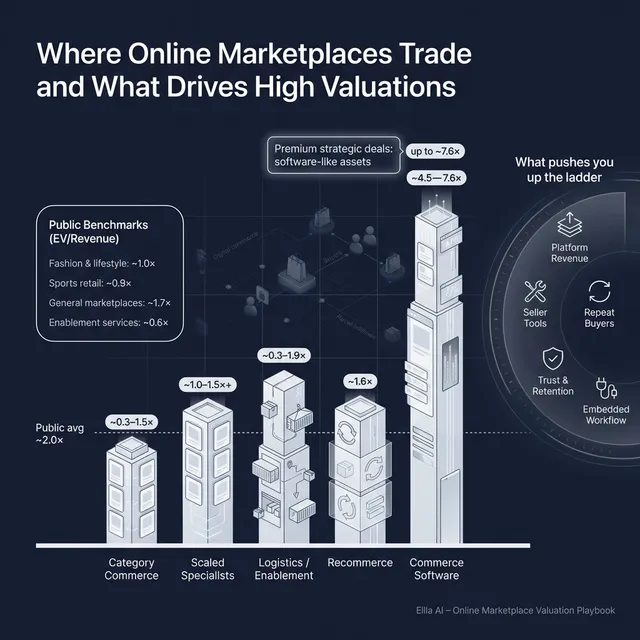
If you run an online marketplace business and are thinking about a sale in the next 1-12 months, valuation is not just a finance exercise. It is a story about how buyers see your growth, your margins, your customer behavior, your supply and fulfillment model, and the durability of your position in the market.
This matters right now because online commerce is in a more selective phase. Buyers still pay strong prices for the right assets, but they are more disciplined than they were a few years ago. They want scale, proof, and a clear reason why your marketplace deserves to keep winning.
This guide is built to help you do three things: understand what online marketplace businesses actually sell for, see what pushes multiples up or down, and work out where your business may fit - plus what you can do over the next 6-12 months to improve the outcome.
1. What Makes Online Marketplace Businesses Unique
Online marketplace businesses sit in a wide spectrum. Some are generalist marketplaces with broad product catalogs. Some are category-led specialists in fashion, sporting goods, home, or electronics. Some are resale and recommerce platforms. Others are hybrid models that blend marketplace economics with first-party inventory, fulfillment, brand services, or software layers.
That is why valuation in this sector is tricky. Two businesses can both call themselves "marketplaces" and still deserve very different multiples. A platform that mainly connects buyers and sellers with high gross margins, low working capital needs, and strong network effects will usually be valued very differently from a merchant-heavy business that owns inventory, handles returns, and operates more like a retailer.
Buyers will always look hard at where your economics really come from. Do you make money from take rates, subscriptions, seller services, ads, payments, fulfillment, or product margins? The more your revenue looks recurring, scalable, and embedded in a workflow, the more attractive it tends to be. The more it depends on buying stock, managing markdown risk, and absorbing returns, the more the valuation tends to look like retail.
They will also check a few sector-specific risks every time. These usually include customer acquisition efficiency, repeat order behavior, return rates, fulfillment quality, supplier or seller concentration, category concentration, cross-border complexity, fraud and trust issues, and whether your brand or traffic is overly dependent on paid channels.
2. What Buyers Look For in a Online Marketplace Business
At a basic level, buyers want the same things they want in most deals: scale, growth, margin, and predictability. But in online marketplaces, they care just as much about the quality of the growth. They want to know whether your growth is driven by a genuine market position or by expensive marketing and temporary promotions.
They also care about what kind of marketplace you really are. If your business has strong seller depth, repeat buyers, healthy gross margins, and multiple ways to monetize the customer relationship, that is a better story than a business that mainly wins by discounting products and pushing volume through logistics. In plain English: buyers pay more for durable economics than for raw sales volume alone.
Another major question is whether your business is becoming more valuable as it scales. In a strong marketplace, scale can improve liquidity, trust, data quality, merchandising, and marketing efficiency. In a weaker one, scale can simply increase operational complexity, returns, customer service costs, and working capital strain. Buyers spend a lot of time figuring out which one you are.
How private equity thinks about your business
Private equity buyers usually ask three simple questions.
First, what multiple are they paying to get in, and what multiple could they sell at in 3-7 years? If they buy a business that looks like a low-margin retailer, they will assume a more modest exit. If they buy one that is moving toward higher-margin platform or enablement economics, they may underwrite a better exit.
Second, who could buy the business from them later? Possible future buyers include strategic acquirers, larger private equity firms, or sometimes public markets. A business with a broad buyer universe is usually more valuable than one that only appeals to a narrow set of acquirers.
Third, what levers can they pull after closing? They may see room for pricing changes, better take rates, improved seller monetization, less paid marketing dependence, better fulfillment economics, smarter returns handling, geographic expansion, add-on acquisitions, or tighter overhead control. If buyers can clearly see those levers, they are often willing to pay more.
3. Deep Dive: Marketplace Economics vs Retail Economics
This is one of the biggest valuation questions in the whole sector: are you being valued as a true marketplace, or as an online retailer with some marketplace features?
The data makes this point very clearly. The highest revenue multiples in your source set do not come from traditional low-margin merchants. They come from software-like and infrastructure-like commerce businesses with very high gross margins and an embedded role in the commerce stack. By contrast, most retail-led and merchant-led online commerce businesses trade and transact in much lower bands.
Why do buyers care so much about this distinction? Because it changes almost everything. Marketplace and software-like revenue is usually lighter, more scalable, and less exposed to inventory and markdown risk. Retail-led revenue usually requires more working capital, carries more returns risk, and produces lower gross margins. A buyer can accept those economics, but they generally will not pay a software-style multiple for them.
This does not mean merchant-heavy businesses are unattractive. It means you need to be honest about what you are. A scaled, profitable, well-run category specialist can still command a strong valuation. But the premium story usually appears when you add defensible platform characteristics on top of commerce volume - for example seller tools, data feeds, fulfillment services, payment services, advertising, or embedded workflows that make the platform harder to replace.
A simple way to think about it is this:
If your business looks more like the left side today, the path is not to reinvent the company overnight. It is to start proving that you can layer in higher-quality revenue streams and stronger retention. Even modest progress here can change the way buyers frame the deal.
4. What Online Marketplace Businesses Sell For - and What Public Markets Show
Here is what the data actually shows: most online marketplace and online retail businesses do not trade at extreme revenue multiples. The range is wide because the sector includes everything from low-margin general merchants to higher-quality specialist platforms and software-like commerce infrastructure businesses.
The cleanest way to use the data is to separate merchant-led marketplace businesses from software-like commerce infrastructure businesses. That helps you avoid one of the biggest mistakes founders make - comparing a retail-style business to a much higher-quality platform or data-infrastructure asset.
4.1 Private Market Deals (Similar Acquisitions)
In the private deal data, the overall average EV/Revenue multiple is 1.5x and the median is 0.7x. The overall average EV/EBITDA is 10.7x and the median is 9.5x. That already tells you something important: the headline average is pulled up by a few better assets, while many ordinary deals still happen in a much lower range.
For online marketplace founders, the most relevant private deal buckets show three broad patterns. First, category-led online retail and commerce businesses often transact around sub-1.0x to low-1.0x revenue, with stronger assets stretching higher. Second, logistics, enablement, and fulfillment-heavy businesses often sit lower unless they have unusual scale or strategic importance. Third, software-like commerce infrastructure assets can command meaningfully higher revenue multiples because buyers view them more like recurring infrastructure than like retail.
The key message is that private market buyers do pay up - but usually only when the business has something beyond standard merchant economics. Scale, profitability, category leadership, embedded distribution, and a more platform-like revenue mix all matter. These ranges are illustrative, not a guaranteed price list.
4.2 Public Companies
The public company data shows the same basic pattern. Overall, the group averages around 2.0x EV/Revenue and 15.4x EV/EBITDA, but the medians are much lower at 0.8x EV/Revenue and 7.5x EV/EBITDA. That gap matters. It means a small number of larger or structurally better businesses lift the average, while the typical public market reference point is more modest.
As of mid to late 2025, the public group breaks down roughly like this:
*That EBITDA figure is distorted by low-profit or near-breakeven businesses, so revenue multiples are often more useful there.
Founders should use public multiples as a reference band, not as a direct price tag. Public companies are larger, more liquid, and easier to benchmark than private companies. So a smaller private business is usually adjusted downward for size, growth risk, customer concentration, and execution risk.
That said, there are exceptions. If your company is scarce, highly strategic, category-leading, or clearly moving toward platform-like economics, buyers may pay above what a simple public comp exercise would suggest. But you need facts to support that story.
5. What Drives High Valuations (Premium Valuation Drivers)
Premium outcomes usually come from a small number of themes showing up together. Buyers do not pay more just because a founder says the business is strategic. They pay more when the business clearly has better economics, stronger defenses, and more future options than the average company in the sector.
5.1 Platform-like economics inside a commerce business
This is the biggest one. The strongest revenue multiple premiums in the data appear when the business looks more like infrastructure than like retail. High gross margins, scalable data or software layers, and embedded tools for merchants or enterprise users make buyers much more comfortable underwriting future cash flow.
In practice, this could mean seller software, catalog and feed management, data syndication, payments, ad products, or fulfillment tools sold as services. Instead of only making money when a product is sold, you are also monetizing the infrastructure around the transaction.
5.2 Deep workflow integration and switching costs
Buyers pay more when leaving your platform would be painful. In the source data, the clearest premium examples come from businesses that are deeply embedded in customer workflows or enterprise distribution networks.
That could mean your marketplace is tied into seller operations, product data, enterprise procurement, dealer networks, or other mission-critical processes. If customers rely on you every day, and replacing you would disrupt operations, buyers see more durable value.
5.3 Strategic geographic reach that is actually useful
Geographic breadth can help, but only if it is real and defensible. Shipping globally is not the same as having a true cross-border operating advantage. The data suggests that international coverage supports value when it comes with logistics capability, customer demand, local partnerships, or embedded regional strength.
For founders, that means "we sell in 50 countries" is not enough on its own. "We have repeat buyers, localized operations, proven cross-border fulfillment, and real seller liquidity across key regions" is a much stronger story.
5.4 Clear room for post-deal upside
Some buyers will pay a stronger headline multiple when they believe the next stage of value creation is obvious. That can include monetizing sellers more effectively, improving take rates, expanding into adjacent categories, fixing returns economics, or using the platform to add services.
In some cases, that premium shows up through deal structure rather than just cash at close. Earn-outs and milestone payments can support a higher headline valuation when the buyer is paying for upside but wants to share some execution risk with the seller.
5.5 Strong operational proof at scale
Scale by itself is not enough. Buyers want proof that your operating machine works. That includes healthy fulfillment, controlled return rates, improving repeat behavior, stable margins, and a business that does not fall apart when paid marketing gets less efficient.
If you can show that your operations improve as you grow, you move toward the top of the valuation range. If scale simply creates more complexity and thinner economics, the market notices that too.
5.6 Clean, credible company building
Some premium drivers are not glamorous, but they matter a lot. Clean financials, clear monthly reporting, consistent KPI tracking, diversified customers and sellers, low founder dependency, and a leadership bench that can run the business after a sale all make buyers more confident.
Confidence matters because valuation is partly a risk decision. When a buyer feels they understand the business and can trust the numbers, they are more willing to stretch.
6. Discount Drivers (What Lowers Multiples)
Most low-end outcomes are not caused by one fatal flaw. They happen when several smaller weaknesses stack up: lower-quality revenue, more execution risk, less proof, and a harder diligence process.
The biggest discount driver in this sector is merchant-style economics without a strong strategic edge. If gross margins are thin, returns are high, and the business depends heavily on inventory turns and promotions, buyers usually keep the valuation anchored closer to retail-style ranges.
Another common issue is growth that looks expensive or fragile. If the company relies heavily on paid traffic, discounting, one channel, or one seller relationship, buyers worry that revenue could soften as soon as ownership changes. That tends to lower both the multiple and the certainty of closing.
Customer and seller concentration also hurts. A marketplace should generally feel broad, liquid, and resilient. If too much volume comes from a handful of sellers, a single category, or one geography, buyers will see that as a structural weakness.
Operational messiness is another major discount. Poor cohort data, weak SKU-level margin visibility, inconsistent revenue recognition, unclear returns accounting, and fuzzy fulfillment metrics make buyers assume the risks are worse than management says. In M&A, confusion usually gets priced as downside.
Finally, founder dependence lowers value. If relationships, pricing decisions, merchandising, supplier ties, and key hires all run through you personally, buyers worry about transition risk. They do not just buy the company - they buy the ability of the company to keep performing after you step back.
7. Valuation Example: A Online Marketplace Company
Let’s make this practical with a fictional company called Northlane Outdoors Marketplace.
This company is fictional. Its USD 10m revenue level is fictional too. The goal here is only to show how valuation logic works for a private online marketplace business.
Northlane is a category-led online marketplace in outdoor and sporting goods. It has a mix of marketplace and merchant revenue, decent profitability, healthy repeat purchasing, and growing seller participation. Gross margin is better than a pure merchant business, but it is still not a software company. So the right valuation lens is still mostly revenue multiples, cross-checked with EBITDA multiples.
Step 1: How the logic works
First, pick the right comp set. For Northlane, the relevant public and private references are category-led online commerce businesses and specialist online retailers, not software-style commerce infrastructure businesses trading at much higher revenue multiples.
Second, narrow to a realistic core range. The source data for specialist online retail and category-led e-commerce points to a rough private and public zone centered around sub-1.0x to low-1.0x revenue, with stronger businesses stretching above that.
Third, adjust for premium and discount factors. If Northlane has stronger repeat demand, better margins, broader seller depth, and cleaner marketplace economics than the average specialist retailer, it can justify moving up the range. If it has weaker margins, higher returns, and heavier merchant exposure, it should sit lower.
Fourth, sanity check using EBITDA. If the revenue outcome implies an EBITDA multiple that feels far too aggressive for a business with ordinary retail economics, the valuation likely needs to come down.
Step 2: Apply it to the fictional company
Assume Northlane has:
- USD 10m revenue
- 12% EBITDA margin
- Healthy but not elite growth
- Good category focus
- A mix of marketplace fees and merchant sales
- No single dominant seller
- Reasonable fulfillment performance
A sensible illustrative framework might look like this:
Why those ranges?
The discounted case fits a business that still looks mostly like an online retailer - thin margins, higher return complexity, more paid traffic dependence, and limited strategic differentiation.
The core range fits a well-run specialist marketplace business with decent scale, believable retention, reasonable profitability, and a clean operating story.
The premium case requires more than just growth. It assumes Northlane has stronger marketplace characteristics: better gross margin, better repeat demand, more seller and customer stickiness, less inventory risk, and some platform-like monetization beyond basic product sales.
Step 3: What this means for founders
Two companies with the same USD 10m of revenue can be worth very different amounts. One might be worth USD 8m. Another might be worth USD 17m. The difference is not just sales - it is the quality of those sales.
That is the whole point of valuation in this sector. Buyers are not only paying for what your marketplace did last year. They are paying for what they believe it can keep doing, how risky that looks, and whether the business is becoming more valuable as it scales.
This is a worked example, not investment advice and not a formal valuation.
8. Where Your Business Might Fit (Self-Assessment Framework)
Here is a simple way to pressure-test your likely position in the valuation range. Score each factor from 0 to 2.
- 0 = weak
- 1 = acceptable
- 2 = strong
Be honest. The goal is not to feel good. The goal is to identify what would matter most before a sale.
A rough way to read the score:
This is not a formula. It is a practical screen. If your score is middling, the good news is that you usually do not need a full transformation to improve value. Often, a few targeted improvements can change the buyer conversation materially.
9. Common Mistakes That Could Reduce Valuation
The first mistake is rushing the sale. Founders sometimes decide to sell, send a few numbers around, and hope a buyer will "see the potential." That rarely works well. If the numbers are not prepared, the story is fuzzy, and the process is loose, buyers take advantage of that uncertainty.
The second mistake is hiding problems. Returns issues, customer concentration, a margin dip, weak retention in one cohort, or a major seller relationship risk will almost always come out in diligence. If you hide it, the buyer stops trusting you. That usually costs more value than the problem itself.
The third mistake is weak financial records. In this sector, buyers want a clear bridge from orders to revenue to gross profit to EBITDA. They want to understand returns, logistics costs, contribution by category, and how customer behavior is trending. If you cannot show that cleanly, your business looks riskier than it may really be.
The fourth mistake is running an unstructured process. Research cited by Axial says working with an M&A advisor can increase sale price by about 6%-25%, largely because advisors expand buyer coverage, create competitive tension, and run a more disciplined process. (Axial) In practice, that matters because a structured competitive process often creates better offers, better terms, and more fallback options if one buyer drops.
The fifth mistake is revealing the price you want too early. If you tell buyers you want USD 10m, many of them will anchor around that number. You kill price discovery. Instead of learning that one buyer might have paid USD 13m or USD 15m, you may end up with offers clustered at USD 10.1m and USD 10.2m.
A sector-specific mistake is failing to separate marketplace economics from merchant economics in your story. If your higher-margin seller services, ad revenue, payment revenue, or platform fees are buried inside a generic sales presentation, buyers may value the whole business like a standard online retailer.
Another sector-specific mistake is ignoring returns and fulfillment quality until diligence. In online commerce, buyers know that a weak returns profile can quietly destroy value. If you have not measured it cleanly by category, customer type, and channel, you are leaving a major risk unanswered.
10. What Online Marketplace Founders Can Do in 6-12 Months to Increase Valuation
10.1 Improve the numbers buyers care about most
Start with gross margin quality, repeat behavior, and EBITDA quality. If you can improve category mix, reduce return-heavy SKUs, tighten pricing, and lower fulfillment leakage, that shows up directly in valuation.
Also clean up how you report the business. Break out marketplace fees, merchant revenue, ads, payments, and any service revenue clearly. If some revenue is structurally better than the rest, make it visible.
10.2 Reduce obvious risk
Work on channel concentration, seller concentration, and founder dependence. If one seller, one geography, or one traffic source matters too much, buyers will discount that hard.
Document the business better. Build a management reporting pack that shows revenue by category, repeat order behavior, margins, returns, and fulfillment performance every month. Buyers love proof.
10.3 Move the story toward platform value
You probably do not have time for a massive strategic pivot before a sale. But you may have time to prove some higher-quality layers. That could mean launching seller tools, improving ad monetization, creating premium services, deepening integrations, or tightening recurring seller relationships.
Even small steps matter if they prove the business is not just pushing product volume. Buyers pay more when they can see the company becoming more embedded and more scalable.
10.4 Build a stronger deal narrative
The best sale processes are not just about numbers. They explain why your marketplace wins, why that position is durable, and why a buyer can own the next chapter successfully.
That means being able to answer simple questions well: Why do customers come back? Why do sellers stay? Why are your margins what they are? What gets better as the business scales? Why is this a strategic asset and not just another online merchant?
10.5 Prepare for diligence before buyers ask
Do not wait until a buyer sends a long diligence list. Prepare now. Clean up legal documents, cap table issues, commercial agreements, KPI definitions, tax matters, and employment arrangements.
The smoother diligence feels, the easier it is for buyers to keep moving. Good businesses can still lose value if the process becomes slow, messy, or confusing.
11. How an AI-Native M&A Advisor Helps
Selling a marketplace business is partly about valuation, but it is also about reach. The right buyer is not always obvious. An AI-native M&A advisor can expand the buyer universe far beyond the usual shortlist, identifying hundreds of qualified acquirers based on deal history, strategic fit, financial capacity, category overlap, and likely synergies. More relevant buyers means more competition, stronger offers, and more ways to keep the process alive if one buyer drops out.
Speed matters too. AI can help compress the early stages of the process - buyer matching, outreach, marketing materials, and diligence preparation - so founders can get to serious conversations and initial offers much faster. In the right situation, that can mean getting to the first real market feedback in under 6 weeks.
The best version of this is not AI alone. It is expert human advisory enhanced by AI. You still want experienced M&A advisors running the process, shaping the equity story, managing buyers, and negotiating terms. The difference is that AI helps them cover more ground, move faster, and present the business with much sharper market intelligence.
The result is a process that feels closer to Wall Street-grade advisory quality without traditional bulge bracket costs. If you'd like to understand how our AI-native process can support your exit - book a demo with one of our expert M&A advisors.
Are you considering an exit?
Meet one of our M&A advisors and find out how our AI-native process can work for you.


