
The Complete Valuation Playbook for Packaging Solutions Businesses
A data-driven guide to what packaging solutions businesses actually sell for and what drives high multiples.

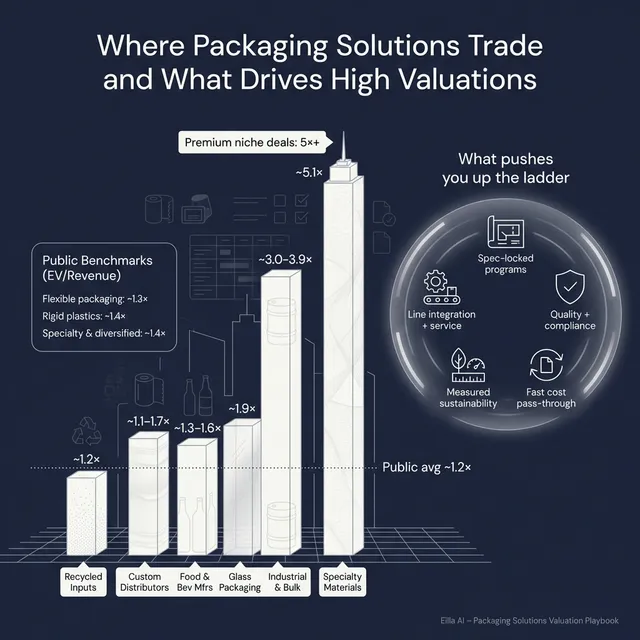
If you are considering a sale in the next 1-12 months, you are selling into a market that is actively consolidating - but also one where buyers are more selective than they were a few years ago. Packaging is essential, but not every packaging business is “must-have.” The difference between a good outcome and a disappointing one is usually not your revenue - it is your mix, your customer stickiness, your risk profile, and how clearly you can prove it.
This playbook is designed for founders and CEOs of privately held Packaging Solutions businesses. It will:
- Show what packaging businesses actually sell for (based on real deal data and public market multiples).
- Decode what drives higher vs lower multiples in this sector.
- Give you a simple self-assessment tool and a practical 6-12 month plan to raise your valuation.
1. What Makes Packaging Solutions Unique
Packaging Solutions is a broad category, but most founder-led companies fall into a few common models:
- Converters and manufacturers: flexible packaging (films, laminates, pouches), rigid/semi-rigid plastics (containers, trays), paper-based packaging, and specialty formats.
- Industrial and bulk packaging: drums, jerrycans, intermediate bulk containers, woven sacks, industrial films.
- Specialty and diversified packaging: labels, sleeves, tubes, medical or electronics composites, decorative and premium packaging.
- Distribution and packaging supply: “stock-and-custom” distributors providing packaging materials plus sourcing and light customization.
- Recycling and sustainability inputs: recycled resin, PCR (post-consumer recycled) feedstock, circular-economy platforms.
- Packaging machinery and automation: equipment, integration, and service - often tied to consumables.
Valuing packaging is not like valuing a typical “product company,” because:
- A big chunk of your cost base can be pass-through (resin, paper, aluminum, energy). Buyers care less about headline revenue and more about margin quality and pricing power.
- Working capital matters a lot. Inventory, customer terms, and resin swings can create cash needs that change perceived risk and deal structure.
- Quality systems and compliance are either a moat or a liability. Food contact standards, pharma validation, UN ratings, traceability, and customer audits can raise the bar - or expose gaps.
- The market ranges from “commodity” to “high-spec”. Two businesses that both “make packaging” can have wildly different customer stickiness, pricing power, and valuation outcomes.
Key risk factors buyers will always check in packaging:
- Customer concentration (one or two big accounts can quietly drive the whole business).
- Margin stability through raw material cycles (and how fast you reprice).
- Quality and compliance: audit history, recalls, non-conformances, certifications.
- Capex needs and asset condition (buyers discount businesses that require immediate reinvestment).
- Environmental exposure: recycling claims, EPR/regulatory risk, energy intensity, and landfill-related scrutiny.
2. What Buyers Look For in a Packaging Solutions Business
Buyers (strategics and private equity) are usually trying to answer one question: “Is this a stable cash-flow business with defensible customers - and can we make it better without taking scary risks?”
The “obvious” basics still matter:
- Scale: bigger tends to be safer and easier to finance.
- Growth: buyers pay more when growth is repeatable and not dependent on one customer or one hero salesperson.
- Profitability: EBITDA margin is the simplest shorthand, but buyers also look at gross margin quality and consistency.
- Visibility: contracts, repeat orders, and predictable volume matter more than a founder’s confidence.
Packaging-specific nuances that often decide the multiple:
- Mix and specification level: high-barrier, validated, regulated, or engineered packaging is valued differently than commoditized film or stock boxes.
- Customer embedment: packaging tied into a customer’s line validation, equipment setup, or packaging design system is harder to replace.
- Repricing mechanisms: if you can adjust pricing quickly when resin/paper changes, buyers see lower earnings risk.
- Quality track record: strong audit outcomes and low complaint rates reduce “deal anxiety” in diligence.
How private equity thinks about your packaging business
Private equity (PE) is usually underwriting a 3-7 year plan. Their valuation logic often looks like this:
- Entry multiple vs exit multiple: they want to buy at a reasonable multiple and sell later to a bigger buyer (strategic or larger PE) at an equal or higher multiple.
- Who is the next buyer? A packaging platform, a strategic with synergy, a global consolidator, or a specialist in a niche (pharma, premium spirits, industrial specialty).
- What levers can they pull?
- Pricing discipline and faster pass-through of input costs
- Mix shift toward higher-margin SKUs and “spec-locked” programs
- Lean manufacturing, scrap reduction, and better scheduling
- Add-on acquisitions (“roll-up” of adjacent converters or specialty categories)
- Cross-sell into a broader customer base
PE gets excited when the plan does not depend on miracles - just tighter execution on levers packaging businesses already have.
3. Deep Dive: The Valuation Nuance That Matters Most - “Spec-Locked” vs “Replaceable” Packaging
In packaging, one of the highest-impact valuation questions is simple:
Is your packaging “locked into” your customer’s product and production line - or can they switch suppliers with a few emails?
This shows up in valuation outcomes because it changes two things buyers obsess over: retention risk and pricing power.
Here is how it shows up in the data:
- Deals tied to regulated or validated end-markets (life sciences, pharma packaging, high-spec industrial compliance) tend to command premium narratives and, in some cases, higher revenue multiples (for example, regulated/mission-critical assets in the provided deal set include life sciences containment and pharma packaging). Those premiums are driven by requalification cycles and strict requirements that slow switching.
- Even within packaging, assets that combine specialized process know-how, design capability, or equipment integration tend to earn stronger outcomes than general converters. In the provided deal examples, integrated solutions and niche leaders are repeatedly associated with higher willingness to pay.
Why buyers care:
- If switching you out requires re-testing, line trials, regulatory documentation, or equipment changes, your customer is “sticky” even if you do not have a formal long-term contract.
- If you are one of many interchangeable suppliers, buyers assume you will eventually get squeezed on price, especially when input costs fall and customers demand givebacks.
How to move from “replaceable” to “spec-locked” over time (without a massive pivot):
- Document your qualification moat: show customer audits, line approvals, specs, change-control processes, and the cost/time of switching.
- Build engineered programs: barrier performance, shelf-life validation, tamper evidence, child-resistant features, or compatibility with the customer’s filling equipment.
- Create operational integration: vendor-managed inventory, forecasting integration, shorter lead times, and service levels that competitors cannot match.
- Attach sustainability requirements to contracts: if a customer’s packaging choice is part of their sustainability commitments, switching becomes harder when you can prove compliance.
A simple way to think about it:
4. What Packaging Solutions Businesses Sell For - and What Public Markets Show
No single multiple fits every packaging business. But the data does show clear clustering by segment and business model.
A helpful mindset: public markets set reference bands, and private deals show what buyers actually paid for specific assets. Your valuation will usually land somewhere inside those bands depending on your mix, growth, margins, and risk.
4.1 Private Market Deals (Similar Acquisitions)
From the precedent transaction groups provided, packaging acquisitions span a wide range. The biggest driver is not “packaging vs packaging” - it is whether the business is a manufacturer with defensible economics, a distributor, a specialty materials supplier, or a high-spec industrial platform.
The group averages in the dataset show:
- Overall private deal averages around ~2.1x EV/Revenue and ~10.5x EV/EBITDA (median similar).
- But that average hides major segment differences (examples below).
These are illustrative ranges derived from the provided group stats, not a price list. Deal structure, country, size, customer mix, and margin profile can move outcomes materially.
A practical takeaway: if you are a subscale general converter, you are rarely valued like a specialty materials business. But you can move toward higher bands if you can prove spec-lock, defensible niches, and pricing power.
4.2 Public Companies
Public market multiples are usually lower than founder expectations because public markets price in:
- cyclicality (input costs and demand),
- capital intensity,
- and “portfolio average” performance.
In the provided public comps, the overall averages are around ~1.2x EV/Revenue and ~10.2x EV/EBITDA, with variation by segment.
These are the “mid/end of 2025-style” reference points you can use as guardrails.
How to use public multiples correctly:
- Treat them as reference bands, not a direct valuation for your business.
- Private businesses are often discounted vs public for smaller scale, customer concentration, and weaker reporting.
- But a scarce, strategic asset with strong spec-lock and niche leadership can trade above public references, especially in a competitive process.
5. What Drives High Valuations (Premium Valuation Drivers)
Based on the premium drivers observed in the deal set - plus what consistently matters in packaging M&A - premium outcomes usually cluster around a handful of themes.
5.1 Regulated, mission-critical end markets
Buyers pay more when your packaging is tied to regulated environments where switching is painful or slow (life sciences, pharma, validated food applications, certified industrial uses). In the dataset, regulated/mission-critical examples are explicitly associated with premium willingness to pay because customer switching is constrained by qualification and validation requirements.
Founder-friendly examples:
- You supply packaging that must meet strict food contact or pharma requirements and customers need documented validation.
- Your product requires line trials and approval cycles that take months, not weeks.
- You have a track record of audits and compliance documentation that a buyer can “inherit.”
5.2 Category leadership in a niche, with differentiated process or technology
Packaging is full of “same-ish” suppliers. Premium outcomes show up when you can credibly say: “We are one of the few who can do this reliably at scale.” In the deal set, niche leaders with differentiated solutions (including premium design manufacturing and integrated offerings) are repeatedly highlighted as premium drivers.
Examples founders relate to:
- You do advanced barrier structures that protect aroma, shelf-life, or sensitive formulations.
- You have proven recyclable mono-material solutions that match legacy performance.
- You have tooling, process controls, or design capabilities that customers cannot easily replicate.
5.3 Sustainability that is measurable (not marketing)
Sustainability can be either a real valuation driver or empty noise. Buyers pay more when it is measurable, audited, and tied to customer demand. In the dataset, sustainability and circular-economy positioning show up as premium narratives, especially when linked to strategic customers and credible metrics.
What “real” looks like:
- Audited PCR content, emissions metrics, and recyclable design claims.
- Customer contracts where sustainability targets matter.
- Closed-loop programs (take-back, recycling partnerships) with evidence of adoption.
5.4 Equipment and automation integration that “locks in” customers
Packaging businesses get stickier when they attach to the customer’s line - especially when equipment drives consumable pull-through. In the deal set, equipment-plus-consumables ecosystems and automation platforms are explicitly described as creating embedded customer relationships and stronger valuation narratives.
Examples:
- You sell packaging plus line-side equipment, service, and upgrades.
- You integrate with the customer’s packaging operations so you become operationally hard to replace.
- You have recurring service revenue and an installed base.
5.5 High-spec materials and scarcity economics
Some packaging-adjacent materials trade like “advanced materials” rather than packaging. The dataset includes high-spec film/material examples where scarcity and R&D intensity drive unusually high multiples. Most packaging companies will not match this, but you can borrow the principle: buyers pay for technical complexity plus limited substitutes.
5.6 Scale platforms with credible integration upside
Larger platforms get valued for synergy capture: procurement scale, plant optimization, cross-selling, and footprint. In the dataset, scaled platforms and roll-up narratives are tied to stronger outcomes than subscale local providers.
5.7 The “boring” premium drivers that matter in every deal
Even in packaging, many premiums come from fundamentals:
- Clean, credible financials (monthly reporting, margin by product line, no surprises)
- A diversified customer base (no single customer risk dominating)
- A leadership bench beyond the founder
- Predictable demand patterns and repeat business
- Evidence that price and margin are managed proactively
6. Discount Drivers (What Lowers Multiples)
Discount outcomes tend to happen when buyers feel they are underwriting risk without being paid for it. In packaging, these risks are usually very specific.
Common packaging discount drivers:
- Customer concentration: one customer drives too much revenue, or one contract renewal could break the year.
- Commodity exposure without pricing power: you compete mainly on price and customers multi-source easily.
- Slow pass-through of input costs: resin/paper swings hit margin before you can reprice.
- Working capital surprises: inventory build-ups, slow-paying customers, unclear terms, or seasonality that creates cash strain.
- Quality and compliance gaps: weak documentation, recurring audit findings, complaints, or a “we do it in people’s heads” culture.
- Deferred capex: equipment is near end-of-life, maintenance backlog, or the plant needs immediate upgrades.
- Founder dependence: key customers, pricing decisions, and supplier relationships live only with you.
- Messy product mix economics: you cannot clearly show which SKUs/customers make money and which are drag.
A subtle but very real discount driver: uncertainty. If buyers cannot quickly understand how you make money and why customers stay, they protect themselves by lowering the multiple or adding earn-outs.
7. Valuation Example: A Packaging Solutions Company
This is a worked example to show how valuation logic typically works. The company below is fictional, and the revenue level is fictional (USD 10m). The multiples and values are illustrative - not investment advice or a formal valuation.
Step 1: Build a “reasonable” multiple band from comps
For a small, privately held packaging converter/manufacturer, you generally triangulate:
- Public comps: packaging companies across segments cluster around ~0.8-1.8x EV/Revenue for quality flexible/rigid cohorts, with commodity segments lower and niche outliers higher. The central tendency for quality converters is often around ~0.9-1.3x, with leaders higher.
- Private deals: manufacturing-focused packaging deals in mainstream categories often sit around ~1.3-1.6x revenue, while specialty materials, high-spec industrial, or integrated platforms can be much higher.
- EBITDA cross-check: many mid-market packaging deals cluster around ~6-8x EBITDA for typical assets, with higher ranges for integrated or niche leaders.
A defensible starting band for a subscale, solid converter is often ~1.2-1.6x EV/Revenue (then adjusted up or down based on drivers). This matches the worked logic style shown in the sources for a subscale flexible packaging converter profile.
Step 2: Apply it to a fictional business
Meet NorthRiver Packaging, a fictional company:
- USD 10m revenue (fictional)
- Flexible packaging converter serving food and household products
- Gross margin: ~35-40% (healthy for a converter with value-added work)
- EBITDA margin: ~10% (solid but not “best-in-class”)
- Customer concentration: top 2 customers = 35% of revenue (a real risk)
- Sustainability: some recyclable mono-material SKUs, but limited audited reporting
- No equipment ecosystem, but strong quality processes and low complaint rates
Now we map scenarios.
How those scenarios happen in real life:
- Discounted case: concentration feels scary, pass-through is slow, financials are messy, capex needs are unclear.
- Base case: solid margins, decent stickiness, believable reporting, normal risks for a small converter.
- Premium case: you can prove spec-lock (validated programs), show measurable sustainability metrics tied to contracts, and demonstrate niche leadership or embedded operations (equipment/service integration or unusually strong differentiation).
Step 3: What this means for you
Two packaging businesses can both be “USD 10m revenue” and still sell for very different values - because buyers are not buying revenue. They are buying future cash flow with an acceptable risk level.
If you want a premium outcome, your job in the next 6-12 months is usually not “grow revenue at all costs.” It is:
- reduce perceived risk,
- increase proof of customer stickiness,
- and show why your margins are defensible.
8. Where Your Business Might Fit (Self-Assessment Framework)
Use this as a quick, honest scoring tool. Give yourself a 0 / 1 / 2 on each factor:
- 0 = weak or unclear
- 1 = decent but inconsistent
- 2 = strong and provable
How to interpret your total:
- High band (mostly 2s in high-impact factors): you are closer to premium outcomes because buyers feel safe underwriting your cash flow.
- Middle band (mix of 1s and 2s): you are in fair-market territory - process and positioning can still make a big difference.
- Low band (several 0s in high-impact factors): expect buyers to demand discounts, earn-outs, or heavy diligence protection until risks are reduced.
The point is not to “win” the score. It is to identify which 2-3 fixes will move valuation the most.
9. Common Mistakes That Could Reduce Valuation
Rushing the sale
If you run a process before your numbers and story are ready, you force buyers to guess. Buyers protect themselves by lowering offers or adding conditions.
Hiding problems
Every issue shows up in diligence: customer churn, margin drops, quality incidents, capex needs, compliance gaps. If buyers discover it late, the value hit is usually worse than if you framed it early with a plan.
Weak financial records
Packaging buyers want clarity on:
- margin by product line/customer,
- pass-through timing,
- scrap and yield,
- working capital seasonality,
- normalized EBITDA (what is truly “ongoing”).
If you cannot explain these cleanly, you do not control the narrative.
Not running a structured, competitive process with an advisor
A structured process creates competition. Competition creates higher prices and better terms. Research often cited in M&A practice suggests structured competitive processes with advisors can lead to meaningfully higher purchase prices (often referenced around ~25% higher), mainly due to better positioning and multiple bidders.
Revealing your price too early instead of letting the market speak
If you tell buyers “we want USD 10m,” you often cap your outcome. You get USD 10.1m and USD 10.2m offers - not the real number the best buyer might have paid.
Packaging-specific mistakes founders underestimate
- No clear raw-material pass-through mechanism: buyers fear margin shocks.
- Overstating sustainability claims: if claims are not auditable, you risk trust loss and legal/regulatory concerns during diligence.
10. What Packaging Solutions Founders Can Do in 6-12 Months to Increase Valuation
You do not need a total reinvention. You need targeted improvements that reduce risk and strengthen proof.
10.1 Improve the numbers buyers care about
- Build a monthly KPI pack: revenue, gross margin, EBITDA, working capital, and a simple bridge explaining changes.
- Track margin by customer and product line so you can explain profitability drivers confidently.
- Tighten your pricing pass-through: show a clear method for resin/paper surcharges and the lag time.
- Reduce “silent leakage”: scrap, downtime, changeover losses, and freight inefficiencies.
10.2 Make customer stickiness provable
- Map the top 10 customers: contract terms, renewal dates, switching friction, audit history, and share of wallet.
- Create a “why they stay” file: complaint rates, service levels, on-time delivery, validation steps, and cost of failure.
- Reduce concentration where possible (even modestly) by growing 3-5 mid-tier accounts.
10.3 Upgrade your risk profile (this is where multiples move)
- Close compliance gaps: certifications, documentation, traceability, supplier qualification, and quality systems.
- Prepare a capex plan: show what you have invested and what is needed - buyers hate surprises more than they hate spending.
- Reduce founder dependence: delegate quoting, key account management, and supplier negotiations to a broader team.
10.4 Turn sustainability into a credible value driver
- Choose 2-3 metrics you can audit and report (PCR %, recyclability claims, CO2e per ton).
- Tie sustainability to customer wins: show that it is demanded and monetized, not just “nice to have.”
- Avoid vague claims - use clear definitions and third-party validation where possible.
10.5 Run a “sale readiness” process before you run a sale process
- Build a clean data room structure early.
- Identify the top 10 diligence questions and answer them in advance.
- Write your story in buyer language: what you do, why you win, why customers stay, and what makes earnings defensible.
11. How an AI-Native M&A Advisor Helps
A strong M&A outcome is usually driven by two things: getting in front of the right buyers and running a tight, credible process. AI-native advisory improves both without turning the process into a hard sell.
First, you get broader buyer reach, fast. AI can map hundreds of qualified acquirers based on deal history, strategic fit, and financial capacity - not just the usual list. More relevant buyers means more competition, stronger offers, and more backup options if one buyer drops out.
Second, you can often reach initial conversations and early offers in under 6 weeks because buyer matching, outreach, and process materials can be produced and iterated faster than manual-only workflows. Speed matters when you are managing momentum and confidentiality.
Third, it is not “AI instead of humans.” It is expert advisory enhanced by AI: experienced M&A professionals driving your strategy, positioning, and negotiations - supported by tools that improve targeting, materials, and diligence execution. The goal is Wall Street-grade process quality without traditional bulge-bracket costs.
If you’d like to understand how an AI-native process can support your exit, book a demo with one of our expert M&A advisors.
Are you considering an exit?
Meet one of our M&A advisors and find out how our AI-native process can work for you.


