
The Complete Valuation Playbook for Payment Solutions Businesses
A practical guide to how payment solutions businesses are valued and what drives high multiples.

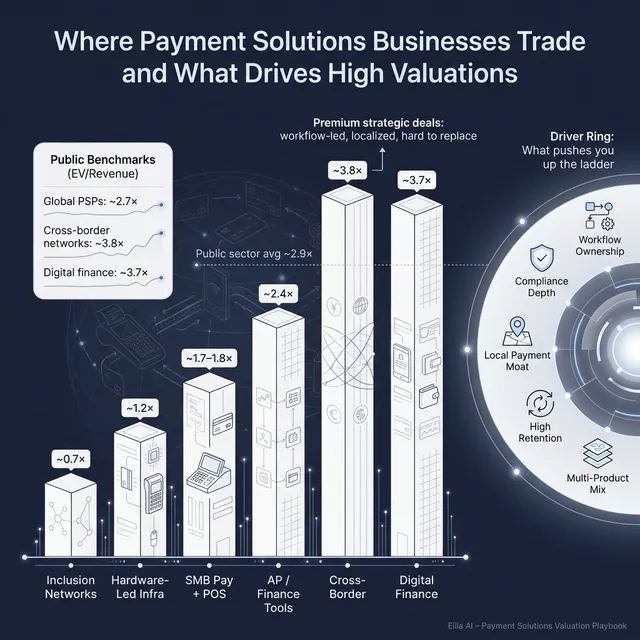
If you run a privately held payment solutions business and may sell in the next 1-12 months, valuation is not just about your latest revenue number. In this market, buyers are looking hard at quality of revenue, compliance depth, embedded workflow value, and whether your business is becoming more strategic as payments, software, and financial services continue to converge.
That timing matters. Financial services M&A entered 2025 with improving deal momentum, and payments buyers have continued to pursue capability-led deals, geographic expansion, and assets that add adjacent services around the payment flow. In other words, there is still buyer interest - but buyers are being selective about what deserves a premium. (PwC)
This playbook is built to help you understand what payment solutions businesses actually sell for, what pushes valuations up or down, how buyers really think, and what you can do in the next 6-12 months to improve your position before going to market.
1. What Makes Payment Solutions Businesses Unique
Payment solutions is a broad category. It includes merchant acquirers, payment service providers, gateway and orchestration platforms, POS-led commerce platforms, cross-border payment networks, mobile and local payment method specialists, and payment-adjacent software or hardware businesses. Some companies are mostly transaction-driven. Others are software-led and use payments as a monetization layer. Others sit somewhere in the middle.
That mix matters because buyers do not value all payment businesses the same way. A business that earns recurring software fees, owns the merchant workflow, and embeds payments deeply into operations will usually be viewed very differently from a business that depends mainly on payment volume and hardware distribution. Two companies can both call themselves "payments companies" and still deserve very different multiples.
This sector also has unusually high scrutiny around risk. Buyers will always examine your compliance setup, fraud and chargeback profile, concentration by processor or banking partner, exposure to regulated verticals, and the stability of your take rate. In many industries, a customer contract is enough. In payments, buyers want to know whether the money flow, compliance framework, and settlement mechanics are durable.
Another reason this sector is unique is that scale can work both ways. Scale helps with negotiating power, spread of compliance costs, data advantage, and product breadth. But if scale comes with weak margins, messy operations, or too much low-value payment volume, it does not automatically create a premium.
2. What Buyers Look For in a Payment Solutions Business
At the most basic level, buyers care about four things: growth, profitability, predictability, and strategic fit. They want to know if your revenue is growing, whether that growth turns into cash earnings, how stable the customer base is, and why your business matters inside a larger buyer's platform.
In payments, that lens gets more specific. Buyers usually ask: Do you own a mission-critical part of the merchant workflow? Are you just moving transactions, or are you also helping merchants run their business? Do customers use you because you are cheapest, or because replacing you would be painful and risky?
They also look closely at revenue quality. Transaction revenue can be very valuable, but only when the underlying merchant base is sticky and the economics are understandable. If your payment revenue is tied to software, compliance, settlement, reporting, lending, or industry-specific workflows, buyers see more staying power. If it is mostly commodity processing with thin differentiation, they usually pay less.
Customer mix matters a lot. A well-diversified base of merchants or enterprise clients is safer than a business where a few partners, ISVs, or large merchants drive too much volume. Buyers also prefer low churn, stable cohorts, and evidence that customers deepen usage over time by adding more products.
How private equity thinks about a payment solutions deal
Private equity buyers usually think in three layers.
First, they care about entry multiple versus exit multiple. If they buy you at a healthy price, they still need a believable path to sell in 3-7 years at an equal or better multiple. That usually means they want a business that can become more software-led, more profitable, more scaled, or more strategic to the next buyer.
Second, they think hard about who buys the business after them. That could be a larger payments platform, a vertical software company, a broader financial technology platform, another private equity fund, or in rare cases a public market investor. If your story only works for one narrow buyer type, that limits value.
Third, they want clear levers. That might include attaching more software to your payment base, raising net revenue per merchant, expanding into adjacent services like business accounts or lending, adding vertical depth, improving pricing discipline, or making acquisitions. If they cannot see those levers, they will be more conservative.
3. What Buyers Look For in a Payment Solutions Business
You already know buyers care about revenue growth and margins. But in payment solutions, they are also buying the shape of your platform.
A buyer will usually pay more when your business has one or more of these qualities: embedded workflow relevance, strong retention, clear compliance muscle, attractive gross margins, multi-product penetration, and a credible path to margin expansion. They want proof that your business gets stronger as customers use more of it.
Strategic buyers often ask, "What can we add to our existing stack if we own this?" Private equity often asks, "What can we improve, package, and later resell?" Both groups care about whether your business can support cross-sell and account expansion rather than just one-off merchant acquisition.
The best-positioned businesses tend to have a strong answer to a simple question: why would customers hate to leave? In payments, that answer may be compliance setup, ERP or POS integrations, settlement workflows, omnichannel data, local market adaptations, or bundled software that runs day-to-day operations.
4. Deep Dive: Commodity Payment Processing vs Embedded Workflow Ownership
This is one of the most important valuation questions in the whole sector. Buyers pay very differently for a business that merely processes transactions versus one that sits inside the customer's operating workflow.
The source data points in this direction clearly. Businesses with broader platform value - such as payments plus software, compliance, localization, decisioning, or adjacent financial services - tend to support better valuation narratives than simple payment acceptance alone. The premium drivers also repeatedly point to workflow ownership, platform breadth, and localization complexity as reasons buyers pay more.
Why do buyers care so much? Because transaction volume by itself can be fragile. If your value proposition is mainly acceptance and routing, price competition is intense, switching is easier, and your take rate can compress. But when payments are tied to the operating system of the merchant or enterprise workflow, the relationship becomes stickier. The buyer is not just underwriting payment revenue. They are underwriting dependency.
This is why POS-led platforms, compliance-heavy payment software, and localized payment infrastructure often attract stronger interest. They can support higher retention, more products per customer, and better expansion over time. They also give the acquirer more room to add value after closing through cross-sell, pricing, financing, or operational integration.
If your business looks more like the lower-value version today, the goal is not to reinvent the company overnight. It is to show the market that you are moving up the value chain. That might mean deepening integrations, packaging software more clearly, improving reporting, adding vertical functionality, or proving that existing customers buy more from you over time.
5. What Payment Solutions Businesses Sell For - and What Public Markets Show
The most useful way to read valuation data in this sector is to look at both private deals and public trading groups. Private deals tell you what buyers actually paid. Public markets tell you what larger, more liquid businesses in adjacent categories are worth on a trading basis.
The key point is simple: payment solutions is not one clean valuation bucket. The market values different models very differently depending on software content, payment mix, margin profile, regulatory complexity, and customer importance.
5.1 Private Market Deals (Similar Acquisitions)
The private deal data here points to a fairly grounded market. Across the precedent transactions provided, the overall average and median EV/Revenue multiple is about 1.5x, while the average EV/EBITDA is around 10.8x and the median is around 11.6x. That tells you buyers in private markets are often paying for cash earnings and strategic usefulness more than pure revenue scale.
Within the deals shown, payment acceptance and POS-oriented businesses sit roughly in the mid-1x to low-2x revenue area, while software-led or infrastructure-led assets with stronger profitability can support stronger EBITDA valuations. The data also suggests that profitability and control matter. The more a buyer can underwrite margin quality and integration upside, the more comfortable they are paying at the better end of the range.
These are illustrative reference points, not fixed price tags. A business with high retention, strong margin trajectory, and deep workflow ownership can outperform the headline averages. A business with concentration, weak earnings, or commodity economics can land below them.
5.2 Public Companies
As of mid to late 2025, the public company set in and around this sector traded at an overall average of about 2.9x EV/Revenue and 17.1x EV/EBITDA, with medians of about 1.8x and 13.1x respectively. That already tells founders something important: public market averages are higher than the private transaction averages in the source set, but the spread is wide.
The highest public revenue multiples tend to appear in categories where buyers and investors see one or more of these traits: stronger growth, better margins, broader platform value, strategic network effects, or high mission-critical relevance. That is why some enterprise PSPs, cross-border payment networks, and broader digital finance platforms trade well above the median, while hardware-heavy, slower-growth, or more commoditized players trade closer to 1x revenue or below.
*Average EV/EBITDA here is shaped by a smaller profitable subset and should be interpreted carefully.
Here is how to use public multiples properly. They are a reference band, not your sale price. A private company should usually be adjusted downward from public benchmarks if it is smaller, less diversified, less liquid, growing slower, or carrying more risk.
That said, public multiples still matter because they frame buyer psychology. If larger strategic buyers themselves trade at healthy multiples, they often have more room to pay for assets that strengthen their platform. And if your company is unusually scarce, strategic, or integration-ready, you can sometimes push toward the stronger end of what the public set implies.
6. What Drives High Valuations (Premium Valuation Drivers)
The data shows that premium outcomes in this sector are not random. Buyers pay up when they see durable strategic value, not just payment volume.
6.1 Localization and compliance as a moat
One of the clearest premium drivers in the source set is regulatory and localization complexity. If your platform is deeply adapted to local tax rules, fiscalization, payment rails, language needs, settlement requirements, or industry-specific regulation, buyers often see more defensibility.
Why? Because that complexity raises switching costs. It is hard for a competitor to copy quickly, and painful for a customer to replace. In payments, compliance work is expensive and ongoing. If you already carry that burden well, buyers may see it as an asset rather than a cost.
Practical examples include local acquiring support, market-specific onboarding flows, vertical compliance modules, or deep support for local payment methods and reporting standards.
6.2 Platform breadth that increases share of wallet
The source data also highlights broader platforms as a premium theme - but only when breadth actually improves customer economics. Buyers do not reward a random list of products. They reward a business where payments, software, business accounts, lending, analytics, loyalty, or workflow tools reinforce each other.
The reason is simple. A customer using two or three products is usually harder to lose and worth more over time than a customer using one. That makes revenue more durable and future growth more believable.
A founder-friendly test is this: can you show that customers who start with one product tend to add others and become better customers over time? If yes, that is premium evidence.
6.3 Mission-critical workflow ownership
Businesses tied directly to daily operations often get stronger buyer interest. That includes payment solutions embedded in POS, ERP, invoicing, field operations, or industry workflows where downtime hurts the customer fast.
Buyers pay more for this because it changes the nature of the relationship. You are no longer one vendor among many. You become part of how the customer runs the business.
That can show up in integrated reconciliation, inventory-linked payments, payroll-linked disbursements, or vertical operating software where payment acceptance is just one layer of a wider stack.
6.4 Demonstrable earnings quality
The premium deals in the data lean heavily on EBITDA quality and margin trajectory. That is a big lesson. In this sector, buyers like growth, but they pay real premiums when they can trust the earnings.
That means healthy contribution margins, improving EBITDA margins, disciplined operating spend, and clear proof that growth is not being bought at any price. It also means buyers will look beyond headline EBITDA and ask whether margins are durable after funding costs, device economics, support costs, fraud losses, and compliance overhead.
6.5 Clean control and integration optionality
Another driver in the source set is clean ownership and post-close integration potential. Buyers can justify better pricing when they know they will control the asset, streamline governance, and integrate product, pricing, operations, and go-to-market without friction.
Founders sometimes underestimate this. A buyer may pay more not just because of what your company is today, but because of what they can do with it once they own it fully. The easier that future picture is to underwrite, the more aggressive they can be.
6.6 Financing certainty and a believable accretion story
Even strong assets can get discounted if buyers are unsure how they will finance the deal or how value will be created after closing. The source data shows that buyers like deals that are clearly financeable and likely to be earnings-accretive.
For you as a founder, that means your story should not stop at "we are growing." It should also answer: why does owning us make the buyer better? Higher cross-sell, lower customer acquisition cost, stronger product suite, better geographic reach, improved margin mix - these are the types of arguments that support a stronger valuation discussion.
6.7 The basics still matter
Even if they are not glamorous, these factors consistently matter in every good sale process: clean financials, recurring or highly predictable revenue, diversified customers, low churn, strong management below the founder, good KPI reporting, and few surprises in diligence.
A premium valuation usually comes from a combination of strategic strengths and basic execution quality.
7. Discount Drivers (What Lowers Multiples)
Most lower-end outcomes are not caused by one fatal flaw. They come from a stack of concerns that make buyers less certain.
A common discount driver in payment solutions is commodity revenue. If buyers believe your growth depends mainly on pricing, incentives, or replacing one processor with another, they will usually stay cautious. The same applies if hardware is a sales tool with weak follow-on economics rather than a path into durable software and payment revenue.
Low visibility into earnings is another major problem. If gross profit, device subsidies, fraud costs, chargebacks, partner economics, reserve impacts, and compliance spend are hard to unpack, buyers will assume the risk is worse than it looks. Confusion lowers confidence, and lower confidence lowers multiples.
Concentration also hurts. That may be concentration in a few merchants, a few referral partners, one banking partner, one processor, one country, or one vertical. In payments, concentration risk can move fast from manageable to serious if one commercial relationship changes.
Weak retention or shallow product usage is another red flag. If customers churn easily, or if they use only one low-value product, buyers worry that revenue is not sticky enough to deserve a premium.
There are also classic deal discounts that apply here too: founder dependence, weak second-line leadership, inconsistent monthly reporting, aggressive revenue recognition, messy legal documentation, unresolved compliance issues, and a sales story that is better than the underlying numbers.
The good news is that many discount drivers are fixable or at least explainable. Buyers do not need perfection. They need clarity, credibility, and evidence that the risk is known and managed.
8. Valuation Example: A Payment Solutions Company
Let’s build a fictional example to show how the logic works.
Assume a fictional business called HarborPay, a private payment solutions company serving SMB merchants in retail and hospitality. It combines card-present acceptance, lightweight POS software, settlement and reporting tools, and a small but growing business account product. HarborPay generates USD 10.0m of annual revenue. This company is fictional, the revenue figure is fictional, and the valuation range below is illustrative only - not investment advice or a formal valuation.
Step 1: Start with the right comp set
Because HarborPay is primarily an SMB payment acceptance and POS-bundled business, the first anchor should be the SMB acquiring and POS-bundled comp set, not pure software or enterprise infrastructure comps.
From the source logic, that public bucket supports a rough revenue band around 0.8x to 2.3x, while the broader enterprise/global PSP set provides an upper-support band up to roughly 2.9x for a business with broader product scope and stronger scale. On the private side, the most relevant check is the SMB merchant payment acceptance and POS transaction at about 1.8x revenue.
Step 2: Select a practical base range
For a normal private business of this type, a sensible starting point is not the absolute top of public multiples. It is usually a narrower private-market-adjusted range.
So for HarborPay, a reasonable base case might be 1.8x to 2.4x revenue. That reflects:
- relevance to the SMB acquiring + POS model
- some additional value from software and adjacent products
- but still a private-company discount for scale, liquidity, and execution risk
On USD 10.0m revenue, that implies:
Step 3: Decide what pushes the multiple up or down
HarborPay could justify the premium case if it had several strong drivers at once: low churn, strong gross profit visibility, increasing software and financial services attachment, good retention by cohort, diversified merchants, attractive unit economics on hardware, and clear evidence that customers become more valuable over time.
It could fall into the discounted case if the picture looked weaker: heavy dependence on transaction revenue alone, poor reporting on margins, concentration in a few partners, weak profitability, or signs that merchants can switch easily.
What this means for founders
Two payment solutions businesses with the same USD 10m of revenue can realistically be worth very different amounts. One may look like a sticky embedded workflow platform. The other may look like a thin-margin payment reseller.
That is why valuation work is not just multiplying revenue by an industry average. The multiple is a judgment about quality, durability, and strategic value. Your job before a sale is to move your company into the version buyers trust more.
9. Where Your Business Might Fit (Self-Assessment Framework)
Use this as a rough scoring tool, not a precise formula. Go factor by factor and give yourself a 0, 1, or 2.
- 0 = weak / unclear
- 1 = acceptable
- 2 = strong
How to interpret your score
If you score strongly across most high-impact factors, you are closer to the top end of the realistic range for your subsector. That does not guarantee a premium deal, but it means buyers have fewer reasons to discount you.
If your score is mostly in the middle, you are probably in fair-market territory. That is where many good businesses sit. The real question becomes which two or three improvements could move you up a tier before launch.
If your score is weak on several high-impact factors, that does not mean your business is unsellable. It means the payoff from preparation is probably high. A few months of focused work may change the buyer conversation materially.
10. Common Mistakes That Could Reduce Valuation
Rushing the sale
This is one of the most common mistakes. Founders decide to sell, send a few numbers around, and hope buyers will fill in the gaps. That usually leads to lower first offers and a weaker process.
You need prepared financials, a clean equity and legal story, a credible buyer narrative, and a process that creates competitive tension. Good assets can still underperform if they are sold casually.
Hiding problems
If you have churn issues, compliance cleanup work, margin pressure, customer concentration, or a processor dependency, say so early and frame it properly. In diligence, problems usually surface anyway.
When a buyer discovers something you tried to bury, trust falls fast. That often hurts value more than the issue itself would have.
Weak financial records
In payments, weak reporting is especially expensive. Buyers want to understand revenue by product, take rate movement, gross profit after direct costs, device economics, cohort behavior, chargeback trends, and true EBITDA quality.
If your books cannot answer those questions cleanly, buyers will protect themselves with lower multiples, earnouts, holdbacks, or more aggressive legal terms.
No structured competitive process
Founders often assume one good buyer is enough. Usually it is not. A structured process helps you reach more relevant buyers, compare interest across different buyer types, and create the pressure that improves price and terms.
Research on private-company M&A shows that private sellers who hire sell-side M&A advisers receive significantly higher valuations on average, in part because advisers reduce information gaps and increase bargaining power by bringing in more competing bids. In practice, a structured competitive process with an experienced advisor often leads to materially better outcomes, and a rule-of-thumb uplift of around 25% is commonly cited in the market even though the exact figure varies by situation. (Harvard Law Forum on Corporate Governance)
Naming your price too early
If you tell buyers upfront, "I want USD 10m," you cap the conversation before real price discovery begins. Buyers are smart. Many will simply anchor around your number and come back with USD 10.1m or USD 10.2m instead of revealing what they might have paid in a competitive process.
A better approach is to let the market speak first. Your job is to position the business strongly, run the process well, and create enough competition that buyers show their real valuation.
Treating compliance as back-office detail
This is an industry-specific mistake. In payment solutions, compliance is not a side issue. It is central to valuation. Weak KYC, underwriting, fraud controls, settlement controls, or licensing discipline can stop a deal or sharply reduce value.
Not separating software economics from payment economics
Another sector-specific mistake is presenting the business as one blended revenue number when the underlying economics are very different. If you have software, fintech, or value-added services layered on top of payments, show that clearly. Otherwise buyers may value everything like plain processing.
11. What Payment Solutions Founders Can Do in 6-12 Months to Increase Valuation
11.1 Improve the numbers buyers care about most
Start by tightening KPI reporting. Show monthly revenue by product line, gross profit by product line, cohort retention, product attach rates, customer concentration, and margin trends. If you have hardware, isolate device economics clearly.
Work on obvious margin improvements. Remove low-quality revenue, improve pricing discipline, renegotiate partner economics where possible, and reduce support or onboarding inefficiencies. Buyers do not need perfect margins, but they do want to see control and direction.
11.2 Increase revenue quality, not just revenue
Focus on getting more from your existing customer base. Add products that deepen dependence - reporting, invoicing, lending, business accounts, vertical modules, or better integrations - rather than chasing low-value transaction volume.
If you can show that customers who use more of your platform churn less and generate more gross profit, you materially improve your story.
11.3 Reduce obvious risk points
Clean up concentration where possible. That includes large customers, referral channels, processors, banking partners, and geographies. If you cannot reduce a concentration quickly, build a strong explanation and mitigation plan.
Also review compliance and legal readiness. Make sure licenses, agreements, underwriting practices, privacy policies, security controls, and partner contracts are current and organized.
11.4 Strengthen the management story
If too much of the business runs through you, valuation can suffer. Use the next 6-12 months to make management depth visible. Buyers want to know the business can perform through a transaction and after one.
That does not require a massive reorganization. Often it means clearer functional ownership, stronger reporting rhythm, and making your second-line leaders more visible in the business.
11.5 Build the right equity story
Your story should explain why your business is strategically valuable, not just financially decent. Are you winning because of local complexity? Because of vertical workflow ownership? Because your merchants adopt more products over time? Because your compliance stack is hard to replicate?
The strongest founder narratives tie numbers to strategic logic. They make the buyer feel that owning the business solves something important.
11.6 Prepare for diligence before the process starts
Do not wait for a buyer to ask for data before building the data room. Prepare customer data, churn analysis, contracts, compliance materials, legal documents, monthly financials, pipeline information, and technology summaries early.
That shortens the process, reduces surprises, and makes you look like a business that can be acquired smoothly. That alone can improve outcomes.
12. How an AI-Native M&A Advisor Helps
Selling a payment solutions business is partly about valuation, but also about reach and process quality. An AI-native advisor can expand the buyer universe far beyond the small list most founders or traditional manual teams would generate - often identifying hundreds of qualified buyers based on deal history, product fit, synergies, financial capacity, and strategic signals. More relevant buyers means more competition, stronger offers, and more options if one bidder drops out.
AI also helps move faster. With AI-driven buyer matching, faster creation of marketing materials, better support during diligence, and more efficient outreach, initial buyer conversations and first offers can often be reached in under 6 weeks. Speed matters because momentum helps preserve leverage.
That does not replace human advisory judgment. It improves it. The best outcomes still come from experienced M&A advisors who know how to frame your business, pressure-test the numbers, handle buyer psychology, and run a disciplined process. AI makes that work broader, faster, and more targeted - without needing traditional bulge-bracket overhead.
If you'd like to understand how our AI-native process can support your exit - book a demo with one of our expert M&A advisors.
Are you considering an exit?
Meet one of our M&A advisors and find out how our AI-native process can work for you.


