
The Complete Valuation Playbook for Personal Care Businesses
A data-driven playbook that shows personal care founders what buyers actually pay.

If you run a personal care business and you might sell in the next 1-12 months, valuation stops being a theory and becomes a set of levers you can actually pull.
This playbook is built for founders like you. It uses real-world private deal multiples and public market trading multiples from the personal care ecosystem to show what businesses sell for, why some command premium outcomes, and what you can do in the next 6-12 months to move your result up the range.
You will see the patterns, a worked example (using a fictional USD 10m revenue company), and a simple self-assessment so you can decide whether to sell now - or earn a meaningfully better outcome by preparing.
1. What Makes Personal care Unique
Personal care looks simple from the outside - “we sell products” - but buyers value it differently than many other industries because the business is a mix of brand, distribution, and operational execution.
The main business types buyers see in personal care:
- Branded consumer products (hair care, body care, hygiene, skincare) sold through retail, Amazon, and/or D2C.
- Beauty and skincare manufacturers (often more trend-driven and marketing-intensive).
- Natural/self-care and wellness-adjacent brands (often higher growth, sometimes premium priced).
- Retailers and distributors (omni-channel players that own customer access rather than IP).
- Contract manufacturing/private label (quality, capacity, and customer concentration matter most).
Unique valuation considerations in this sector:
- Your “asset” is rarely just a factory or a formula - it is repeat purchase behavior and the ability to keep winning shelf space, search ranking, and mindshare.
- Buyers constantly separate brand strength (pricing power, repeat rate, loyal audience) from distribution dependence (one retailer, one marketplace, one influencer channel).
- Margin quality matters in a specific way: buyers love brands with gross margin headroom because it gives them options (more marketing, better packaging, more retailer trade spend - without killing profits).
Key risk factors buyers will always check:
- Customer concentration by channel (one retailer or one platform can control your fate).
- Product concentration (one hero SKU is great until it is not).
- Regulatory and claims risk (ingredients, labeling, “clean” claims, clinical or derm claims, safety documentation).
- Supply chain fragility (single-source ingredients, long lead times, manufacturing capacity constraints).
- Marketing efficiency and durability (is growth driven by a repeatable engine or a temporary spike?).
2. What Buyers Look For in a Personal care Business
Buyers are not just buying last year’s revenue - they are buying confidence in future revenue and future profit.
The basics still matter
Most acquirers start with four questions:
- How big is it today? (revenue scale and distribution footprint)
- Is it growing? (and is growth durable?)
- Is it profitable? (EBITDA and cash generation)
- Is it defensible? (brand equity, unique channel position, product advantage)
The personal care-specific lens
In personal care, “defensible” tends to mean a few very practical things:
- Pricing power: Can you raise price without losing volume? Are you premium, mass, or value - and is that positioning consistent?
- Repeat purchase: Do customers come back on a predictable cycle (deodorant, body wash, acne patches) or is it a “try once” category?
- Distribution resilience: Are you balanced across retail, Amazon, D2C, and international - or over-dependent on one door?
- Innovation rhythm: Not “do you have patents?” but “do you reliably launch winners and refresh the line without confusing customers?”
- Operational maturity: Forecasting, inventory turns, fill rates, and shrink matter more than founders expect - because cash can get trapped in inventory fast.
How private equity thinks about your business
Private equity (PE) can be a great buyer in personal care, but their mental model is different:
- They care about entry price vs exit price. If they buy at a high multiple, they need a believable path to sell at a similar or higher multiple in 3-7 years.
- They always ask: Who will buy this next? A strategic buyer (large CPG), a bigger PE fund, or (rarely) public markets.
- They look for levers they can realistically pull:
- Improve gross margin (sourcing, packaging, freight, mix)
- Improve marketing efficiency (creative testing, channel mix)
- Expand distribution (new retailers, international, professional channel)
- Expand portfolio (new SKUs, adjacencies, tuck-in acquisitions)
- Professionalize the team (strong COO/CFO/VP Sales)
In short: strategics often pay for “fit and synergy.” PE often pays for “a machine they can scale and later resell.”
3. Deep Dive: The One Valuation Nuance That Quietly Drives Outcomes - Margin Trajectory vs Revenue Multiple
Here is a non-obvious truth in personal care M&A: sometimes buyers pay what looks like a “high” price not because revenue is scarce, but because they believe profits are about to rise materially.
This shows up in the data as a wide gap between EV/Revenue and EV/EBITDA. In the premium drivers provided, one observed pattern was a business that looked cheap on revenue, but expensive on EBITDA - implying the buyer underwrote structural margin expansion or normalized EBITDA rather than paying up for top-line alone.
Why buyers care
Personal care businesses can change profitability quickly when a few things click:
- A packaging redesign reduces costs at scale.
- Mix shifts toward higher-margin SKUs.
- Freight and contract manufacturing terms improve.
- Retail trade spend becomes more efficient.
- You stop “buying” growth with unprofitable ads.
If a buyer believes those improvements are real and repeatable, they may accept a lower revenue multiple but still pay a strong EBITDA multiple - because they think EBITDA is the “true” value metric for your business.
How you move from the lower-value profile to the higher-value profile
Practical steps founders take:
- Track gross margin by SKU and by channel (not just blended).
- Separate “launch costs” from steady-state marketing.
- Build a simple margin bridge: what changed margin this year, and why it will continue.
A buyer does not need perfection - they need to believe your margin improvement is structural, not luck.
4. What Personal care Businesses Sell For - and What Public Markets Show
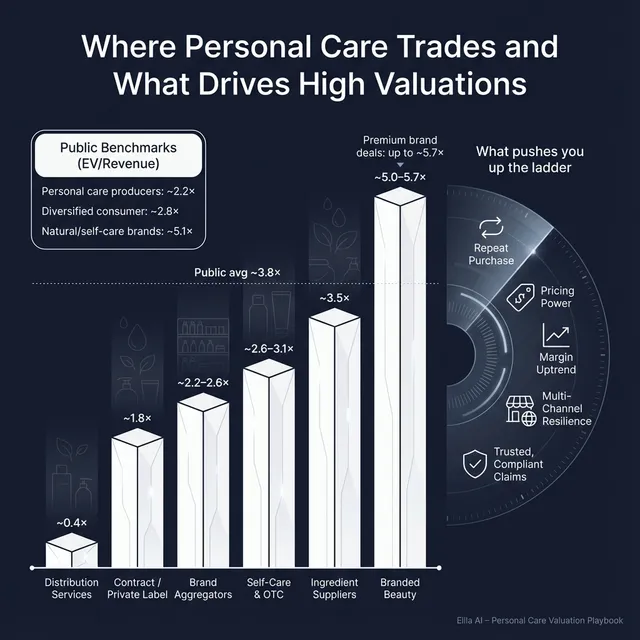
Valuation in this sector is best understood as a band, not a single number. Public markets set reference points, and private deals show what buyers are actually willing to pay when control is on the table.
The key is matching your business to the right “bucket” (branded D2C, mass personal care, natural/self-care, contract manufacturing, etc.) and then adjusting for your specific strengths and risks.
4.1 Private Market Deals - Similar Acquisitions
Across the precedent transactions dataset, the grouped private-market multiples look like this:
How to interpret this as a founder:
- The branded D2C/retail group is the premium zone, but it tends to be reserved for brands with clear momentum (fast growth, strong brand story, and often some form of de-risking like earnouts).
- Self-care and wellness-adjacent assets typically sit above commodity personal care when trust, repeat purchase, and claims credibility are strong.
- Contract manufacturing and distribution trade lower because buyers worry about customer churn, price competition, and concentration.
These are illustrative ranges. Your actual outcome depends on your mix of growth, margins, and risk.
4.2 Public Companies
Public markets provide a sanity check. In the provided public comps set (think mid/end of 2025 reference point), the overall averages were about 3.8x EV/Revenue and 16.0x EV/EBITDA, but personal care sub-segments vary widely.
How to use public multiples correctly:
- Treat publics as reference bands, not a price tag for your business. You are smaller, less liquid, and often more concentrated than a public company - so private buyers usually adjust downward for risk.
- But private deals can still go above public references when an asset is scarce, strategic, or has clear growth momentum.
- The right approach is: pick your closest segment, then adjust for your growth rate, margin quality, brand durability, and channel risk.
5. What Drives High Valuations (Premium Valuation Drivers)
Premium outcomes usually come from two things:
- a business that is genuinely strong, and
- a story that makes buyers believe the strength will last - and can scale.
Below are the premium drivers observed in the provided deal patterns, grouped into practical themes, plus a few “always matter” M&A fundamentals.
5.1 Brand momentum buyers can monetize
One clear premium pattern in the sources was a DTC-style brand where the buyer paid for velocity and future growth, not just current margins - often supported by a founder/celebrity halo and an earnout structure.
What that means for you:
- Buyers pay more when demand looks like a flywheel: community, repeat purchase, strong product reviews, and consistent new customer flow.
- A premium narrative is stronger when growth is not dependent on a single paid channel.
Founder-friendly examples:
- You have a hero product, but you also show the “next 3” products that are already working.
- Your Amazon rank and retail sell-through are improving even when you reduce discounts.
5.2 Credible margin expansion and EBITDA normalization
A subtle premium driver in the sources was the buyer effectively underwriting future margin expansion even if revenue multiples looked modest.
What that means for you:
- If your margins are improving for structural reasons (mix, sourcing, pricing discipline), you can be valued more like a “profit engine in progress” than a static SKU set.
Practical examples:
- You moved 20% of volume to a higher-margin format (refills, bundles, larger sizes).
- You locked in a better contract manufacturing rate tied to volume tiers.
5.3 Synergy that is real, measurable, and fast
Where strategics pay up, it is often because they can point to specific synergies - not vague “strategic fit.” In the source patterns, explicit synergy math was associated with premium outcomes when the base business was strong enough to absorb it.
What that means for you:
- “We fit your portfolio” is not enough.
- “You can add USD X million of profit within Y months because of A, B, C” gets attention.
Examples:
- A buyer can plug your brand into their existing retail relationships immediately.
- Your manufacturing footprint solves a capacity constraint for a strategic.
5.4 Earnouts and retention that reduce risk and unlock upside
Several deals in the sources used earnouts, rollovers, options, or management retention to align incentives and de-risk growth.
What that means for you:
- Premium valuations often come with a trade: buyers may pay more if you stay, or if part of the price depends on hitting performance milestones.
- This can be founder-friendly if you are confident in the plan and you negotiate terms well.
5.5 “Moat” in personal care: trust and repeat purchase
Personal care rarely has a hard technology moat. But buyers still pay more for defensibility:
- Real trust signals (safety standards, compliance, clinically supported claims where relevant)
- Consistent repeat purchase (not just one-time gifting)
- Strong brand positioning that is hard to copy
5.6 The boring fundamentals that unlock the premium
Even the best brand can get discounted if basics are weak:
- Clean financial statements and clear margin reporting
- Diversified channel mix
- Strong second layer of management
- Predictable working capital and inventory discipline
6. Discount Drivers (What Lowers Multiples)
Discounts usually come from buyer fear - fear that revenue will drop, profits will disappoint, or diligence will surface surprises.
Here are the most common value killers in personal care:
6.1 Channel and customer concentration
If one retailer, one distributor, or one marketplace drives most of your revenue, buyers worry about leverage shifting away from you.
What you can improve:
- Show active diversification (new doors in pipeline, growing D2C, international testing).
- Document the relationship quality: buyer meetings, category reviews, performance metrics.
6.2 Product concentration and trend risk
A single hero SKU can drive a great business - but it can also create a cliff.
What you can improve:
- Show a credible SKU roadmap and early traction for the next wave.
- Demonstrate that the brand, not just the SKU, drives repeat purchase.
6.3 Weak or unstable margins
If EBITDA is low, volatile, or propped up by one-time effects, buyers will compress multiples.
What you can improve:
- Build a clear “normalized” view: what margins look like without one-offs.
- Create discipline around promotions and trade spend.
6.4 Claims, quality, and compliance gaps
In personal care, diligence goes deep: labeling, ingredients, documentation, adverse event handling, supplier quality.
What you can improve:
- Tighten documentation, testing, and supplier agreements.
- Reduce “gray area” claims that invite regulatory or legal risk.
6.5 Messy inventory and cash conversion
Many founders underestimate how much inventory risk scares buyers. Excess inventory can be hidden losses.
What you can improve:
- Clean up slow-moving SKUs.
- Improve forecasting, reduce stock-outs and overstocks, and show healthy turns.
7. Valuation Example: A Personal care Company
This is a worked example to show the logic - not investment advice, not a fairness opinion, and not a promise of price.
The fictional company
Let’s call it Harbor & Field, a fictional personal care brand.
Assume:
- USD 10.0m annual revenue (fictional)
- Mix: 55% retail, 30% Amazon, 15% D2C
- Category: body care + deodorant
- Gross margin: strong but not luxury-level
- EBITDA margin: mid-teens and improving
- No single retailer over 30% of sales
- A couple of credible new SKUs launching next year
Step 1: Choose the right reference ranges
From the sources, a reasonable comp-driven approach for a mainstream branded personal care business is:
- Heavily weight public branded personal care producers and private self-care deals.
- De-emphasize extreme high-growth D2C outliers and low-multiple distributors.
That logic produced a blended defensible core band around ~1.8x to ~3.5x EV/Revenue for a USD 10m revenue business.
Step 2: Apply scenarios (illustrative)
Why the ranges move:
- Discounted case happens if Harbor & Field is over-dependent on one retailer, has one hero SKU, has messy inventory, or margins are volatile.
- Base case fits a solid, credible brand with reasonable diversification and stable profitability.
- Premium-leaning case is possible if the brand has clear momentum, repeat purchase strength, improving margins that look structural, and a story a strategic buyer can scale quickly - often paired with earnout/retention structures.
Step 3: What this means for you
Two businesses can both have USD 10m revenue and end up with very different outcomes because buyers are pricing:
- confidence in repeat purchase,
- durability of distribution,
- and how much profit the business can generate as it scales.
Your job in the next 6-12 months is to reduce the reasons a buyer would discount you - and increase the reasons they will fight to win the deal.
8. Where Your Business Might Fit (Self-Assessment Framework)
Use this to quickly locate yourself. Score each factor 0 / 1 / 2:
- 0 = weak / unclear
- 1 = acceptable but not compelling
- 2 = strong and proven
Quick scoring table
How to interpret your total score:
- High band: You likely sit toward the top of your segment’s range if you run a good process.
- Mid band: You can sell, but a focused 6-12 month plan can materially improve your outcome.
- Low band: Expect heavy diligence friction and lower offers unless you fix the biggest risks first.
Honesty helps here. The goal is not self-judgment - it is identifying what will move valuation most.
9. Common Mistakes That Could Reduce Valuation
These are avoidable, and they cost founders real money.
9.1 Rushing the sale
If you go to market without clean numbers and a clear story, you invite discounting. Buyers interpret chaos as risk.
9.2 Hiding problems
Issues will surface in diligence. If buyers feel misled, they lower price or walk.
Better approach:
- Disclose issues early, explain root causes, and show a fix in progress.
9.3 Weak financial records
Personal care has channel complexity (trade spend, chargebacks, promos, returns, inventory). If you cannot explain margins clearly, buyers assume the worst.
Low-hanging improvements:
- Clean revenue recognition by channel.
- Track gross margin by SKU and channel.
- Separate one-time costs from steady-state.
9.4 Not running a structured, competitive process with an advisor
A structured process creates competition. And competition drives price.
Research often cited in M&A circles suggests that a well-run competitive process with experienced advisory support can increase purchase prices meaningfully (often quoted around ~25%), largely because it improves buyer tension and reduces avoidable diligence failures.
9.5 Revealing what price you want too early
If you say “I want USD 10m,” many buyers will anchor there and come back with USD 10.1m, USD 10.2m offers - instead of telling you what they truly would have paid.
Let the market speak first. Your leverage is highest when multiple buyers are learning the story at the same time.
9.6 Personal care-specific mistake: confusing “clean” with “compliant”
“Clean” positioning can be powerful, but if documentation, claims, and testing are weak, it becomes a diligence landmine.
9.7 Personal care-specific mistake: letting inventory quietly pile up
Old packaging, slow-moving SKUs, and overstocks turn into write-downs. Buyers will find it and haircut value.
10. What Personal care Founders Can Do in 6-12 Months to Increase Valuation
You do not need a total reinvention. You need a focused plan that improves buyer confidence.
10.1 Improve the numbers buyers pay for
- Strengthen gross margin and prove it is sustainable (supplier renegotiations, packaging optimization, freight strategy, mix improvement).
- Stabilize EBITDA and show a clear trend line (reduce one-offs, build a realistic budget, track monthly).
- Clean up inventory (exit weak SKUs, fix forecasting, show healthier turns).
10.2 Reduce concentration risk
- If one retailer is too large, build real momentum in a second channel.
- If Amazon is dominant, prove you can win in retail or D2C too.
- Document channel economics so buyers can see where growth is most profitable.
10.3 Build a believable growth engine (not just a plan)
- Validate 1-2 new SKUs with early traction (small launches with measurable results).
- Show repeat purchase: subscriptions, bundles, replenishment reminders, loyalty.
- Build evidence that marketing works beyond one platform or one creative angle.
10.4 De-risk diligence before you start the process
- Tighten claims support, labeling, and quality documentation.
- Lock down supplier agreements and second sources for key ingredients.
- Prepare a simple “diligence-ready” data room: financials, customer/channel reports, SKU margin reports, compliance docs.
10.5 Upgrade the story - without exaggerating
Premium valuation is often “premium certainty.” Your narrative should connect:
- why customers buy and rebuy,
- why the brand can expand,
- and how a buyer can scale it (including synergy where real).
11. How an AI-Native M&A Advisor Helps
Even a great business can get an average outcome if the process is narrow, slow, or poorly positioned. An AI-native M&A advisor combines human deal leadership with software that expands reach and accelerates execution.
First, higher valuations through broader buyer reach. AI can expand the buyer universe to hundreds of qualified acquirers based on deal history, synergy fit, and financial capacity. More relevant buyers means more competition, stronger offers, and a higher chance the deal closes even if one buyer drops.
Second, initial offers in under 6 weeks. AI-driven buyer matching and outreach, faster creation of marketing materials, and structured support through diligence can compress timelines compared to manual-only processes - getting you to real conversations and credible offers much sooner.
Third, expert advisory enhanced by AI. Experienced M&A advisors still run the process, manage buyer psychology, and negotiate terms. AI helps them prepare sharper materials, surface the best-fit buyers, and keep diligence organized - which improves credibility and reduces value-eroding surprises.
If you would like to understand how an AI-native process can support your exit, book a demo with one of our expert M&A advisors.
Are you considering an exit?
Meet one of our M&A advisors and find out how our AI-native process can work for you.


