
The Complete Valuation Playbook for SEO Marketing Businesses
A guide for SEO agency founders on what really drives buyer multiples - from retainer stickiness and defensible results to a practical plan to maximize your exit outcome.

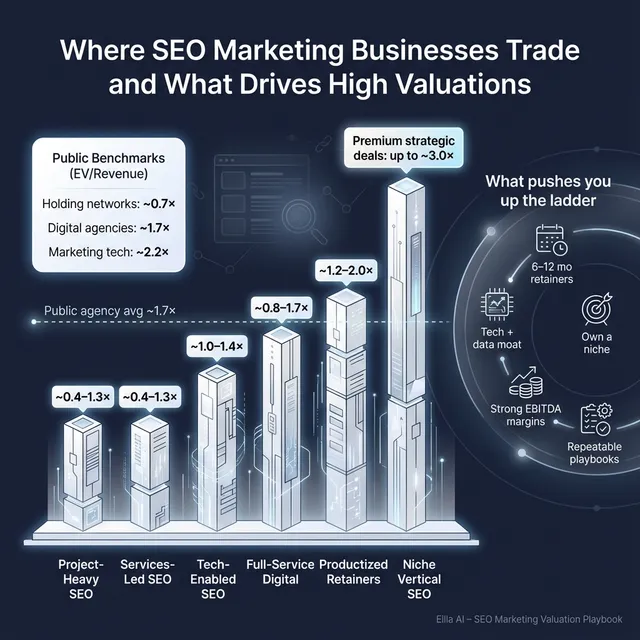
If you run an SEO marketing business and you might sell in the next 1-12 months, your valuation will be driven less by “SEO is hot” and more by a handful of very specific buyer beliefs: how sticky your revenue is, how defensible your results are, and how easy it is for a buyer to scale you without breaking margins.
This playbook is data-based and practical. It will (1) show what similar businesses have sold for, (2) decode what pushes multiples up or down, and (3) give you a self-assessment and a 6-12 month action plan to maximize outcome. Valuation ranges here are illustrative - not a formal valuation or investment advice.
1. What Makes SEO Marketing Unique
SEO marketing businesses sit in a weird middle ground: you are not a pure software company, but you are also not a generic “hours-for-dollars” agency when you do it well. That hybrid nature is why valuation spreads are wide.
The main types of SEO marketing businesses buyers see:
- Services-led SEO agencies: retainers + projects (technical SEO, content, link acquisition/digital PR, CRO support).
- Performance digital agencies with SEO + paid mix: SEO alongside paid media, creative, analytics, marketing automation.
- Content-led SEO studios: content production plus distribution/PR, sometimes heavy on editorial workflows.
- Tech-enabled agencies: proprietary tooling, automation, dashboards, AI workflows, or data assets embedded into delivery.
- SEO software / martech platforms: recurring software revenue (not the typical “agency” model, but relevant as an upper reference point).
Unique valuation considerations in SEO:
- Google risk is real: algorithm updates, AI overviews, SERP layout shifts, and channel mix changes directly affect your “product.”
- Results are hard to attribute: buyers will test whether your performance is repeatable or just a few lucky wins.
- Labor is the cost base: delivery quality depends on people, process, and institutional knowledge - not just “the brand.”
- Your revenue quality matters more than your revenue size: a USD 10m agency can be worth less than a USD 5m agency if revenue is fragile.
Key risk factors buyers will always check:
- Customer concentration (one or two clients can quietly control your future).
- Retention and contract structure (month-to-month vs 6-12 month terms).
- Delivery dependency on founders and a few senior SEOs.
- “Gray hat” practices (link schemes, PBNs, risky tactics) that can blow up post-close.
- Proof that growth is not fueled by underpricing or heroics.
2. What Buyers Look For in an SEO Marketing Business
Buyers are not buying “SEO.” They’re buying predictable cash flow and a scalable growth engine that can be expanded across more clients, more geographies, or more services.
The obvious stuff still matters:
- Size (revenue and EBITDA)
- Growth trend (stable, accelerating, or declining)
- Profitability (EBITDA margin and gross margin discipline)
- Customer retention and repeatability
But in SEO, a few nuances often decide where you land in the range:
- Retainer quality: Are retainers tied to a clear scope and renewal cycle, or are they vague “we do SEO” commitments that churn when budgets tighten?
- Proof of durable outcomes: Buyers love clear case studies, but they trust systems more than stories (process, QA, playbooks, reporting cadence).
- Vertical credibility: Agencies that “own” a niche (B2B SaaS, healthcare, fintech, legal, ecommerce) often defend pricing better and retain longer.
- Channel mix: Pure SEO can be amazing, but buyers like risk-balanced revenue (SEO + content + digital PR + CRO, sometimes paid support).
- Leadership bench: A buyer wants to believe the business still grows if you take a 2-week vacation - and later, if you exit.
How private equity thinks
Private equity (PE) usually has a 3-7 year plan. They care about:
- Entry multiple vs exit multiple: they want to buy at a sensible price and sell later without the multiple shrinking.
- Who buys it next: a larger PE fund, a strategic agency network, a martech platform, or a “roll-up” buyer building a group.
- The levers they can pull:
- Raise prices (especially if you’re underpriced relative to outcomes)
- Improve utilization and delivery efficiency
- Cross-sell adjacent services (CRO, analytics, paid, creative)
- Add bolt-ons (small agencies with complementary niches)
- Reduce founder dependency with a stronger management layer
In SEO, PE gets excited when your business looks less like “talent on demand” and more like a repeatable production system with recurring revenue.
3. Deep Dive: The Biggest Valuation Nuance in SEO - “Retainer Stickiness” vs “Project Churn”
If SEO revenue is easy to win but easy to lose, buyers will treat it as fragile and discount the multiple. If SEO revenue is structured as long-term partnerships with clear scope, measurable value, and low churn, buyers underwrite it more like recurring revenue.
Here’s how this shows up in market behavior:
- In services-heavy digital marketing deals, revenue multiples can cluster around sub-1.0x to ~1-2x when work is project-like or dependent on a few clients.
- When agencies show niche mastery, durable margins, and repeatable delivery, outcomes can move meaningfully higher (often supported by stronger EBITDA multiples and more competitive processes).
Why buyers care:
- SEO is not a one-time fix. It’s ongoing technical maintenance, content iteration, and authority building.
- The “product” is your process. If your process is mature and your client relationships are sticky, integration risk drops.
How you move from “lower-value” to “higher-value” over time:
- Productize your retainers (clear tiers, defined deliverables, clear renewal rhythm).
- Prove your outcomes with consistent reporting (rankings are not enough - pipeline, revenue, or qualified leads).
- Build an account management layer so clients stay for the relationship and operating cadence - not just one SEO lead.
A quick profile comparison:
4. What SEO Marketing Businesses Sell For - and What Public Markets Show
To value your business, buyers triangulate:
- What similar private businesses sold for (precedent transactions)
- What comparable public companies trade at (public multiples)
- The “quality” of your revenue and margins versus both sets
The key takeaway: multiples are a range, not a rule. Your job is to understand what makes buyers place you at the low end, middle, or high end of that range.
4.1 Private Market Deals (Similar Acquisitions)
In the private deal data for digital marketing and related agencies, a clear pattern shows up:
- Generalist and smaller agencies often clear at lower revenue multiples (frequently below 1.0x) especially when growth, retention, or margins are not clearly durable.
- Higher-quality agencies (specialist positioning, strong profitability, or tech/data integration) can land at higher revenue multiples (often north of 1.0x, and sometimes pushing toward ~2.0-3.0x in stronger cases).
- EBITDA multiples can look healthier than revenue multiples when profitability is clear - buyers often pay for cash flow when they trust it.
A simple way to translate this into founder-friendly ranges:
These are illustrative. Deal structure (earn-outs, deferred payments, rollover equity) can also change headline multiples without changing the underlying risk.
4.2 Public Companies
Public markets give you a “reference band,” not a price tag. As of mid-to-late 2025, the public comps in and around SEO marketing show:
- Service-heavy marketing networks and agencies tend to trade at lower revenue multiples (often around ~0.5-1.0x for large holding groups).
- Digital performance agencies can trade higher (the group averages show around ~1.7-1.9x EV/Revenue).
- Marketing software / SEO platforms can trade at meaningfully higher revenue multiples when they have strong recurring economics - but the group is volatile (wide dispersion between average and median).
Using the provided public group averages:
How to use this as a private founder:
- Treat public multiples as guardrails: a high-quality private business can sometimes outperform public comps, but smaller scale and higher risk often mean a discount.
- If your revenue is sticky, margins are strong, and your niche is defensible, buyers may underwrite you closer to premium outcomes - especially if multiple buyers see strategic fit.
5. What Drives High Valuations (Premium Valuation Drivers)
Premium outcomes are usually not magic. They’re a combination of a few “buyer confidence builders” that consistently show up in deals.
5.1 Vertical focus that creates pricing power
When you dominate a niche (e.g., B2B SaaS SEO, healthcare SEO, fintech SEO, enterprise ecommerce), buyers pay up because:
- You can sell faster (clear ICP and proof)
- You retain longer (you understand the domain)
- You price better (specialists are harder to replace)
Practical examples:
- A niche playbook (keywords, content formats, link strategies, compliance constraints) that generalist agencies can’t replicate quickly.
- Long client tenure in one vertical with strong referenceability.
5.2 High EBITDA margins with defensible gross margins
In services, margins are your “proof of quality.” Deals with clear profitability and resilient delivery economics tend to command stronger outcomes.
What buyers want to see:
- Stable gross margin (not inflated by temporary under-investment)
- Clear utilization and delivery planning
- EBITDA margins that don’t collapse when you hire
5.3 Growth with discipline (or a credible path to it)
Buyers pay more when growth is not “chaos growth.” They want:
- A repeatable sales motion
- Lead sources that don’t depend on one person
- Margin expansion alongside growth (or at least not margin destruction)
5.4 Proprietary tech, data, or automation embedded into delivery
Tech-enabled service models can earn a premium because switching costs rise when clients rely on your workflow, dashboards, automation, or data assets.
In SEO, “real tech” can include:
- Proprietary reporting and forecasting tooling tied to business outcomes
- Automated technical SEO monitoring and alerting
- Internal content production systems that improve speed and quality
- Data assets (keyword sets, competitor intelligence, industry benchmarks) that improve results
5.5 Clear strategic fit for a scaled platform buyer
Premium pricing often clusters when a buyer can plug your capabilities into a bigger engine:
- A marketing network that can cross-sell you across clients
- A martech platform that wants services to drive adoption
- A broader digital agency group consolidating niche leaders
Your job is to make the synergy obvious: what they can sell more of, faster, at higher margin because you exist.
5.6 Deal structures that reduce buyer fear (earn-outs, retention, leadership continuity)
Many premium deals include earn-outs, deferred payments, or equity rollover to keep key leaders engaged and align incentives. This can increase headline valuation when execution risk is real.
Also include the “boring” premium drivers (they matter):
- Clean financials and consistent reporting
- Diversified customer base
- A leadership bench that is not founder-only
- Strong positioning and brand in a niche
6. Discount Drivers (What Lowers Multiples)
Discounts happen when buyers see fragility - even if revenue looks good today.
Common SEO-specific discount drivers:
- Customer concentration: one client leaving changes everything.
- Churn and short contracts: month-to-month retainers with no renewal discipline.
- Founder dependency: the buyer feels like they’re buying your brain, not a business.
- Opaque performance attribution: “trust us” reporting with weak linkage to leads, pipeline, or revenue.
- Risky tactics: link schemes, low-quality content farms, or anything that could trigger penalties or reputation issues.
- Over-reliance on one channel: if your results depend on one traffic source without a mitigation plan, buyers price in risk.
General M&A discount drivers that hit agencies hard:
- Messy books (unclear client profitability, poor revenue recognition)
- Weak management reporting (no reliable KPIs like retention, margin by service line, backlog)
- Overstaffing or underpricing (growth bought at the expense of margin)
7. Valuation Example: A SEO Marketing Company
This is a fictional example to show the logic. The company and numbers are illustrative.
Step 1: The logic (how buyers build a range)
A buyer usually triangulates:
- Private deals for similar agencies (services-led digital marketing and SEO-focused shops).
- Public market reference bands for digital performance agencies (around the ~1.7-1.9x revenue average/median in the group data).
- Your quality adjustments (premium drivers vs discount drivers).
In plain English: buyers start with a “core range,” then push it up or down based on how safe and scalable your revenue looks.
Step 2: Apply it to a fictional business
Company: NorthPeak SEO (fictional)Revenue: USD 10m (fictional)Profile (base case):
- 70% retainer, 30% projects
- Solid delivery team, but founder still involved in major accounts
- EBITDA margin: ~15% (USD 1.5m)
- Moderate customer concentration (top 3 clients = 30%)
A reasonable illustrative range might look like:
Now cross-check with EBITDA logic (because agencies often get valued on EBITDA too):
- Base case EBITDA = USD 1.5m
- If buyers pay ~8-13x EBITDA (consistent with observed patterns where profitability is trusted), that implies USD 12-20m EV - nicely consistent with the revenue-multiple base case.
Premium version (what changes):
- 80-90% retainer on 6-12 month terms
- Clear niche leadership (e.g., “we are the SEO engine for B2B fintech”)
- Founder steps back from delivery
- EBITDA margin improves to 20-25% through better pricing and utilization
That’s how the same USD 10m revenue business can plausibly move from “USD ~12-20m” to “up to ~USD 30m+” in buyer underwriting.
Step 3: What this means for you
Two businesses with the same revenue can be worth dramatically different amounts because buyers pay for:
- confidence your revenue stays
- confidence margins are real
- confidence the business scales without heroics
This example is not a formal valuation - it’s a worked illustration of how the math and buyer psychology interact.
8. Where Your Business Might Fit (Self-Assessment Framework)
Score yourself honestly from 0 to 2 on each factor:
- 0 = not true today
- 1 = partially true
- 2 = clearly true and provable
How to interpret:
- Top band (mostly 2s on high-impact): you are closer to premium outcomes and can run a tighter process.
- Middle band: you can sell, but your multiple will be heavily shaped by buyer perception of risk.
- Lower band: consider a 6-12 month improvement sprint before selling unless there’s a strategic buyer with unique synergy.
9. Common Mistakes That Could Reduce Valuation
Rushing the sale
If you start outreach before your story and numbers are clean, you burn buyer attention. First impressions matter, and buyers do not “forget” early sloppiness.
Hiding problems
Every real issue shows up in diligence: churn, client disputes, margin compression, dependence on one channel, founder dependency. If you hide it, the valuation drop later is usually worse - and trust gets damaged.
Weak financial records
Agency valuation is extremely sensitive to confidence. If you can’t clearly show:
- revenue by client and service line
- gross margin by service line
- true EBITDA (normalized for owner comp and one-offs)…buyers either walk or price you defensively.
Lack of a structured, competitive sale process with an advisor
Running a real competitive process matters. Advisor datasets and market studies often show that a structured process can drive meaningfully higher purchase prices - commonly cited around ~25% higher versus one-off negotiation - because competition improves leverage and reduces the risk of a single buyer controlling terms.
Revealing what price you’re after instead of letting the market bid
If you tell buyers “I’m looking for USD 10m,” don’t be surprised when offers come back at USD 10.1m and USD 10.2m. You just killed price discovery. Let the market tell you what it’s willing to pay.
SEO-specific mistakes to avoid:
- Over-claiming performance without clean proof (buyers will test it).
- Relying on risky tactics that boost short-term results but raise long-term penalty risk.
10. What SEO Marketing Founders Can Do in 6-12 Months to Increase Valuation
Think of this as improving two things: the numbers and buyer confidence.
Improve revenue quality (this usually moves valuation the most)
- Move more clients onto 6-12 month terms (even if you keep flexibility, formalize renewals).
- Productize retainers into tiers with defined scope and outcomes.
- Reduce customer concentration: add 3-5 mid-sized clients so no single client dominates.
Improve margins without breaking delivery
- Raise prices where you are underpriced relative to impact (especially in a niche).
- Tighten utilization and capacity planning (avoid “panic hiring” that kills margin).
- Standardize delivery playbooks so quality is consistent across teams.
Reduce founder dependency
- Assign a clear #2 (delivery lead) and #2 (commercial lead), even if part-time initially.
- Move key relationships into a structured account management cadence.
- Document your “North Star playbook” (how you win, deliver, retain).
Strengthen proof and reporting
- Tie reporting to business outcomes (leads, pipeline, revenue contribution) where possible.
- Build a “case study library” with before/after metrics and clear methodology.
- Show cohort retention: how long clients stay, and what expands over time.
Add selective defensibility
- If you have tooling, turn it into a consistent internal product (and make it buyer-visible).
- Build partnerships (CMS, analytics, ecommerce platforms) that support distribution and credibility.
11. How an AI-Native M&A Advisor Helps
Selling an SEO marketing business is not only about finding “a buyer.” It’s about finding the right set of buyers and running a process that creates competition, urgency, and confidence - without exhausting you.
Higher valuations through broader buyer reach: AI can expand the buyer universe to hundreds of qualified acquirers based on deal history, synergies, financial capacity, and other signals. More relevant buyers creates more competition, stronger offers, and a higher chance the deal closes even if one buyer drops.
Initial offers in under 6 weeks: AI-driven buyer matching and connecting, faster creation of marketing materials, and structured diligence support can compress timelines dramatically versus manual-only outreach. The goal is to get to real conversations and early offers faster - without sacrificing quality.
Expert advisory, enhanced by AI: The best outcomes still need experienced human M&A leadership. An AI-native advisor combines senior banker judgment with AI speed: sharper positioning, cleaner materials, better buyer targeting, and a process that speaks the buyer’s language - often delivering Wall Street-grade quality without traditional bulge bracket costs.
If you’d like to understand how our AI-native process can support your exit, book a demo with one of our expert M&A advisors.
Are you considering an exit?
Meet one of our M&A advisors and find out how our AI-native process can work for you.


