
The Complete Valuation Playbook for Staffing and Recruitment Businesses
A valuation guide for staffing and recruitment founders.

If you are considering a sale in the next 1-12 months, your valuation will be driven less by “what the market is paying” in the abstract - and more by which kind of staffing and recruitment business you’ve built (and how cleanly you can prove it).
This playbook is built specifically for staffing and recruitment founders. It will (1) show what businesses like yours actually sell for using real private deal and public market data, (2) decode what pushes multiples up or down in this sector, and (3) give you a practical self-assessment and a 6-12 month action plan to improve outcomes.
A good time to think about valuation is before you go to market: staffing is cyclical, buyers are more selective when hiring slows, and consolidation keeps accelerating - which rewards the most “de-risked” businesses with the clearest differentiation.
1. What Makes Staffing and Recruitment Unique
Staffing and recruitment is not valued like most other services businesses - and definitely not like software - because a big portion of “revenue” is often pass-through labor cost (especially in temp/contract staffing). Two firms can each do USD 10m of revenue and have wildly different gross profit, cash needs, and risk.
The main business models you’ll see in this sector:
- Temp/contract staffing (often lower gross margin %, high volume, significant working capital swings)
- Perm placement / retained search (often higher gross margin %, more “project-like” revenue)
- RPO/MSP and outsourced recruiting (more recurring contracts, operational delivery and service quality matter)
- Specialist vertical staffing (healthcare, cybersecurity, engineering, finance, legal - pricing and defensibility can improve)
- Tech-enabled recruiting and HR software (platform economics, higher gross margins, different valuation logic)
Unique valuation considerations buyers will always pressure-test:
- Gross profit quality over revenue size: in staffing, gross profit (and EBITDA) often matters more than top-line revenue.
- Cyclicality and concentration: a few clients pausing hiring can hit you hard.
- Candidate and recruiter dependency: who “owns” relationships - the firm, a few rainmakers, or the founder?
- Compliance risk: worker classification, wage/hour, co-employment, data privacy, background checks - problems here can kill deals.
- Working capital and cash conversion: terms, pay/bill timing, bad debt, and client quality matter more than founders expect.
2. What Buyers Look For in a Staffing and Recruitment Business
Most buyers - strategic acquirers and private equity alike - start with the basics:
- Scale and stability: not just big revenue, but steady performance through different hiring cycles.
- Growth: consistent growth is valued, but in staffing it must be explained (new logos, deeper penetration, new verticals, new delivery model).
- Profitability: sustainable EBITDA matters a lot because staffing is operationally intensive.
- Cash flow and risk: clean collections, limited write-offs, and predictable working capital.
Then the sector-specific nuances kick in:
- Mix of temp vs perm vs outsourced contracts: contract-heavy models can be resilient if well-managed, but revenue multiples can look low because revenue includes pass-through wages.
- Client “stickiness”: contract length, reorder rates, and embedded relationships matter more than a single great year.
- Recruiter productivity and scalability: buyers want to see repeatable production per recruiter and a bench that can scale.
- Differentiation: a proprietary niche, unique supply of candidates, compliance capability, or tech that improves fill rates and time-to-fill.
How private equity thinks about your business
Private equity (PE) is usually underwriting a 3-7 year plan. In plain language, they are asking:
- “What multiple do we pay now - and what multiple can we sell at later?”If your business is highly cyclical, concentrated, or founder-dependent, PE assumes the exit multiple could be lower.
- “Who could buy this from us?”Likely buyers include larger staffing platforms, specialist strategics, or bigger PE funds - but only if the asset is clean, scalable, and defensible.
- “What levers can we pull?”Common levers in staffing include pricing discipline on markups, shifting mix toward higher-margin segments, improving recruiter productivity, expanding in a vertical, and adding more contractual/outsourced revenue.
3. Deep Dive: Why “Revenue Multiple” Can Mislead in Staffing
Founders often anchor on revenue multiples because they are easy. In staffing, that shortcut can backfire.
Here’s the core issue: in temp/contract staffing, your “revenue” often includes large pass-through payroll costs. That means two firms with the same revenue can have very different gross profit and EBITDA - and buyers know it.
What the data implies:
- Public staffing and recruitment businesses (overall) trade around ~0.6x EV/Revenue and ~9.3x EV/EBITDA on average, with generalist staffing even lower on revenue multiples.
- Private deals for services-heavy recruitment and staffing show a wide spread on EV/Revenue, because “revenue quality” varies dramatically deal to deal.
Why buyers care:
- Gross profit is closer to your real economic output than revenue in many staffing models.
- EBITDA shows whether your delivery engine scales (or whether growth just adds complexity and cost).
- Working capital can eat the purchase price if billing terms, pay cycles, and collections are messy.
How to move from the “lower-value” version to the “higher-value” version over 6-12 months:
If you take only one action: rebuild your reporting around gross profit by segment and by recruiter, then tie it to retention and cash collection. It makes diligence easier and value easier to defend.
4. What Staffing and Recruitment Businesses Sell For - and What Public Markets Show
This section is intentionally data-first. Think of these multiples as reference bands, not price tags. Your actual outcome will depend on mix (temp vs perm vs RPO), margin profile, concentration, and defensibility.
4.1 Private Market Deals (Similar Acquisitions)
Across the private deals in the dataset, you can see three clear “lanes”:
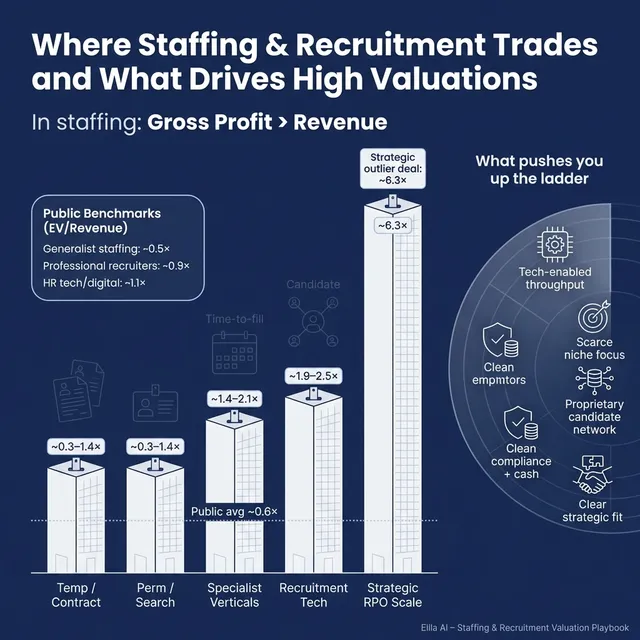
- Services-heavy recruitment and staffing most often clusters in sub-1.5x revenue territory, with many deals in the ~0.3-1.4x EV/Revenue range depending on quality, niche, and profitability.
- Recruitment tech and HR software clusters materially higher, with deals around ~1.9-2.5x EV/Revenue.
- Strategic outliers exist - for example, one scaled outsourced recruiting/RPO transaction priced around ~6.3x revenue, justified by synergy and strategic fit rather than “normal” staffing math.
A simple way to interpret that: buyers pay for de-risked cash flow and defensible differentiation. Tech-like economics and strategic integration fit can move you into a different lane entirely.
These are illustrative ranges based on the dataset - your profile can pull you meaningfully above or below them.
4.2 Public Companies
Public markets set a “sanity check” band for private valuations. They are not a direct template (you are smaller, less liquid, and often more concentrated), but they do show how investors value different models.
In the dataset, public staffing and recruitment companies (overall) average around ~0.6x EV/Revenue and ~9.3x EV/EBITDA. Segment differences matter:
- Global generalist staffing trades lower on revenue multiples (average ~0.5x, median ~0.2x) and mid-single-digit to high-single-digit EBITDA multiples on average.
- HR tech and digital recruiting solutions trade higher on average EV/Revenue (~1.1x average, with a lower median), reflecting that the group mixes true tech with lower-margin models.
- Professional/specialist recruiters show higher average EV/Revenue (~0.9x) and ~10x EV/EBITDA, consistent with better mix and pricing power.
- Early-career platforms land around ~0.7x EV/Revenue on average, though business model differences inside that bucket are large.
How to use public multiples properly:
- Use them as reference guardrails, not a promise.
- Adjust downward for smaller scale, customer concentration, and higher cyclicality.
- Adjust upward if you are scarce, strategically critical, or genuinely tech-enabled with scalable margins.
5. What Drives High Valuations (Premium Valuation Drivers)
The premium outcomes in the dataset are not random. They concentrate around a few themes that buyers consistently reward.
5.1 Tech-enabled recruitment with near-software economics
Premium deals cluster where technology turns recruiting workflows into something closer to software: automation, repeatability, and high gross margins.
Practical examples buyers like:
- Automated screening and matching that measurably improves time-to-fill
- Engagement workflows that re-activate candidates and reduce sourcing cost
- A tech layer that makes each recruiter more productive (and proves it in numbers)
5.2 Clear strategic acquirer fit
Some of the highest revenue multiples in the dataset show up when the target plugs directly into a strategic buyer’s core offering - for example, outsourced recruiting at scale that is immediately earnings-accretive.
What makes this real (not hand-wavy):
- Your service line clearly extends the acquirer’s product or delivery capability
- Integration is straightforward (systems, process, delivery model)
- The target improves the acquirer’s economics quickly (more revenue per client, lower cost to deliver)
5.3 Proprietary candidate network, matching, and engagement IP
Buyers pay more when your “database” is not just a list - it is an asset with defensible sourcing advantages and measurable performance.
Founders often underestimate what counts as proof:
- Fill rates by role type over time
- Time-to-fill vs market benchmarks
- Retention outcomes (for contract renewals or post-placement retention)
5.4 Vertical specialization where talent is scarce or compliance is critical
Specialist staffing in skills-scarce or regulated environments can attract premium outcomes even at smaller scale because the buyer is paying for defensibility.
Examples in staffing where this matters:
- Cybersecurity, healthcare, engineering, or other constrained talent pools
- Roles where background checks, credentialing, or compliance workflows are non-negotiable
- Markets where speed and quality matter more than lowest price
5.5 Scale with defensible positive EBITDA
In the dataset, EBITDA-based premiums show up when a business is scaled enough that margins look durable, not accidental.
What “durable EBITDA” looks like to a buyer:
- Consistent profitability across hiring cycles (or a clear explanation of variance)
- Mature leadership bench, not a founder-centered machine
- Visibility into recruiter productivity, client retention, and gross profit by segment
5.6 Earn-outs as a tool to unlock a higher headline price
Earn-outs show up as a practical mechanism to bridge valuation expectations when growth is credible but not fully proven yet.
Used well, earn-outs:
- Let a buyer pay for future performance without taking all the risk upfront
- Reward you for hitting measurable milestones (revenue, gross profit, EBITDA, renewals)
Used poorly, earn-outs can turn into “maybe money.” The key is picking milestones you can control and that are easy to measure.
6. Discount Drivers (What Lowers Multiples)
Low-end outcomes are usually explainable. Buyers are not just negotiating - they are pricing risk.
The most common discount drivers in staffing and recruitment:
- Customer concentration: one client pause can wipe out a quarter.
- Cyclicality with no shock absorbers: if revenue swings wildly and you cannot explain why, buyers assume the worst.
- Low gross profit quality: thin spreads, weak pricing discipline, or heavy discounting to win volume.
- Founder dependency: key accounts, key recruiters, or all hiring decisions route through you.
- Weak reporting and messy numbers: no segmented gross profit, unclear recruiter productivity, inconsistent revenue recognition.
- Compliance concerns: worker classification risk, wage/hour exposure, co-employment issues, privacy/security gaps.
- Working capital surprises: aging receivables, disputed invoices, poor client credit, or misaligned pay/bill terms.
- No defensible differentiation: “We’re great recruiters” is not a moat in diligence.
The good news: many of these can be improved in 6-12 months with focused execution and cleaner proof.
7. Valuation Example: A Staffing and Recruitment Company
This is a worked example to show how the logic works. The company and numbers are fictional and simplified. This is not investment advice or a formal valuation.
Step 1: The logic (in plain English)
- Start with the right laneIf your model is services-heavy staffing/recruiting, you should not anchor to tech/software multiples. In the dataset, services-heavy staffing and recruitment private comps commonly fall around ~0.3-1.4x revenue, while recruitment tech/HR software clusters around ~1.9-2.5x and strategic outliers can be much higher.
- Cross-check with public compsPublic staffing/recruiting averages are modest (overall ~0.6x revenue), and generalist staffing is lower still. That provides a “gravity” reference point.
- Adjust for premium and discount driversPremiums come from defensibility (niche), proof (metrics), and scalability (team and process). Discounts come from concentration, founder dependency, compliance risk, and messy reporting.
Step 2: Apply it to a fictional business (USD 10m revenue)
Fictional company: “NorthBridge Talent Partners”
- USD 10m annual revenue (fictional)
- Mix: 55% contract staffing, 25% perm placement, 20% embedded RPO for mid-market clients
- Positioning: specialist in cybersecurity and data roles (scarce talent pool)
- Operations: solid KPI reporting by gross profit, time-to-fill, and retention; moderate client concentration (top client 18%)
- Profitability: positive EBITDA but not “software-like”
Illustrative valuation scenarios (revenue multiple approach):
What would justify the premium case (still not tech multiples)?
- Clear scarcity-driven niche with pricing power
- Repeatable delivery (KPIs prove quality and speed)
- Lower dependence on a single founder or a couple of recruiters
- More contracted/embedded revenue, not just transactional placements
What triggers the discounted case?
- Concentration (one client = too much of revenue)
- Poor documentation of gross profit and recruiter performance
- Compliance or classification risk
- High churn of recruiters or key accounts
Step 3: What this means for you
Two staffing firms can both be “USD 10m businesses” and still be worth 2-4x different enterprise values. In this sector, buyers pay for predictability, proof, and defensibility - not just top-line scale.
8. Where Your Business Might Fit (Self-Assessment Framework)
Use this to be honest about where you sit today and what would move the needle fastest. Score each factor 0-2:
- 0 = weak / not proven
- 1 = decent / partially proven
- 2 = strong / consistently proven
How to interpret your total:
- Mostly 2s: you look more like a “premium services” asset - easier to run a competitive process.
- Mixed 0s and 1s: you can still sell, but expect buyers to push you toward the lower/middle of ranges unless you fix the highest-impact gaps.
- Many 0s in high-impact: consider delaying and doing a focused 6-12 month “valuation improvement sprint.”
9. Common Mistakes That Could Reduce Valuation
These are avoidable - and they show up constantly in real processes.
- Rushing the saleIf you go out with messy numbers, unclear story, and no preparation, buyers will either walk or price in a big risk discount.
- Hiding problemsIssues will surface in diligence (compliance, concentration, churn, collections). Hiding them destroys trust and usually costs more later through retrades or failed deals.
- Weak financial records and KPI reportingIn staffing, buyers want to see: gross profit by segment, recruiter productivity, client retention, and cash collection. If you cannot produce it quickly and cleanly, they assume risk.
- Not running a structured, competitive process with an advisorA disciplined process with the right buyer universe typically improves leverage and outcomes. Across M&A more broadly, structured competitive processes are often associated with meaningfully higher prices (commonly cited around ~25% better outcomes) because competition forces real price discovery.
- Revealing the price you’re after too earlyIf you say “we want USD 10m,” you often cap your upside. Buyers will cluster offers around that anchor (USD 10.1m, USD 10.2m) instead of showing what they would have paid in a truly competitive process.
Two staffing-specific mistakes worth calling out:
- Not cleaning up compliance and classification risk before diligence (buyers hate open-ended legal exposure)
- Letting key recruiter or client relationships remain non-transferable (value collapses if relationships walk out the door)
10. What Staffing and Recruitment Founders Can Do in 6-12 Months to Increase Valuation
Think of this as four workstreams: improve the numbers, reduce risk, strengthen proof, and run a better process.
10.1 Improve the numbers buyers trust
- Rebuild reporting around gross profit by segment (temp/contract vs perm vs RPO) and gross profit per recruiter
- Tighten pricing discipline: markups/spreads, approval rules for discounts, and “profit leakage” controls
- Identify 2-3 margin expansion levers you can execute quickly (mix shift, contract terms, recruiter productivity, back-office efficiency)
10.2 De-risk concentration and cyclicality
- Reduce top-client exposure with a clear plan (target mix, new vertical pods, new logos)
- Convert more work into contracted/embedded relationships where possible (even if it starts small)
- Improve collections: client credit checks, billing accuracy, dispute resolution SLAs, and aging discipline
10.3 Make differentiation provable (not just a narrative)
- If you claim speed/quality, measure it: time-to-fill, submit-to-hire ratio, retention outcomes
- If you claim niche defensibility, document it: candidate scarcity, acceptance rates, and repeat order behavior
- If you have tech or automation, quantify impact: recruiter throughput, sourcing time saved, improved fill rates
10.4 Build a business that can run without you
- Transition key accounts to account owners with clear handoffs and documented playbooks
- Incentivize recruiter retention and continuity (buyers discount churn risk heavily)
- Strengthen your second layer of leadership so diligence does not feel “founder-only”
11. How an AI-Native M&A Advisor Helps
In staffing and recruitment, the best outcomes usually come from two things: the right buyer set and a process that creates competitive tension. AI can materially improve both.
First, higher valuations through broader buyer reach. An AI-native approach can expand the buyer universe to hundreds of qualified acquirers based on deal history, synergy fit, financial capacity, and strategic signals. More relevant buyers means more competition, stronger offers, and more backup options if one buyer drops.
Second, initial offers in under 6 weeks is increasingly realistic when buyer matching, outreach, and core process materials are accelerated with AI - while still being guided by experienced humans. Speed matters because staffing markets move with hiring cycles, and momentum is leverage.
Third, you still need expert advisory, enhanced by AI: senior M&A professionals who can shape a credible equity story, prepare buyer-ready materials, and manage diligence so the process stays controlled. The goal is “Wall Street-grade” advisory quality without traditional bulge-bracket costs.
If you’d like to understand how our AI-native process can support your exit, book a demo with one of our expert M&A advisors.
Are you considering an exit?
Meet one of our M&A advisors and find out how our AI-native process can work for you.


