
The Complete Valuation Playbook for Sustainable Packaging Businesses
A practical guide to how sustainable packaging businesses are valued today and what drives high multiples.

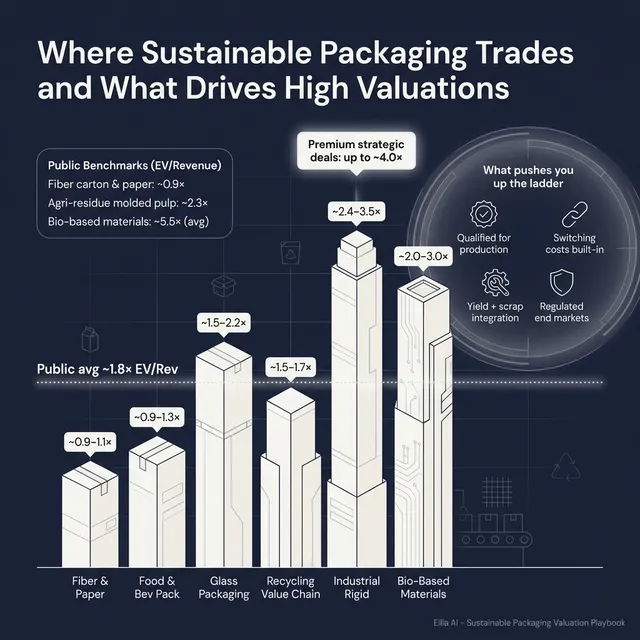
If you run a sustainable packaging business and you’re thinking about selling in the next 1-12 months, your valuation will not be decided by one number. It will be decided by how buyers classify your company - as a commodity manufacturer, a specialized platform, a regulated-quality supplier, or a technology-enabled packaging solution with real switching costs.
This matters right now because the sector is consolidating: large packaging groups are buying capability (materials, formats, regional footprint), while private equity is leaning into “platform + add-ons” strategies in packaging and adjacent equipment and services. At the same time, sustainability claims are being scrutinized more than ever - buyers will reward proof and punish fluff.
This playbook is built on real market data (public multiples and precedent deals) plus practical M&A pattern recognition. You’ll see what similar businesses sell for, what drives higher vs lower multiples, a worked valuation example on a fictional USD 10m revenue company, and a self-assessment plus 6-12 month action plan.
1. What Makes Sustainable Packaging Unique
Sustainable packaging is not one industry - it’s a set of business models that sit at the crossroads of manufacturing, materials science, brand marketing, and regulation. Two companies can both call themselves “sustainable packaging” and trade at completely different multiples because one is a high-margin, specialized solution and the other is a capacity business with cyclical inputs.
The main business types you see in this sector
Most sustainable packaging companies fall into a handful of archetypes:
- Fiber-based and paper packaging manufacturers (cartonboard, corrugated, molded fiber, paper-based formats)
- Bio-based and compostable materials/resins (biopolymers, compostable films, resin IP)
- Agri-residue and molded pulp innovators (bagasse, agri-waste pulp, molded formats with novel feedstocks)
- Flexible packaging and converting with sustainability angles (mono-material, recyclable structures, downgauging, recycled content)
- Rigid containers and industrial packaging (jerrycans, drums, IBCs, often with recycling and re-use angles)
- Packaging systems and equipment-adjacent solutions (filling/dispensing equipment, automation, installed base with service revenue)
Each archetype has a different “valuation engine.” A fiber mill is valued like an asset-heavy manufacturer. A compostable resin business with IP is valued more like a specialty materials company. A packaging system with an installed base can behave like a hybrid of product + recurring service.
Unique valuation considerations
There are three valuation questions buyers obsess over in sustainable packaging:
- Is sustainability a profit engine or a marketing layer? Buyers pay more when the “green” claim drives conversions, pricing power, retention, or regulatory access - not when it’s just a nicer story.
- Are you selling “units” or solving a workflow? A packaging format that requires equipment integration, qualification, or line validation creates stickiness and can lift multiples.
- Is your cost structure stable and scalable? Packaging businesses live and die by input costs, yield, scrap, throughput, and customer changeovers. Buyers will underwrite your operations like a factory, even if your pitch sounds like a tech company.
Key risk factors buyers will always check
In this sector, diligence is less about “can you code it?” and more about “can you produce it reliably at the economics you claim”:
- Feedstock supply and price volatility (recycled content availability, pulp pricing, resin inputs)
- Qualification risk (food contact compliance, migration testing, pharma or medical requirements)
- Line performance (speed, scrap, defects, sealing, barrier performance, shelf life)
- Customer concentration and switching friction (a few anchor accounts can be great - until one leaves)
- Capex and working capital intensity (inventory, receivables, tooling, equipment, maintenance)
- Regulatory and “green claims” risk (what you can legally say, and what customers demand as proof)
2. What Buyers Look For in a Sustainable Packaging Business
Buyers don’t buy sustainable packaging because it’s virtuous. They buy it when it changes their growth curve, their cost curve, or their risk profile.
The universal value drivers (still matter here)
Even in a very sector-specific business, the fundamentals are the starting point:
- Size and momentum: revenue scale and growth trend
- Profitability: gross margin and EBITDA margin trajectory (not just the current snapshot)
- Customer quality: retention, renewals, and repeat orders
- Concentration: how exposed you are to 1-3 customers or one end market
- Operational control: clean financials, reliable reporting, and the ability to forecast
The sector-specific nuances that move multiples
In sustainable packaging, buyers focus on proof of adoption and proof of manufacturability:
- Qualification status: “approved for production” beats “in pilot” by a mile.
- Cost-performance parity: if you’re asking customers to pay more, buyers need to see why that premium sticks.
- Switching costs: anything that ties you into the customer’s line, equipment, certification, or SKU redesign increases stickiness.
- Regulated end markets: pharma, medical, and temperature-sensitive supply chains often justify higher valuation logic because compliance creates barriers (you see this show up in premium outcomes for mission-critical packaging niches).
- Scalability path: buyers want a believable plan from today’s footprint to a multi-site, resilient supply chain.
How private equity thinks about your business
Private equity will often like sustainable packaging if they can see a clean path to “buy, improve, and sell.”
They tend to think in three steps:
- Entry multiple vs exit multiple: they want to buy at a reasonable valuation and sell later to a bigger buyer at an equal or higher multiple.
- Who is the buyer in 3-7 years?: a strategic packaging group, a larger PE fund, or occasionally public markets.
- What levers can they pull?:
- price increases (especially in specialty or design-forward packaging)
- operational efficiency (yield, scrap, throughput, procurement)
- mix shift (more specialty SKUs, more recurring/service-like revenue)
- add-on acquisitions (roll up smaller converters or regional players)
- commercial expansion (new geographies, new end markets)
If your business has a credible “platform + add-ons” story, PE interest rises. If it’s a single-plant, single-customer, input-cost-exposed operation, they will either discount it heavily or pass.
3. Deep Dive: The Valuation Nuance That Matters Most - Proof of Scalability and Switching Costs
Here’s the key question: Are you a product supplier that can be swapped out, or a packaging solution that’s “built into” the customer’s operation? This is one of the biggest splitters between average outcomes and premium outcomes in this sector.
Why this matters
Packaging buyers fear two things: operational disruption and reputational risk. If your packaging change causes line downtime, quality issues, or shelf-life failures, the customer gets punished. That fear is why buyers pay more for packaging businesses that are hard to replace.
How this shows up in the data
Premium deal outcomes cluster around businesses with either:
- technology-enabled packaging platforms (specialized formats, proprietary performance), and/or
- equipment integration and installed base that creates sticky revenue and switching friction, and/or
- mission-critical end markets (temperature-control, pharma-grade requirements) where compliance locks in customers.
You can see this logic in high revenue multiples paid for specialized packaging and platform-like solutions, including cases where buyers paid up even when profitability was weak, because the technology and customer criticality were strong.
Lower-value profile vs higher-value profile
How you move right on this table in 6-12 months
You usually don’t need a massive pivot. You need proof:
- Convert pilots into production runs with documented line performance (speed, scrap, defect rates).
- Package your sustainability as verifiable economics (cost curves, pricing stability, supply reliability, avoided fees, regulatory compliance).
- Build an “integration wedge” - tooling, design services, equipment compatibility, or qualification packages that make you harder to replace.
- Formalize your quality system (even if you’re not pharma) so a strategic buyer believes you can scale without breaking.
4. What Sustainable Packaging Businesses Sell For - and What Public Markets Show
This is the section founders often misread. Public multiples are useful reference points, but private deals reflect reality: size, risk, margins, and buyer competition.
Across the data provided, the overall averages cluster around:
- Public markets: ~1.8x EV/Revenue and ~12.2x EV/EBITDA
- Precedent transactions: ~2.0x EV/Revenue and ~7.6x EV/EBITDA
The spread inside sustainable packaging is wide because “sustainable” spans both commodity packaging and IP-led materials.
4.1 Private Market Deals (Similar Acquisitions)
The private deal data shows clear segment differences:
- Sustainable fiber and paper-based packaging tends to transact around ~1.1x EV/Revenue on average, with ~7-8x EV/EBITDA type outcomes in the group averages.
- Food and beverage packaging (multi-material) shows ~1.3-1.7x EV/Revenue in the averages, but with lower EBITDA multiples in the group averages (partly reflecting mature, margin-pressured profiles).
- Industrial and chemical rigid packaging is the standout in the private averages with ~3.1-3.4x EV/Revenue and ~11-13x EV/EBITDA range in group stats - consistent with specialty formats, global footprints, and higher switching costs.
- Glass packaging deals cluster around ~1.8-1.9x EV/Revenue in group averages.
A simple way to read this: the more your packaging product behaves like a specialized system (or a regulated-quality supplier), the more the market pays.
These are illustrative ranges based on the provided deal set and group averages - your actual outcome depends on your growth, margins, customer risk, and how strategic you are to the buyer.
4.2 Public Companies
Public markets give you a “reference band,” not a price tag. The grouped public data shows:
- Fiber-based carton & paper packaging trades around ~0.9-1.0x EV/Revenue and ~7.7-8.4x EV/EBITDA.
- Agri-residue & molded pulp innovators trade higher, around ~2.0x EV/Revenue and ~12x EV/EBITDA.
- Bio-based & compostable materials show a high average (~5.5x EV/Revenue) but a much lower median (~2.4x), which screams “outliers.” Some public names trade at very high revenue multiples even with negative EBITDA, which is not directly comparable to a private manufacturing business.
- Industrial & consumer flexible packaging looks mixed: median EV/Revenue around ~0.8x, but higher EBITDA multiples in the average, reflecting how profitability profiles vary.
- Metal and glass packaging generally sit in the ~0.9-1.5x EV/Revenue zone with mid-single to high-single digit EBITDA multiples.
These public multiples are best treated as “as of mid-to-late 2025” reference points from the dataset you provided, not as timeless truths.
How to use public multiples correctly
- Use public comps as outer guardrails, not an answer.
- Adjust down for smaller scale, customer concentration, weaker margins, or higher operational risk.
- Adjust up only when you have scarce capabilities (qualified format, proprietary performance, regulated end markets, or platform-like stickiness) and multiple motivated buyers.
5. What Drives High Valuations (Premium Valuation Drivers)
Premium outcomes in sustainable packaging tend to cluster around a few repeatable themes. The data supports these patterns, and they’re consistent with how strategic buyers and PE underwrite risk.
Theme 1: Sustainability that is provable - and profitable
Buyers pay up when sustainability is tied to real economics: conversion wins, customer willingness to pay, regulatory tailwinds, and stable margins. The deals that read “premium” don’t just say “recyclable.” They show why the customer switches and stays.
What this looks like in practice:
- Third-party LCAs (life cycle assessments) that customers actually use in decision-making
- Case studies showing rollout scale, not just pilot announcements
- Evidence the cost curve improves with volume (yield, throughput, procurement)
Theme 2: Specialized, technology-enabled packaging platforms
Premium valuations appear when technology delivers performance or compliance advantages that incumbents can’t easily replicate. This shows up in specialized rigid formats, temperature-control packaging, and proprietary materials platforms.
Founder-level examples:
- Your packaging solves a hard problem (barrier, thermal stability, dispensing accuracy, contamination control)
- Customers qualify you because failure has consequences (recalls, compliance breaches, product spoilage)
- You have defensible know-how beyond “we run a plant”
Theme 3: Equipment integration and installed base = stickier revenue
A packaging business becomes more valuable when it’s tied into equipment, tooling, or installed workflows. An installed base creates:
- recurring service revenue
- predictable replacement cycles
- switching friction
Even if your core revenue is still product sales, showing that your solution is embedded in operations can lift buyer confidence and reduce perceived churn risk.
Theme 4: Brand-critical, design-forward capability
Packaging is sometimes a marketing surface, not just a container. In premium spirits, cosmetics, and certain consumer categories, design and decoration capabilities can create pricing power and customer lock-in.
What buyers want to see:
- repeat orders and SKU expansion with the same brand families
- proven ability to hit aesthetic specs at scale (color, texture, finish, print)
- lead time reliability (brands hate missed launches)
Theme 5: Strategic synergies and platform expansion
Strategic buyers will pay more when you unlock expansion:
- a new format that fits their customer base
- a new region or footprint
- a capability they can cross-sell through existing channels
Your job in a sale process is to make those synergies “feel real” with concrete overlap analysis, not vague statements.
Theme 6: Mission-critical end markets (pharma, temperature-sensitive supply chains)
Where compliance is strict and failure is expensive, buyers often accept higher multiples because revenue is stickier. If you can credibly play in these niches (with validated compliance and quality systems), it can change your valuation reference set.
Theme 7: High gross margins and EBITDA discipline
This is the unsexy truth: sustainable packaging still gets valued like packaging. Gross margin quality, EBITDA discipline, and operational control show up consistently in stronger outcomes.
Even for earlier-stage companies, buyers look for:
- improving margins over time
- controlled scrap and rework
- stable pricing and a credible path to profitability
6. Discount Drivers (What Lowers Multiples)
Discounts usually come from one place: buyers don’t trust the durability of your earnings, or they don’t trust your ability to scale without breaking.
Here are the most common value killers in this sector:
“Sustainability story” without proof
If the pitch is strong but the data is thin, buyers haircut the multiple:
- no third-party validation
- no repeatable conversion math
- unclear customer willingness to pay
Pilot-heavy revenue and weak repeatability
If most revenue is one-off pilots, custom trials, or non-repeatable projects, buyers will treat it like fragile revenue. They’ll either:
- lower the multiple, or
- structure earn-outs heavily (you only get paid if growth happens)
Customer concentration (and single end market exposure)
Many sustainable packaging businesses start with anchor accounts. That’s fine - until you sell.If one customer is 30-50% of revenue, your valuation becomes a negotiation about risk, not upside.
Low visibility on margins and operational KPIs
If you can’t clearly explain:
- yield and scrap
- throughput constraints
- labor and energy drivers
- gross margin by product line…then buyers assume the worst and discount accordingly.
High working capital or capex surprises
Packaging deals often get renegotiated late because of working capital and capex misunderstandings:
- inventory build needs
- customer-specific tooling
- maintenance capex underestimated
- receivables stretched by large customers
Regulatory or claims risk
If your “compostable” or “recyclable” claims are jurisdiction-dependent or hard to substantiate, buyers will price in future disputes, relabeling, or customer churn.
7. Valuation Example: A Sustainable Packaging Company (Fictional)
This example is designed to show the logic of how valuation ranges form. It is not a formal valuation or investment advice.
The fictional company
VerdantForm Packaging (fictional) is a sustainable packaging business with USD 10m annual revenue (fictional).
Profile:
- Produces a fiber-based rigid format for beverages and personal care
- Mix of production contracts and growing repeat orders
- Early but improving gross margins
- Several pilots converting to longer-run SKUs
- Some proprietary know-how (process + performance), but not yet “proven at massive scale”
Step 1: How you select and narrow multiples
Start with the reality: packaging revenue multiples are usually low single digits unless there is clear tech differentiation, stickiness, or regulated-end-market value.
Using the source logic:
- Commodity and scaled packaging peers cluster roughly ~0.7x-2.0x revenue depending on segment.
- Specialty sustainable materials and rigid/specialized packaging can reach ~2.0x-3.0x, excluding extreme public-market outliers that often involve loss-making “tech stories.”
- Private data shows a specialty rigid bucket reaching into the ~2.4x-3.5x range for the right profiles.
So for a USD 10m revenue business like VerdantForm, a reasonable way to frame it is:
- Base case: where you’re a differentiated packaging manufacturer, but still proving scale
- Premium case: where you’ve clearly earned switching costs and repeatability
- Discount case: where pilots dominate and economics are unclear
Step 2: Apply the multiples to USD 10m revenue
Here is an illustrative framework consistent with the source logic that defended a ~1.8x-3.2x revenue multiple band for an early-stage, differentiated sustainable packaging format:
Why keep the “core” anchored at ~1.8x-3.2x?
- Below that starts to look like commodity packaging, which ignores differentiation.
- Above that usually requires stronger proof: repeatable scale economics, deeper switching costs, or a regulated niche.
Step 3: What this means for you as a founder
Two businesses with the same USD 10m revenue can be worth radically different amounts because buyers are pricing confidence:
- Confidence your customers stay.
- Confidence your margins improve with scale.
- Confidence your sustainability claim is defensible.
- Confidence the operation won’t collapse during growth.
If you’re selling soon, your job is not to “argue a multiple.” Your job is to reduce the reasons a buyer would discount you.
8. Where Your Business Might Fit (Self-Assessment Framework)
Use this as a rough positioning tool, not a grade. Score each factor 0 / 1 / 2:
- 0 = weak or unclear
- 1 = decent but not proven
- 2 = strong and evidenced
How to use it
Be honest. The point is to identify the highest-return improvements in the next 6-12 months.
Interpreting your score
- High band: You’re closer to premium outcomes because risk is low and proof is high.
- Middle band: You’re in fair-market territory - a good process can still produce a strong outcome.
- Low band: You can still sell, but expect more structure (earn-outs) or a lower multiple unless you fix the biggest risks.
9. Common Mistakes That Could Reduce Valuation
Rushing the sale
If you launch a process before your numbers and story are ready, you turn your deal into a buyer-driven negotiation. In packaging, buyers move fast when they smell urgency - and they use it.
Hiding problems
Every problem surfaces in diligence: customer concentration, margin volatility, quality issues, missed forecasts. If you hide it, buyers don’t just discount the price - they discount trust, which kills competition.
Weak financial records
A surprising number of packaging businesses lack clean segmentation:
- margin by product line
- pilot vs repeat revenue
- customer-level profitability
- clear working capital drivers
Cleaning this up can be a 6-12 month project that pays back directly in valuation and deal certainty.
No structured, competitive sale process with an advisor
A competitive process matters because it creates price discovery. Research often cited in M&A shows that running a structured, competitive process with a professional advisor can materially increase outcomes - often quoted around ~25% higher purchase prices versus bilateral negotiation. (Treat this as directional, not a guarantee.)
Revealing what price you’re after too early
If you tell buyers “we want USD 10m,” you cap your upside. You’ll get offers like USD 10.1m and USD 10.2m instead of what the market might have paid with proper competition.
Two sector-specific mistakes founders make
- Selling “sustainability” instead of selling “risk reduction.” Buyers want proof your format won’t cause downtime, defects, or claims risk.
- Under-preparing the operational story. In sustainable packaging, valuation is heavily tied to factory reality: throughput, yield, scrap, and qualification. If you can’t explain it, you get discounted.
10. What Sustainable Packaging Founders Can Do in 6-12 Months to Increase Valuation
You don’t need to reinvent your company. You need to de-risk it and make the value legible.
A. Improve the numbers buyers underwrite
- Build a simple, credible gross margin bridge: input costs, yield, scrap, labor, energy, logistics.
- Separate pilot revenue from repeat revenue: show repeat order growth as the core story.
- Reduce customer concentration where possible: even adding 2-3 meaningful customers can change buyer psychology.
- Tighten working capital: clean up inventory logic, receivables discipline, and purchasing terms.
B. Turn sustainability into defensible proof
- Publish or commission third-party LCAs that are decision-useful for customers.
- Create case studies that show: why the customer switched, what changed operationally, and what scaled.
- Document cost-performance parity (or the justified premium) with real purchase order data, not assumptions.
C. Increase switching costs (without being “salesy”)
- Standardize qualification packages (testing, documentation, training) so adoption is repeatable.
- Push toward equipment compatibility or tooling integration when relevant.
- Introduce service-like elements (QA support, line optimization, changeover support) that make you part of operations.
D. Upgrade the deal readiness of the business
- Produce monthly reporting that a buyer can trust.
- Make your leadership bench visible (who runs ops, quality, sales).
- Prepare a data room early: contracts, specs, certifications, customer communications, IP documentation.
E. Run a process that creates competition
Even a great business can sell for an average price if you don’t create a market around it. The goal is not to “pitch harder.” The goal is to get the right buyers in the room at the same time.
11. How an AI-Native M&A Advisor Helps
Selling a sustainable packaging business is not only about finding a buyer - it’s about finding the right set of buyers who value your specific combination of format, economics, and strategic fit. AI helps expand the buyer universe based on real deal history, synergy signals, and capacity to transact, often reaching hundreds of qualified acquirers. More relevant buyers means more competition, stronger offers, and more backup options if one party drops.
AI also compresses timelines. With AI-driven buyer matching, faster outreach, and streamlined creation of marketing materials and diligence support, you can often reach serious conversations and initial offers in under 6 weeks - not because diligence is skipped, but because the process is executed with more speed and structure.
The best outcomes still require experienced human judgment. An AI-native advisory model pairs senior M&A expertise with AI tooling so your positioning, materials, and negotiation strategy match what acquirers actually respond to. The result is “Wall Street-grade” process quality without traditional bulge bracket costs - especially valuable for founder-owned businesses where every dollar of outcome matters.
If you’d like to understand how an AI-native process can support your exit, book a demo with one of our expert M&A advisors at Eilla AI.
Are you considering an exit?
Meet one of our M&A advisors and find out how our AI-native process can work for you.


