
The Complete Valuation Playbook for Veterinary Services Businesses
A guide to what veterinary clinic groups sell for and the steps founders can take to lift multiples by strengthening staffing, access, and deal readiness.

If you are thinking about selling your veterinary services business in the next 1-12 months, valuation stops being a theoretical topic and becomes a set of practical choices: what story you tell, what risks you remove, and what proof you can show buyers.
This playbook is built for veterinary founders and CEOs. It will (1) show what veterinary businesses actually sell for (using real deal data and public market reference points), (2) explain what pushes multiples up or down in this sector, and (3) give you a simple self-assessment and a realistic 6-12 month action plan to improve outcomes.
1. What Makes Veterinary Services Unique
Veterinary services looks simple from the outside - clinics provide care, clients pay, and outcomes depend on great medicine and great teams. But valuing a veterinary business is not the same as valuing a generic “services company,” because the engine of the business is clinical capacity.
Here are the main business types buyers see inside “veterinary services”:
- Companion animal general practice (routine visits, dentistry, basic surgery)
- Emergency and after-hours (unplanned care, overnight hospitalization)
- Specialist referral hospitals (orthopedics, internal medicine, imaging, oncology)
- Mixed animal practices (companion + equine + farm / herd health)
- Adjacencies that change the economics: in-house pharmacy programs, compounding relationships, diagnostic lab partnerships, or product distribution
What makes valuation unique in this sector:
- Labor is the constraint. Buyers pay for sustainable veterinarian and nurse capacity, not just a building and a brand.
- Case mix drives revenue per clinician. Emergency, referral, and higher-acuity procedures can lift revenue per vet and improve defensibility.
- Recurring behavior exists, but it is “relationship recurring,” not contractual recurring. Retention comes from trust, continuity of care, convenient hours, and quality standards.
- Clinical standards and compliance are value drivers, not just “good practice.” Buyers will pressure-test controlled drug management, medical records, and governance.
Key risk factors buyers will always check (and discount hard if weak):
- Owner dependence (if you are the rainmaker, surgeon, and medical director all in one)
- Recruiting and retention track record (especially for vets who can handle emergency or higher-acuity work)
- Pricing discipline and discounting habits
- Facility condition and equipment readiness (especially imaging, surgery, inpatient capacity)
- Regulatory and clinical compliance (controlled substances, clinical protocols, complaints)
2. What Buyers Look For in a Veterinary Services Business
Most buyers - strategic consolidators and private equity backed groups - look at veterinary clinics as a “throughput” business: how reliably can the organization convert demand into high-quality appointments and procedures, without burning out the team.
The obvious fundamentals still matter
- Scale: multi-site groups tend to be valued more predictably than single sites
- Growth: stable year-over-year growth beats one “hero year”
- Profitability (EBITDA): not just the number, but whether it is sustainable without heroic effort
- Cash conversion: clean billing, predictable working capital, limited surprises
The veterinary-specific “this is what actually moves price” items
- Revenue per veterinarian and per exam room (a proxy for throughput and demand capture)
- Hours and access: after-hours, weekends, emergency coverage
- Clinical depth: specialists, strong surgery/dentistry, imaging, inpatient capability
- Mix of revenue: how much is routine vs complex care, and whether pharmacy/diagnostics programs increase share of wallet
- Quality and consistency across sites: do clients experience the same standard of care everywhere?
How private equity thinks (in plain English)
Private equity does not buy your business hoping it stays exactly the same. They buy it believing they can improve it and sell it later.
They typically think about:
- Entry multiple vs exit multiple: “If we pay X today, can we sell for X or more in 3-7 years?”
- Who the next buyer is: a larger consolidator, a bigger private equity fund, or (rarely) a public market path for very large groups
- The levers they expect to pull:
- pricing discipline and better fee schedules
- improved scheduling and clinician utilization
- add services with higher margins (dentistry, imaging, inpatient, emergency)
- add locations (buy more clinics) if your platform is strong
- professionalize management so performance does not rely on one person
The takeaway: buyers pay up when they believe your clinic group can run “repeatably” - good medicine, good experience, and good economics, even as it grows.
3. Deep Dive: Why 24/7 Emergency and Higher-Acuity Case Mix Can Change Your Multiple
In veterinary services, not all revenue is equal.
Two clinics can each do USD 10m in revenue, but the one that captures urgent and complex care often commands more buyer interest because it can generate more revenue per clinician and reduce “leakage” (clients going elsewhere when needs are urgent or specialized).
Across comparable veterinary clinic deals and public clinic operators, 24/7 coverage and emergency capacity show up repeatedly as premium narratives because they create:
- unplanned demand capture (urgent cases do not wait for next Tuesday)
- higher average invoice values (more diagnostics, procedures, hospitalization)
- stickier client relationships (the clinic becomes the default provider)
- better scheduling economics (more consistent use of facilities and staff)
Just as importantly, buyers care how after-hours care is delivered. In-house coverage is usually valued more than outsourcing to a third party because it tends to keep revenue and continuity of care inside the business.
If your clinic looks more like the “lower-value” profile today, you do not need to magically become a specialist hospital to benefit. You can often move in the right direction by building the operational foundations: hours, staffing model, triage protocols, and a clear offer to clients.
Here is a simple way buyers mentally bucket this:
Practical steps to move right (without breaking your team):
- Start with extended hours and structured urgent-care blocks, not “overnight from day one.”
- Build protocols (triage, hospitalization, handoffs) so quality is consistent.
- Invest in the staffing model: you cannot outwork a broken schedule - you need shift design that retains people.
4. What Veterinary Services Businesses Sell For - and What Public Markets Show
Founders often hear big headline numbers in animal health (diagnostics, pharma, software) and assume clinics should trade similarly. The data says otherwise: pure clinical services typically trade at lower revenue multiples than product or software businesses, but premiums exist when clinical depth, access, and scalability are real.
Think of public market multiples as a “reference band” and private deals as “what actually gets done” for businesses like yours.
4.1 Private Market Deals (Similar Acquisitions)
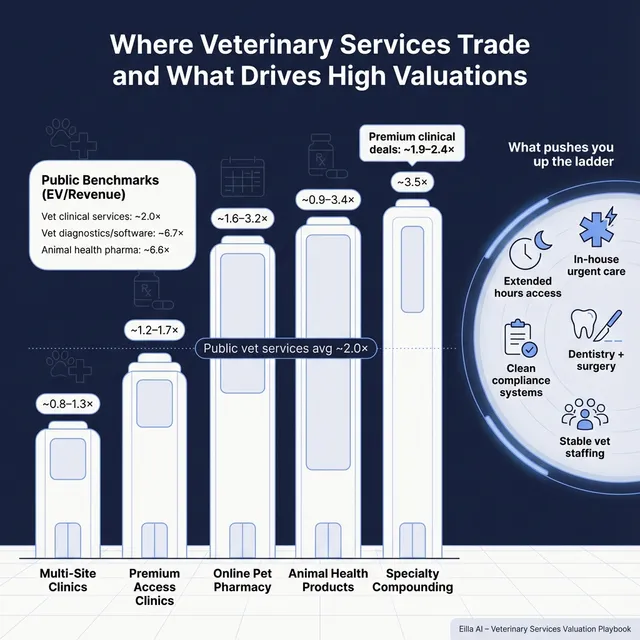
In the precedent transactions data, multi-site veterinary practices with emergency and general care cluster around ~1.1x EV/Revenue on average, with examples spanning from well under 1.0x to around the mid-1.0x range depending on context.
Adjacencies can trade higher because their margins and defensibility differ:
- Specialty compounding pharmacies serving veterinary needs show ~3.5x EV/Revenue in the deal sample.
- Online pet pharmacies and retailers cluster around ~2.4x EV/Revenue (with wide variation deal-to-deal).
- Animal health product manufacturers and distributors show a wide range, with a ~1.2x median EV/Revenue and ~2.5x average in the sample (skewed by larger deals).
A practical way to interpret this as a veterinary services founder: buyers are usually paying around 0.8x-1.3x revenue for “standard” clinic groups, and they may pay more when you have genuine premium attributes (access model, case mix, staffing depth, or high-margin adjacencies).
Illustrative private market ranges by segment (based on the provided deal groupings):
These are illustrative bands, not a pricing guarantee. Deal structure (earnouts, rollovers, real estate, working capital) can also materially change the “headline multiple.”
4.2 Public Companies
Public market multiples give you a reality check: investors price different animal health segments very differently.
As of mid-to-end 2025 in the provided dataset, average public multiples by segment look roughly like this:
Two practical points for clinic founders:
- Public clinic operators are often a higher multiple reference point than private clinic deals, because public platforms can have scale, liquidity, and more stable investor perception.
- Do not “price yourself off diagnostics or pharma” unless you actually have those economics. A clinic business without IP or software-like margins will usually be valued off clinic comps, plus or minus premiums based on your specific strengths.
Use public multiples as a reference band, not a direct price tag. Private buyers will usually adjust downward for smaller scale, local concentration, or key-person risk - and adjust upward when your asset is scarce and strategically valuable (for example: true emergency coverage, strong referral capability, or unusually durable staffing and demand).
5. What Drives High Valuations (Premium Valuation Drivers)
Premium outcomes in veterinary services are not magic. They are usually the result of buyers believing two things:
- Your revenue is defensible (clients stay, demand is stable, competition is manageable).
- Your economics can scale (you can add clinicians, hours, and services without the model breaking).
Based on the observed premium drivers in the provided deal set - plus standard M&A patterns in clinics - here are the biggest “multiple lifters,” grouped into founder-friendly themes.
5.1 Premium access and higher-acuity care
Buyers pay more when your clinics capture urgent and complex care because it often increases revenue per clinician and reduces leakage.
What this looks like in practice:
- In-house after-hours coverage (not just outsourced)
- Overnight hospitalization capability where appropriate
- Strong dentistry and surgery utilization (not just “available,” but actively delivered)
5.2 Multi-site footprint with real clinical capacity
A multi-site model is only worth a premium if it is more than a list of addresses. Buyers want proof of throughput and staffing depth.
Signals buyers like:
- multiple vets per site (not “one-vet dependency”)
- consistent medical standards across sites
- shared scheduling, call handling, and operational playbooks
5.3 Mixed species breadth (when it is real and profitable)
Mixed species can diversify revenue and smooth seasonality, and it can create premium services (equine procedures, herd health programs). It also attracts consolidators looking for platform assets that can add services over time.
The key is that it must be repeatable and staffable, not just “we do a bit of everything.”
5.4 Higher-margin adjacencies (pharmacy, compounding, manufacturing partnerships)
The data shows higher revenue multiples in compounding and CDMO-style businesses than in clinics, because margin and defensibility change.
Most clinics will not become manufacturers, but you can still benefit from the idea:
- formalize your pharmacy program (capture more prescriptions in-house where appropriate)
- build compliant processes and reporting
- create trusted partnerships that increase your share of wallet
5.5 Proven margin discipline and EBITDA uplift
Buyers pay premiums when you can show that improvements are not hypothetical.
Examples:
- you improved clinician utilization without increasing burnout
- you raised prices with minimal client loss because you communicated value well
- you reduced overtime and turnover with better staffing design
- you improved scheduling and reduced “appointment leakage” (missed calls, long waits)
5.6 The “boring” fundamentals that still matter a lot
Even in a clinical business, buyers pay more when you remove uncertainty:
- clean financials and clear add-backs (one-time costs)
- diversified client base (not one rescue org driving 30% of volume)
- strong management bench (practice managers, medical leadership beyond the founder)
- consistent KPIs (visits, average invoice, rechecks, capacity, churn of staff)
6. Discount Drivers (What Lowers Multiples)
Discounts in veterinary M&A usually come from one fear: “Will this fall apart after the founder sells?”
Here are the most common value killers, and how buyers interpret them.
6.1 Owner dependence and fragile staffing
- If you are the main clinician, main manager, and main relationship holder, buyers see a fragile machine.
- If you have high vet turnover or open requisitions you cannot fill, buyers worry revenue will shrink.
What to do: build a leadership bench and show that the clinic runs well during your absence.
6.2 Limited access model and weak capture
Daytime-only clinics can be great businesses, but they often lose urgent and higher-value cases to competitors.
What to do: even modest access improvements (extended hours, structured urgent slots) can strengthen retention and perception.
6.3 Thin or distorted profitability
Clinic EBITDA can be “accidentally low” (overstaffing, poor scheduling, founder paying themselves oddly) or “structurally low” (bad pricing, weak demand, broken processes). Buyers discount both until proven otherwise.
What to do: show a believable path to stable margins, backed by data and actions already taken.
6.4 Messy financials and unclear performance by site
If buyers cannot trust the numbers, they protect themselves with lower offers, tougher terms, and more holdbacks.
What to do: clean site-level reporting, consistent chart of accounts, and clear separation of owner perks vs true operating costs.
6.5 Concentration and local competitive risk
- One site driving most of the profit
- One referrer, rescue, or employer driving a large share of cases
- A new competitor opening nearby
What to do: diversify demand sources and prove local defensibility through retention and capacity.
6.6 Compliance and clinical governance red flags
Controlled substances, records, complaints, and inconsistent protocols can become “deal friction.” Even if the business is good, buyers discount the risk.
What to do: treat compliance as part of the value story, not a back-office chore.
7. Valuation Example: A Veterinary Services Company
Let’s make the logic real with a fictional company. This is not a formal valuation or investment advice - just a worked example to show how buyers think.
The fictional business
Riverstone Veterinary Group (fictional)
- 3 companion animal clinics + 1 urgent care site
- One location has extended hours and handles urgent walk-ins; no true specialist referral
- Strong dentistry and surgery utilization
- Stable staffing: 14 vets across the group, low turnover in the last 12 months
- USD 10.0m trailing twelve-month revenue (fictional)
- EBITDA margin: ~12% (USD 1.2m) after normalizing owner compensation (fictional)
Step 1: Pick the right “multiple family”
Riverstone is a clinical services business, so the most relevant anchors are:
- Private multi-site clinic deals (often around ~0.8x-1.3x revenue for typical profiles)
- Public clinical services operators (often around ~1.3x-2.0x revenue as a broader reference)
- Higher multiples seen in diagnostics/software or pharma are not appropriate unless your economics truly match those models.
Step 2: Build a base range, then adjust up or down
A simple approach that mirrors how many buyers triangulate:
- Start with a core clinic range: ~1.2x-1.8x revenue
- Push higher if premium drivers are proven (access model, staffing depth, utilization, margin discipline)
- Pull lower if key risks exist (owner dependence, staffing gaps, weak profitability, messy reporting)
Step 3: Apply it to USD 10.0m revenue
Why the premium case is not “infinite”: without true specialist referral depth or product/software economics, you are still a services business. Premiums exist, but they are usually earned through demonstrated throughput, defensibility, and management strength.
What this means for you
Two veterinary groups with the same USD 10m revenue can be worth very different amounts because buyers are not paying for revenue alone. They are paying for:
- how durable the revenue is (retention + access + reputation)
- whether the team and systems can sustain and grow it
- whether margins are real and improvable
8. Where Your Business Might Fit (Self-Assessment Framework)
This is a quick tool to locate yourself roughly in the valuation spectrum. Score each factor 0, 1, or 2:
- 0 = weak or unproven
- 1 = decent but inconsistent
- 2 = strong and evidenced
How to interpret your total (roughly):
- High scores: you are closer to the upper end of clinic multiples because buyers can underwrite durability.
- Middle scores: fair market outcomes, but you likely have 2-3 fixable items that could move price and terms.
- Low scores: you may still sell, but expect buyers to protect themselves with lower multiples, more holdbacks, or earnouts.
The goal is not to “get a perfect score.” The goal is to identify which 2-3 changes have the biggest payoff in the next 6-12 months.
9. Common Mistakes That Could Reduce Valuation
These are painful because they are avoidable.
9.1 Rushing the sale
If you go to market before your numbers and narrative are ready, buyers will fill the gaps with conservative assumptions.
Fix: give yourself time to clean reporting, normalize EBITDA, and document the story.
9.2 Hiding problems
Staffing issues, compliance gaps, client complaints, or churn patterns will come out in diligence. When buyers feel surprised, they lose trust - and trust is worth real money in a deal.
Fix: disclose issues early, explain the plan, and show progress.
9.3 Weak financial records
This is the fastest way to turn a strong business into a discounted deal.
Fix: improve site-level P&Ls, consistent categories, clear owner add-backs, and monthly KPI tracking (visits, average invoice, utilization, payroll ratios, turnover).
9.4 Not running a structured, competitive process with an advisor
A competitive process forces buyers to put forward their best offer and best terms. Research and market studies often show structured competitive processes with experienced advisors can drive materially higher purchase prices - sometimes around 20-30% (often cited near ~25%) - because competition changes behavior.
Fix: run a real process, not “one buyer over coffee.”
9.5 Revealing what price you want instead of letting the market bid
If you tell buyers “I want USD 10m,” you often get USD 10.1m and USD 10.2m - not because that is the true value, but because you just capped the bidding psychology.
Fix: let buyers anchor themselves, then negotiate from strength.
9.6 Two veterinary-specific mistakes that show up often
- Underinvesting in management: great clinicians do not automatically create scalable operations. Buyers discount chaos.
- No staffing plan for the next 12-24 months: in this sector, the labor plan is the growth plan.
10. What Veterinary Services Founders Can Do in 6-12 Months to Increase Valuation
You do not need a total reinvention. You need focused improvements that increase certainty and defensibility.
10.1 Improve the numbers buyers trust
- Move to monthly closes with consistent categories across sites
- Produce site-level P&Ls and a simple “bridge” from accounting profit to normalized EBITDA
- Track and share core KPIs:
- visits, average invoice, recheck rates
- clinician capacity and utilization
- payroll ratios and overtime
- staff turnover and open roles
10.2 Reduce owner dependence (this is worth real multiple)
- Document clinical protocols and standards so quality is consistent
- Elevate a medical lead (or leads) who are not you
- Strengthen practice managers so operations do not run through your inbox
- Prove it: take real vacations and show the business performs
10.3 Strengthen access and case mix without burning out the team
- Add extended hours where demand supports it
- Create structured urgent care slots and triage protocols
- Improve scheduling and call handling to reduce leakage
- Expand high-value services you already do (dentistry, surgery) through training and marketing
10.4 Build a credible staffing and retention story
- Implement shift design that supports after-hours coverage sustainably
- Improve onboarding, mentorship, and utilization support for new grads
- Track retention and present it as an asset: “Our team stays.”
10.5 Upgrade your “deal readiness” narrative
- Write a clear story: why your locations win locally, what makes clients loyal, how you recruit and retain
- Identify risks before buyers do (facility needs, lease renewals, compliance) and fix or mitigate them
- Prepare a realistic growth plan that does not depend on fantasy hiring
11. How an AI-Native M&A Advisor Helps
Selling a veterinary services business is not just about finding “a buyer.” It is about finding the right set of buyers who value your specific strengths - clinical access, staffing stability, footprint, and growth potential - and then running a process that turns interest into competitive offers.
An AI-native M&A advisor can help you reach higher valuations through broader buyer reach. AI can expand the buyer universe to hundreds of qualified acquirers based on deal history, likely synergies, financial capacity, and other signals. More relevant buyers means more competition, stronger offers, and a higher chance the deal closes because you have options if one buyer drops.
It can also compress time. With AI-driven buyer matching, faster outreach, and streamlined creation of core marketing materials and diligence support, initial conversations and offers can often be reached in under 6 weeks - far faster than manual-only processes.
Finally, you still need human judgment. The best outcomes come from expert advisory, enhanced by AI: experienced M&A professionals who know how buyers think, how to frame your business credibly, and how to run a disciplined process - with AI doing the heavy lifting behind the scenes so you get Wall Street-grade execution without traditional bulge bracket costs.
If you would like to understand how an AI-native process can support your exit, book a demo with one of our expert M&A advisors.
Are you considering an exit?
Meet one of our M&A advisors and find out how our AI-native process can work for you.


