
The Complete Valuation Playbook for Waste Management Businesses
A practical guide to what waste management businesses sell for and the concrete levers that can lift your multiple.

If you run a privately held waste management business and you might sell in the next 1-12 months, valuation is not an academic exercise - it directly shapes how you prepare, who you target, and how hard you push for a premium.
This is a sector where consolidation never really stops, but buyer attention shifts fast depending on interest rates, commodity cycles (recyclables), and how confident investors feel about “infrastructure-like” cash flows. The goal of this playbook is simple: show what waste management businesses actually sell for, decode what pushes multiples up or down, and give you a practical self-assessment plus a 6-12 month plan to improve outcomes.
Everything here is illustrative, not investment advice or a formal valuation. But it is grounded in real market ranges from the sources you provided.
1. What Makes Waste Management Unique
Waste management is a rare mix of “boring and essential” and “complex and regulated.” Buyers like the stability, but they also know this is a business where small operational issues can become big financial issues fast.
The main business models you see in waste management:
- Integrated solid waste hauling and disposal: residential and commercial routes, transfer stations, landfills, and sometimes recycling.
- Municipal and urban services: street cleaning, sanitation, city contracts, often tender-driven and price-sensitive.
- Industrial and hazardous waste: regulated waste streams, treatment/disposal facilities, emergency response, industrial cleaning.
- Recycling and circular economy processors: metals, plastics, WEEE, paper - often exposed to commodity pricing and contamination risk.
- Organics, composting, anaerobic digestion, biogas: feedstock quality, offtake economics, and permitting matter.
- Waste-to-energy and thermal treatment: high capex, long permitting cycles, and often “infrastructure-like” cash flows.
- Tech, equipment, and monitoring layers: telematics/RFID, route optimization, compliance tech, equipment providers.
Why valuation is different here vs most services businesses:
- Assets and permits can matter as much as revenue. A transfer station, landfill airspace, or a scarce hazardous permit can be more valuable than a “nice growth rate.”
- Route density is a real moat. In hauling, a buyer pays more if your trucks don’t deadhead and your stops per hour are strong.
- Contracts and regulation shape risk. A 5-10 year municipal contract is not “just revenue” - it can look like infrastructure cash flow if margins are real and renewal risk is low.
- Commodity exposure is a double-edged sword. Recycling businesses can look great in good markets and ugly when prices fall.
Key risks buyers will always check:
- Permits, compliance history, and any outstanding notices/violations
- Environmental liabilities (known and unknown), including legacy sites
- Customer concentration (one municipality or one industrial client can be a hidden “single point of failure”)
- Fleet condition, capex needs, maintenance backlog
- Safety performance, insurance claims history, and labor risk
- Pricing power (ability to pass through fuel, disposal, and labor inflation)
2. What Buyers Look For in a Waste Management Business
Buyers typically fall into two camps: strategic operators (other waste companies) and private equity (financial buyers, often building platforms).
The universal “core” things buyers want
- Predictable revenue: contracts, recurring routes, repeat industrial clients
- Healthy margins and proof they’re real: not a one-time spike, not under-investment in fleet maintenance
- Cash conversion: can EBITDA turn into actual cash after capex and working capital?
- A business that runs without you: clear dispatch, ops managers, safety lead, and a second layer of leadership
Waste-specific things that really move valuation
- Route density and stickiness (especially commercial): lower churn, stronger price increases, fewer empty miles
- Control points in the value chain: transfer, disposal access, processing - anything that reduces your dependence on third parties
- Regulated capability: hazardous permits, specialized treatment, strong compliance program
- Data and reporting discipline: contamination tracking, cost-to-serve by route, margin by customer type
How private equity thinks about your business (in plain English)
PE is not buying your past - they are buying a plan they believe they can execute and later sell to someone bigger.
They care about:
- Entry multiple vs exit multiple: they want to buy at a fair price and sell 3-7 years later at a similar or higher multiple.
- Who they can sell to later: a larger waste operator, a bigger PE fund, or sometimes public markets (less common for small platforms).
- Levers they expect to pull:
- pricing discipline (especially commercial contracts)
- route optimization and dispatch efficiency
- add-on acquisitions (buy smaller operators to increase density)
- cost control (maintenance, insurance, disposal costs)
- “mix shift” into higher-margin waste streams
If your story is “steady operator, stable cash flows,” PE can like that - but they will be very sensitive to how durable margins are and how much capex is required to keep the machine running.
3. Deep Dive: Contracted Cash Flows vs Commodity-Exposed Revenue
A major valuation split in this sector is whether your revenue behaves like infrastructure or like a commodity business.
If buyers believe your cash flows are contracted, repeatable, and resilient, they will often pay a higher EV/EBITDA multiple even if EV/revenue is not extreme. The sources explicitly show this pattern: infrastructure-like, contracted platforms can clear premium EV/EBITDA outcomes when margins are strong and durable (for example, the “infrastructure-like contracted cash flows” driver observed in deals such as Eco Management Korea and WaterSurplus).
If buyers believe your economics are driven by recyclable commodity pricing or project-like jobs (big clean-ups, one-off industrial work), they will usually haircut the multiple because earnings can swing.
Why buyers care
- Debt financing is a big part of many acquisitions in waste. Lenders love contracted, predictable cash flow.
- Buyers want to underwrite the next downturn. If margins collapse when commodity prices drop, they price you for that risk today.
What “lower-value” vs “higher-value” profiles look like
How to move toward the higher-value profile in 6-12 months
- Shift more customers onto contracts with pricing escalators (fuel/disposal pass-through where possible).
- Prove route economics: stops/hour, contamination, cost per pickup, and margin by route.
- Reduce commodity dependence by building service + processing bundles (collection + sorting + offtake agreements) where you can show stable gross profit, not just “recycling volume.”
4. What Waste Management Businesses Sell For - and What Public Markets Show
Here’s the punchline: waste management valuations span a wide range because buyers pay for risk-adjusted earnings durability, not just revenue.
The data you provided includes:
- Precedent private transactions (what companies were acquired for)
- Public market multiples (what listed companies traded at)
- Group averages/medians that help you triangulate where a private business might land
4.1 Private Market Deals (Similar Acquisitions)
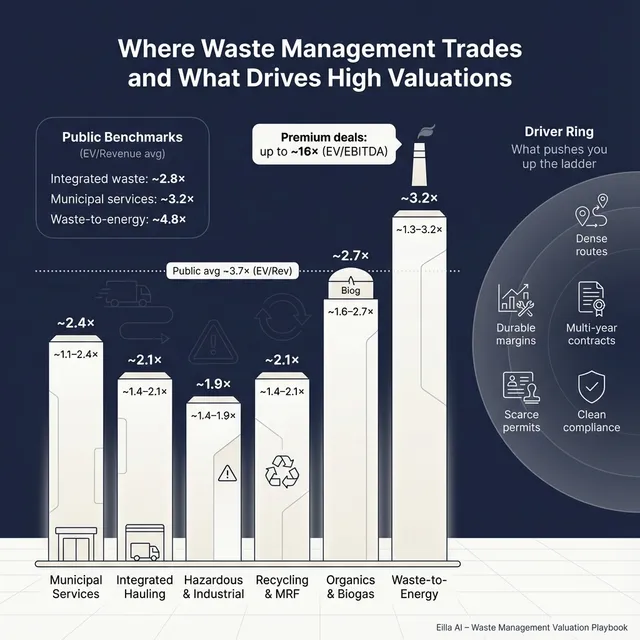
Across the precedent transactions dataset, the overall average EV/Revenue is ~2.2x and overall average EV/EBITDA is ~16.0x for the set provided. Within waste-related segments, service-heavy operators tend to cluster lower on EV/Revenue, while specialized tech layers or very profitable niches can push higher.
A practical way to read the private data: most “normal” private waste services deals land around 1.5x-2.4x revenue, with upside when there’s differentiation (permits, contracted margins, technology, or scarce assets).
These are illustrative ranges based on the grouped private “football field” data in your sources and should be adjusted for your size, growth, margins, and risk profile.
4.2 Public Companies
Public markets provide a useful “reference band,” but you must adjust down for smaller scale and higher business risk. In the data you provided (as of mid/end 2025), the overall public average EV/Revenue is ~3.7x and overall average EV/EBITDA is ~15.1x.
Public multiples also show how different waste sub-sectors can trade very differently.
How to use this as a private founder:
- Treat public multiples as outer guardrails, not your price tag.
- Smaller private businesses usually trade below the biggest public operators because scale creates route density, lower cost of capital, and operating leverage.
- You can sometimes trade above a simple public-adjusted number if you have something scarce (unique permit, landfill access, contracted offtake, or a must-have niche).
5. What Drives High Valuations (Premium Valuation Drivers)
The deal data shows a consistent truth: buyers pay premiums for waste businesses when the “value story” is backed by real economics, not just a good narrative.
Below are the premium drivers from your sources, grouped into founder-friendly themes, plus a few universal M&A best practices that matter in this sector.
5.1 Monetized sustainability, not just “green branding”
The sources show a bifurcation: “circular economy” positioning only commands a premium when it shows up in defensible earnings power. Eco Management Korea achieved a very high EV/EBITDA multiple with strong margins, while a recycling player like Sirplaste transacted at a much lower EV/Revenue multiple - highlighting that “green” alone is not enough.
What buyers pay for:
- advantaged feedstock access
- scarcity of permits
- contracted offtake (buyers for outputs)
- structurally higher margins
Practical founder examples:
- You can show that recycled output has stable pricing because you have contracted buyers.
- You can prove contamination control and yield, not just volume.
5.2 Infrastructure-like contracted cash flows with strong margins
Your sources explicitly call out that premium EV/EBITDA outcomes show up when earnings are visible and repeatable, especially with long-tenor contracts and utility-grade margins (e.g., Eco Management Korea; WaterSurplus was valued strongly on EBITDA).
What buyers pay for:
- multi-year municipal/industrial contracts with clear renewal logic
- pricing escalators
- durable margins that lenders will finance
Founder examples:
- Contract structure that passes through disposal and fuel.
- A renewal history that shows you keep contracts without margin collapse.
5.3 Mission-critical digital or data layer (when it is truly sticky)
The c-trace deal is a clean example of buyers paying up for an “operating system” layer (RFID/telematics) that plugs into an incumbent platform and scales across the installed base.
What buyers pay for:
- control of the system that runs the workflow
- stickiness (customers can’t easily switch)
- expansion potential through existing buyer relationships
Founder examples:
- If you have proprietary route optimization tech or compliance reporting that customers rely on daily, treat it like a product - document retention and switching costs.
5.4 Regulatory “must-have” capability in fast-growing end-markets
The airprotech example highlights a nuance: compliance-driven offerings can be strategically valuable, but if revenue is project-based or margins are volatile, buyers still haircut EV/Revenue. The driver matters, but it’s not magic.
What buyers pay for:
- scarce permitted capacity
- specialized hazardous streams
- recurring service/replacement parts revenue that smooths cycles
Founder examples:
- Build recurring inspection/maintenance around regulated systems, not just one-off installs.
5.5 Small but exceptionally profitable niches
The sources point out that “small but very profitable” assets can earn premium EV/EBITDA because they are immediately accretive and easy to integrate (WaterSurplus is a strong illustration of paying up for high-quality earnings).
Founder examples:
- A specialized medical waste route with strong pricing and low churn.
- A niche industrial stream where you have a permit advantage and high margin per ton.
5.6 Deal structures that preserve headline valuation (when growth is real but not proven)
Earn-outs show up when the buyer wants to pay for upside but protect downside (Cell&Co example). In waste, earn-outs are common when a new facility ramp, new waste stream approval, or a big contract award is the real prize but not guaranteed.
Founder examples:
- You can protect valuation by tying part of the price to volume ramp once a permit expansion is fully operational.
5.7 The “boring” premium drivers that still matter
Even if not in the dataset explicitly, these are consistently valued in waste:
- clean financials with clear margin by service line (collection vs disposal vs recycling)
- diversified customers and routes (no single municipality dominating)
- strong safety record and insurance profile
- second layer of leadership (ops, sales, compliance)
6. Discount Drivers (What Lowers Multiples)
Discounts in waste are often about uncertainty. If a buyer can’t clearly underwrite the stability of cash flows, they lower the multiple or push for earn-outs and holdbacks.
Common discount drivers in this sector:
- Low or volatile margins (especially when tied to recyclables pricing or project work)
- Customer concentration (one city, one industrial customer, one landfill contract)
- Permit and compliance risk (violations, weak documentation, informal practices)
- Deferred capex (fleet replacement cliff after the sale)
- Weak route economics visibility (no cost-to-serve, no margin by route)
- Revenue that isn’t really recurring (handshake arrangements, short-term pricing)
- Founder dependency (you do sales + ops + key customer relationships)
A note grounded in the provided valuation logic: small service operators with sub-10% EBITDA margins tend to price well below large scaled public majors on EV/Revenue. The logic explicitly benchmarks smaller operators closer to ~1.2x-2.1x revenue comps rather than the 4x-5x revenue multiples of scaled North American majors.
7. Valuation Example: A Waste Management Company
This is a fictional example to show the logic. The company, its characteristics, and the USD 10m revenue are made up. The multiples and ranges are illustrative, grounded in the patterns from your sources.
Step 1: The valuation logic (plain English)
- Pick the right comp “bucket.” Waste has very different valuation bands depending on whether you’re an integrated hauler, hazardous operator, recycling processor, municipal contractor, or waste-to-energy owner.
- Start with private deal ranges as your “reality check.” In the provided logic, service-heavy small operators commonly sit around ~1.3x-2.1x revenue in private comps, with upside to ~2.6x when diversified.
- Use public markets as guardrails, not as a direct answer. Big public waste majors trade at higher EV/Revenue because of scale, route density, and lower risk. For a smaller business, you usually adjust down unless you have a scarcity advantage.
- Cross-check with EBITDA. Revenue multiples can overstate value if margins are low. If your EBITDA margin is ~8%-10%, a very high revenue multiple can imply an unrealistic EV/EBITDA unless growth or strategic scarcity justifies it.
Step 2: Apply it to a fictional company
Meet Riverbend Environmental Services (fictional):
- USD 10.0m annual revenue (fictional)
- Mix: commercial hauling routes + small transfer operation + some recycling sorting
- EBITDA margin: ~10% (USD 1.0m EBITDA)
- Customer base: diversified SMB commercial, no single customer above 10%
- Contracts: 2-3 year agreements with annual price increases on most accounts
- Fleet: in decent shape, no “replacement cliff”
Now apply scenarios:
How this ties back to the source logic:
- The private comp “football field” ranges for service-led segments cluster around ~1.3x-2.1x revenue, with upside into the mid-2x range when diversified.
- The sample logic also allows for higher outcomes if strategic buyers see expansion value - but warns that very high revenue multiples can imply very high EV/EBITDA for low-margin operators.
Step 3: What this means for you
Two businesses with the same USD 10m revenue can be worth very different amounts because buyers are pricing:
- how durable your margins are
- how much capex is needed to sustain them
- how risky your contracts and compliance profile are
- whether your assets/permits create scarcity
This is why founders who prepare early can often create real multiple expansion without “doubling revenue.”
8. Where Your Business Might Fit (Self-Assessment Framework)
Use this to pressure-test where you might land on the valuation spectrum. Score each factor 0 / 1 / 2:
- 0 = weak / not in place
- 1 = okay / mixed
- 2 = strong / clearly proven
How to interpret your total:
- High band: You look like a premium asset - expect strong buyer interest and higher multiples within the observed ranges.
- Middle band: You are sellable at fair market - focus on fixing 2-3 issues that buyers will discount hard.
- Low band: You can still sell, but you’ll likely face lower offers, tougher diligence, or more earn-outs/holdbacks.
9. Common Mistakes That Could Reduce Valuation
9.1 Rushing the sale
If you go to market without clean numbers and a clear story, buyers will assume the worst and price in risk. Waste buyers move fast when confident - but they get conservative when information is messy.
9.2 Hiding problems
Environmental and compliance issues almost always surface. Hiding them destroys trust and can kill a deal late, when you have the least leverage. Better strategy: disclose early, frame clearly, and show mitigation.
9.3 Weak financial records
This is a bigger valuation killer in waste than many founders expect, because buyers want to see:
- margin by service line
- disposal and fuel pass-through mechanics
- normalized maintenance and capex
- customer profitability (not just top customers)
You don’t need perfection, but you need clarity.
9.4 No structured, competitive sale process
A structured process with real buyer competition is one of the most reliable ways to increase price. Research often cited in M&A advisory circles suggests competitive processes can lead to materially higher outcomes - commonly referenced around 25% higher purchase prices when run well with an advisor.
9.5 Naming your price too early
If you tell buyers “we want USD 10m,” you kill price discovery. You often get USD 10.1m and USD 10.2m offers instead of the true market-clearing number. Let the market speak first.
9.6 Industry-specific mistake: ignoring the fleet and capex story
If buyers discover a major replacement need post-close, they will either discount EV or add holdbacks. Having a clear fleet condition plan and capex forecast is a simple, high-impact fix.
9.7 Industry-specific mistake: treating compliance as “ops” instead of “value”
Buyers price compliance maturity. A clean record, documented training, manifests, audits, and clear permit standing reduce perceived risk and increase confidence in cash flows.
10. What Waste Management Founders Can Do in 6-12 Months to Increase Valuation
Think in three buckets: improve the business, reduce risk, and run a strong process.
10.1 Improve the numbers (without pretending)
- Raise prices with discipline (especially commercial): tighten contract terms, add escalators, reduce “special pricing” exceptions.
- Prove route profitability: margin by route, stops/hour, fuel per route, disposal cost per ton - then fix the worst 10%.
- Reduce customer concentration: even small steps matter - add 10-20 midsize accounts to dilute the biggest one.
- Stabilize margins: if recycling is volatile, show how you manage commodity risk or shift more economics to service fees.
10.2 De-risk the story buyers worry about
- Compliance package: organized permits, inspection history, training logs, incident history, corrective actions.
- Environmental liability clarity: don’t wait for diligence - summarize known issues and remediation status.
- Fleet and capex plan: document replacement schedule, maintenance backlog, and what’s already budgeted.
10.3 Strengthen the “runs without you” narrative
- Put a clear ops leader in place (or visibly empower one).
- Document key customer relationships and ensure at least 2 people own them.
- Show KPI rhythm: weekly safety/ops scorecard, monthly financial review.
10.4 Position for premium drivers (when realistic)
Tie back to the premium patterns from the sources:
- If you can credibly move toward contracted, infrastructure-like cash flows, you become easier to finance and often more valuable.
- If you claim “circular economy,” back it with economics: higher-margin outputs, contracted offtake, or scarce capacity.
- If you have a tech layer, prove stickiness: retention, daily usage, and switching friction.
11. How an AI-Native M&A Advisor Helps
Selling a waste management business is not just “finding a buyer.” The outcome depends on reaching the right buyer set, creating competitive pressure, and running diligence without value leakage.
Higher valuations through broader buyer reach: An AI-native approach can expand the buyer universe to hundreds of qualified acquirers based on deal history, synergy fit, financial capacity, and other signals. More relevant buyers usually means more competition and stronger offers - and more options if one buyer drops late in the process.
Initial offers in under 6 weeks: AI-driven buyer matching and outreach, faster creation of marketing materials, and structured diligence support can compress timelines significantly compared to manual-only processes - which matters when markets or buyers’ budgets shift quickly.
Expert advisory, enhanced by AI: The best outcomes still require experienced human advisors who know how buyers think, how to frame your story, and how to negotiate. AI can raise the “floor” on quality and speed - helping produce buyer-ready materials and positioning that speaks in the buyer’s language, without traditional bulge-bracket costs.
If you’d like to understand how an AI-native process can support your exit, book a demo with one of Eilla AI’s expert M&A advisors.
Are you considering an exit?
Meet one of our M&A advisors and find out how our AI-native process can work for you.


