
The Complete Valuation Playbook for Procurement Software Businesses
A data-driven guide to how procurement software businesses are valued and what drives premium multiples.

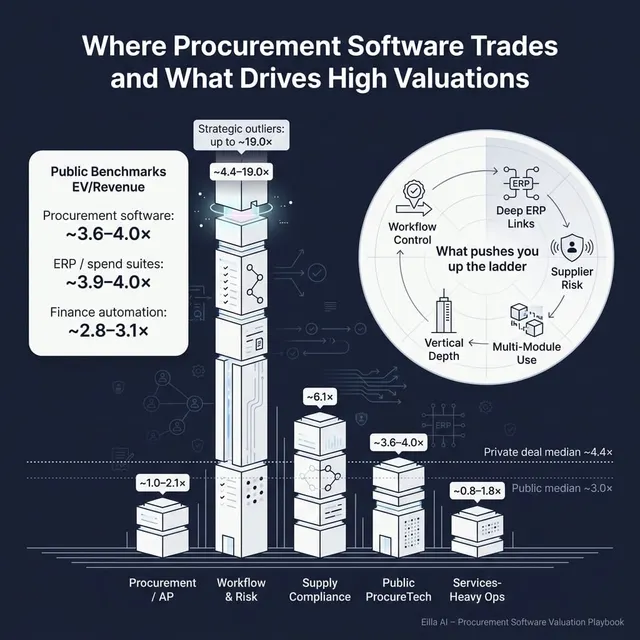
Procurement software has moved from a back-office tool to a strategic control layer. Buyers are paying close attention because procurement now touches cost savings, supplier risk, approvals, compliance, ESG, payment flows, and operating efficiency.
For founders considering a sale in the next 1-12 months, valuation is not just about revenue. Two procurement software companies with the same revenue can be worth very different amounts depending on growth, margins, customer stickiness, product depth, and how critical the platform is inside customer workflows.
This playbook shows what procurement software businesses actually sell for, what public markets suggest, what pushes multiples higher or lower, and how you can assess your own position before going to market.
1. What Makes Procurement Software Unique
Procurement software sits at the intersection of spend control, supplier management, finance workflows, compliance, and business operations. That makes it different from generic SaaS. A buyer is not only asking, "Does this software save time?" They are asking, "Does this platform control an important part of how money leaves the business?"
The sector includes several types of companies:
The strongest procurement software companies usually become embedded in daily workflows. They are not just dashboards. They decide who can buy, which supplier can be used, what approvals are needed, whether risk checks are complete, and how procurement connects into finance or ERP systems.
That creates unique valuation considerations. Buyers care about recurring revenue, but they also care about whether the software is a system of record, a workflow engine, or a nice-to-have add-on. They will look closely at integration depth, supplier data quality, approval logic, compliance controls, and whether customers depend on the platform to avoid operational risk.
The key risks buyers will always check are also sector-specific. Is the product deeply integrated into finance and ERP systems, or can it be replaced easily? Are customers actively using the platform across departments, or only in one small procurement team? Does the software reduce real spend, risk, or cycle time, or does it mostly produce reports? And how much implementation or manual support is required to keep customers happy?
2. What Buyers Look For in a Procurement Software Business
Buyers start with the basics: revenue scale, growth rate, gross margin, EBITDA margin, retention, customer concentration, and the quality of the management team. These points matter in every software deal.
In procurement software, buyers then go deeper. They want to understand where your product sits in the procurement workflow. A tool that only reports on spend after the fact is usually less valuable than a platform that manages intake, approvals, supplier onboarding, purchase orders, risk checks, renewals, and invoice handoff.
They also care about customer type. Enterprise customers can be more attractive because procurement is complex, budgets are larger, and switching costs can be higher. But enterprise sales cycles can also be long, implementation-heavy, and dependent on a few big accounts. Mid-market customers may offer faster sales cycles and cleaner growth, but buyers will test whether retention and contract values are strong enough.
Strategic buyers usually ask: "What does this add to our existing suite?" If your product fills a gap in ERP, AP automation, supplier risk, contract lifecycle, or workflow automation, you may be worth more to that buyer than to a purely financial investor.
Private equity buyers think slightly differently. They ask what they can pay today, what the business could be worth in 3-7 years, and who might buy it from them later. They look for levers they can pull: price increases, new modules, cross-sell, improved sales execution, margin expansion, and acquisitions of smaller related tools.
How private equity buyers think
A private equity buyer is not only valuing your business as it stands today. They are building a future case.
They will ask:
This is why a procurement software company with clear expansion potential can attract more interest than one with flat growth, custom-heavy delivery, and unclear product direction.
3. Deep Dive: Control Point vs Point Tool
The most important valuation question in procurement software is simple: are you a control point or a point tool?
A point tool solves a narrow problem. It might classify spend, manage a supplier form, route an approval, or automate one part of invoicing. These can be useful products, but they are easier for larger platforms to copy, bundle, or replace.
A control point is different. It becomes part of how the customer enforces policy. It manages approval rights, supplier eligibility, risk checks, compliance sign-off, and procurement workflow rules. Once a system sits in those processes, it becomes harder to remove.
The deal data supports this distinction. Stronger outcomes appear in assets tied to risk, compliance, supplier governance, auditability, and vendor management. Buyers paid more attention where the software owned a critical process, not just a convenience feature.
This matters because procurement is no longer just about saving money. Large companies are under pressure to manage supplier risk, comply with regulations, reduce fraud, track approvals, and prove that purchasing decisions were controlled. Software that helps enforce those rules has a stronger strategic story.
If your business looks more like the left column today, the path is not necessarily a full rebuild. You can move toward the right by adding workflow depth, improving integrations, tracking customer usage by department, reducing manual services, and proving that customers use your platform to enforce real policy.
The other high-impact nuance is vertical specialization. Generic procurement tools can work well, but specialized platforms often have stronger buyer appeal when they serve complex industries such as healthcare, construction, manufacturing, infrastructure, public sector, or regulated supply chains. In those markets, the software often reflects real-world supplier rules, compliance requirements, and approval complexity that generic products do not handle well.
4. What Procurement Software Businesses Sell For - and What Public Markets Show
The data shows a wide valuation range. That is normal in procurement software because the market includes many different models: pure SaaS, AP automation, supplier risk, ERP-adjacent tools, workflow platforms, data analytics, and services-heavy supply chain businesses.
The most important point for founders is this: headline multiples are only useful after you understand the type of business behind them. A high-growth, high-margin procurement workflow platform is not valued the same way as a services-heavy procurement operations business.
4.1 Private Market Deals (Similar Acquisitions)
Private transaction data in this universe shows an overall average EV/Revenue multiple of about 5.5x and a median of about 4.4x. The average EV/EBITDA multiple is about 14.9x, with a median of about 13.4x.
But the spread is wide. Broader procurement, AP, and enterprise finance software transactions in the data were generally closer to 1.0-2.1x revenue. Workflow, risk, and vendor management software showed a much wider and generally higher range, with several transactions around 4.4x revenue and one very small-revenue outlier at 19.0x revenue. Supply chain visibility and compliance software showed a premium example around 6.1x revenue.
These ranges are illustrative, not a pricing formula. In particular, very small companies can show very high revenue multiples because buyers are paying for a product capability, team, or strategic fit rather than current revenue. Founders should be careful not to treat those outliers as normal market-clearing values for larger businesses.
The clear pattern is that buyers paid more for procurement-adjacent software when it had workflow control, compliance relevance, strong margins, or strategic fit with a larger enterprise software suite.
4.2 Public Companies
Public company data gives a broader reference point. Across the full set, the average EV/Revenue multiple is about 4.5x, and the median is about 3.0x. The average EV/EBITDA multiple is about 24.5x, with a median of about 19.1x.
As of mid to end 2025, procurement and supplier management software public comps traded around 3.6x average EV/Revenue and 4.0x median EV/Revenue, though the range was broad. Enterprise workflow automation traded at a higher average because of one extreme AI-related outlier, but the median was closer to 3.3x revenue. ERP, finance, AP, AR, and payments software generally sat in the 3.0-4.0x revenue range on average, with variation based on scale, growth, and profitability.
Public multiples should not be used as a direct price tag for your company. Public companies are usually larger, more liquid, better known, and more diversified than private founder-owned businesses. Smaller private companies often trade at a discount to public companies unless they have unusually strong growth, scarce product capability, or a clear strategic buyer universe.
At the same time, public markets help set the buyer's mental range. If scaled public workflow, ERP, and finance automation platforms trade around the mid-single-digit revenue multiple range, a private procurement software company needs a strong reason to trade well above that. Strong reasons can include faster growth, higher retention, mission-critical workflow ownership, strong margins, vertical dominance, or an obvious strategic fit for multiple buyers.
5. What Drives High Valuations - Premium Valuation Drivers
The premium valuation drivers in procurement software are not mysterious. Buyers pay more when they believe your business is durable, strategic, hard to replace, and capable of growing with limited extra cost.
Mission-critical workflow control
Platforms that sit inside approvals, supplier onboarding, risk checks, compliance workflows, audit trails, and procurement governance attract stronger interest. These systems are not just productivity tools. They help customers control who can spend money, which suppliers can be used, and whether internal rules are followed.
A buyer will pay more when your software becomes part of the customer's operating policy. For example, if a customer cannot onboard a supplier, approve a purchase, or complete a compliance check without your platform, that is a stronger position than providing a dashboard that can be ignored.
Breadth across adjacent modules
Procurement software becomes more valuable when it covers several connected workflows: intake, approvals, supplier records, supplier risk, contract renewals, purchase order creation, invoice handoff, and reporting.
Breadth only matters if the modules are actually connected. A long feature list does not create value by itself. Buyers want to see that customers use multiple modules, spend more over time, and would face real disruption if they switched away.
Strategic fit with larger software buyers
Many premium outcomes happen because the target fills a clear gap for a larger buyer. A procurement workflow product may be valuable to an ERP vendor, AP automation platform, supplier risk company, contract management vendor, enterprise workflow suite, or vertical software platform.
This is where buyer psychology matters. A financial buyer may value your business based on growth and margins. A strategic buyer may also value the revenue they can cross-sell, the product gap they can close, and the years of development time they can avoid.
Vertical or specialist positioning
Procurement software that serves a specific industry can be more defensible than generic horizontal software. Construction procurement, healthcare procurement, public sector supplier management, manufacturing supply chains, and regulated vendor risk each have unique workflows and compliance requirements.
Specialization can support higher value when it improves win rates, reduces churn, and makes the product harder to replace. It also gives buyers a cleaner story: "This is the best procurement platform for this specific customer segment."
Strong profitability and clean software margins
The deal data shows that strong EBITDA conversion was an important premium driver. In plain English, buyers like software companies where a high share of revenue turns into profit because the product scales without needing a large services team for every new customer.
This does not mean every high-growth company must be highly profitable today. But buyers will want to understand the path. If your delivery model requires heavy customization, long implementations, and constant manual support, your software revenue may be viewed as lower quality.
Observable growth momentum
Buyers can pay more when recent results show a clear inflection. That may mean strong new bookings, accelerating revenue growth, improved retention, growing customer size, or strong expansion from existing accounts.
Momentum must be real and measurable. A good story helps, but buyers will test it against monthly revenue, signed contracts, pipeline quality, churn, and customer usage.
Clean financials and low buyer friction
This is less glamorous, but it matters. Clean revenue recognition, clear gross margin reporting, reliable customer cohorts, properly tracked recurring revenue, and well-organized contracts all reduce buyer anxiety.
A business that is easy to diligence is easier to bid for. A business with messy numbers forces buyers to add risk discounts.
6. Discount Drivers - What Lowers Multiples
Low multiples usually come from one of three problems: weak growth, weak quality of revenue, or weak confidence.
In procurement software, the most common discount driver is looking more like a services business than a software business. If every customer requires heavy customization, manual data work, long implementation projects, and ongoing human support, buyers may reduce the multiple even if the product category sounds attractive.
Another discount driver is limited workflow importance. If the product is useful but not essential, customers can delay buying, reduce seats, or replace it with a module from a larger suite. Buyers will test this by reviewing usage data, renewal behavior, customer references, and whether the platform is connected to ERP, finance, AP, risk, or supplier systems.
Customer concentration can also hurt valuation. If a large share of revenue comes from a few customers, buyers worry that one lost renewal could change the whole deal. In enterprise procurement software, some concentration is normal, but it needs to be balanced by long contracts, strong relationships, and clear expansion potential.
Other discount drivers include:
A discount does not mean a business is unsellable. It means buyers need compensation for perceived risk. The goal before a sale is to remove as many avoidable discounts as possible.
7. Valuation Example: A Procurement Software Company
This example is fictional. The company, revenue level, and valuation range are illustrative only. This is not investment advice, not a formal valuation, and not a fairness opinion.
Assume a fictional procurement software company called Northstar Procure. It has USD 10m of annual revenue. The platform handles procurement intake, approval workflows, supplier onboarding, supplier risk checks, and ERP handoff for mid-market and enterprise customers.
Step 1: How the logic works
We would not value Northstar Procure like a logistics services company or a low-margin consulting business. The right starting point is software comps, especially procurement software, workflow automation, supplier risk, AP automation, and ERP-adjacent platforms.
The public data suggests a broad software-oriented range mostly around the low to mid-single-digit revenue multiples, with stronger workflow and ERP-adjacent platforms often supporting higher reference points. The private deal data is more useful because it shows actual acquisitions. It suggests that broader procurement and AP software can trade around the low end, while workflow, risk, vendor management, and compliance-heavy assets can move meaningfully higher.
For a company like Northstar Procure, a reasonable core range could be around 5.0-8.0x revenue if it has strong growth, high recurring revenue, good retention, real workflow control, and credible strategic buyer interest.
A premium case may be justified if the company is growing quickly, has strong margins, owns a mission-critical control point, is deeply integrated into ERP and finance workflows, and has multiple strategic buyers that clearly need the capability.
A discount case may apply if growth is slowing, implementation is services-heavy, revenue is concentrated, churn is elevated, or the product is mostly a point solution.
Step 2: Apply it to USD 10m revenue
The core case assumes Northstar Procure looks like a real procurement workflow platform, not a services-heavy implementation shop. It has good customer retention, clear recurring revenue, multi-module adoption, and strong integration into customer systems.
The premium case requires more proof. Buyers would want to see fast growth, strong gross margins, low churn, expansion from existing customers, high-quality enterprise logos, and evidence that the platform controls important procurement decisions.
The discounted case could still be a good outcome for a founder, but it reflects risk. Maybe the company has USD 10m revenue but only modest growth. Maybe a few customers represent too much revenue. Maybe the product requires too much manual services work. Or maybe the platform is useful but not deeply embedded.
The lesson is simple: two procurement software companies with the same USD 10m revenue can have very different values. Revenue is the starting point. Revenue quality decides the multiple.
8. Where Your Business Might Fit - Self-Assessment Framework
Use this as a rough self-assessment. Score each group from 0 to 2.
0 means weak or not proven. 1 means acceptable but not clearly premium. 2 means strong and well supported by data.
How to interpret your score
Be honest with yourself. The point is not to create a perfect valuation. The point is to identify which improvements could have the biggest impact before you speak to buyers.
For example, if your product is strong but your financial reporting is weak, that is fixable. If customers love the product but only use one module, expanding adoption could improve the story. If revenue is growing but margins are poor because implementation is too manual, standardizing delivery may increase buyer confidence.
9. Common Mistakes That Could Reduce Valuation
Rushing the sale
Many founders start a process before the business is ready. They have not cleaned up financials, prepared customer metrics, built a buyer story, or decided which buyers are most likely to pay a premium.
That creates avoidable discounts. Buyers sense when a process is unprepared, and they use uncertainty to reduce price or demand more protection in the deal terms.
Hiding problems
Problems will surface in due diligence. Churn, customer concentration, weak margins, implementation issues, disputed revenue, or product gaps almost always come out later.
Hiding problems damages trust. A better approach is to identify the issue early, explain what caused it, show what has changed, and frame the remaining risk clearly.
Weak financial records
Procurement software companies often have mixed revenue streams: subscriptions, implementation fees, professional services, support, usage-based fees, and sometimes payment or transaction revenue. If these are not clearly separated, buyers struggle to understand revenue quality.
In the 6-12 months before a sale, founders should clean up revenue recognition, gross margin reporting, recurring revenue tracking, customer-level profitability, churn, upsell, and implementation costs. These are not cosmetic details. They directly affect buyer confidence.
No structured competitive process
Research commonly shows that a structured competitive sale process with an advisor can lead to meaningfully higher purchase prices, often around 25%. The reason is simple: competition improves price discovery.
If only one buyer is at the table, that buyer controls the process. If several relevant buyers are engaged in a structured way, each buyer has to show what the business is worth to them.
Revealing your target price too early
Do not tell buyers the price you want too early. If you say you are looking for USD 10m in enterprise value, many buyers will anchor around that number with offers like USD 10.1m or USD 10.2m.
That kills price discovery. The goal is to let the market come back with offers based on strategic value, competition, and each buyer's own view of the opportunity.
Underplaying integrations and data quality
In procurement software, integrations are often a major value driver. If your ERP, finance, supplier, AP, contract, or identity integrations are messy or poorly documented, buyers may assume implementation risk.
Good integration documentation, API usage data, security materials, and customer architecture examples can reduce concern.
Selling a feature instead of a platform story
A common industry-specific mistake is positioning the company as a narrow feature: "We automate purchase approvals" or "We classify spend." That may be accurate, but it can undersell the business.
A stronger story explains the control point: "We help customers govern spend from request to supplier approval to finance handoff." Buyers pay more for strategic workflow ownership than for isolated features.
10. What Procurement Software Founders Can Do in 6-12 Months to Increase Valuation
Improve the numbers buyers care about
Start by cleaning your financial and operating metrics. Separate recurring subscription revenue from implementation and services revenue. Track gross margin by revenue type. Show monthly recurring revenue, churn, expansion revenue, and customer cohorts in a simple way.
If your services margin is low, identify what can be standardized. Can onboarding templates reduce delivery hours? Can integrations be packaged? Can customer success reduce avoidable support work? Even modest improvements can change the buyer's view of scalability.
Strengthen the control-point story
Map your product against the procurement workflow: intake, approval, supplier onboarding, risk checks, contract renewal, purchase order creation, invoice handoff, and reporting. Then show where you are essential.
If customers use only one module, work to increase adoption across more workflows. If procurement is your only buyer inside the customer, expand usage into finance, legal, risk, compliance, or operations. Multi-department usage usually makes the platform harder to remove.
Reduce customer and revenue risk
Review customer concentration before going to market. If one or two customers represent too much revenue, focus on renewals, expansions across the rest of the base, and new logo wins that reduce concentration.
Lock in renewals where possible. Clean contract terms. Document customer references. Buyers will feel more comfortable if they see long-term contracts, high renewal rates, and customers who can clearly explain the value they receive.
Build integration and security proof
Procurement software often touches sensitive spend, supplier, and approval data. Buyers will check security, permissions, audit trails, and integration reliability.
Prepare documentation for ERP integrations, AP connections, supplier data flows, APIs, security policies, access controls, and audit logs. If your platform supports regulated workflows, show exactly how it helps customers reduce risk.
Prepare the buyer narrative
Do not wait until the sale process to decide what your company is. Are you a procurement intake platform, supplier risk platform, AP automation tool, spend control layer, vertical procurement operating system, or broader workflow platform?
The answer affects who should buy you and how they should value you. A clear narrative helps buyers understand why your business is strategically important.
Build the management bench
Founder-led businesses can still sell well, but buyers discount companies where all product vision, sales relationships, and customer knowledge sit with one person.
In the 6-12 months before a sale, strengthen second-line leadership. Show that customer success, sales, product, finance, and implementation can operate without the founder making every decision.
11. How an AI-Native M&A Advisor Helps
An AI-native M&A advisor like Eilla AI can help procurement software founders run a broader, faster, and more data-driven process without losing the judgment of experienced human advisors.
The first advantage is buyer reach. AI can expand the buyer universe to hundreds of qualified acquirers based on deal history, strategic fit, product gaps, financial capacity, sector focus, and other signals. More relevant buyers usually means more competition, stronger offers, and a higher chance the deal closes even if one buyer drops out.
The second advantage is speed. AI-driven buyer matching, buyer outreach, preparation of process materials, and support in due diligence can help founders reach initial conversations and offers in under 6 weeks. That does not mean cutting corners. It means reducing manual work that traditionally slows down a process.
The third advantage is expert advisory enhanced by AI. You still need experienced M&A advisors who know how to position the company, manage buyers, negotiate tension, and protect value. AI helps them prepare better materials, analyze buyer fit, frame the deal in the buyer's language, and deliver Wall Street-grade advisory quality without traditional bulge bracket costs.
If you would like to understand how an AI-native process can support your exit, book a demo with one of Eilla AI's expert M&A advisors.
Are you considering an exit?
Meet one of our M&A advisors and find out how our AI-native process can work for you.


