
The Complete Valuation Playbook for Real Estate Brokerage Businesses
A practical guide to how real estate brokerage businesses are valued and what drives high multiples.

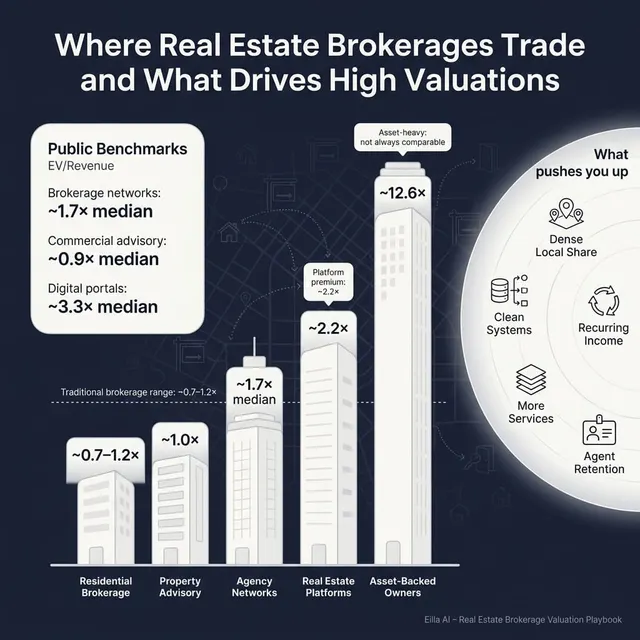
Selling a real estate brokerage is not just about revenue. Two brokerages with the same USD 10m of revenue can be worth very different amounts depending on margin quality, agent dependence, office footprint, recurring income, technology, and how strategically useful the business is to a buyer.
Now is an important time to think carefully about valuation. Real estate brokerage remains cyclical and exposed to transaction volumes, interest rates, housing affordability, and agent competition. At the same time, larger platforms, franchisors, advisory groups, and technology-enabled real estate companies continue to look for ways to expand geography, add services, and capture more of the property transaction journey.
This playbook shows what real estate brokerage businesses actually sell for, how buyers think about higher and lower multiples, and what you can do in the next 6-12 months to improve your positioning before a sale.
1. What Makes Real Estate Brokerage Unique
Real estate brokerage businesses sit in an unusual position. They are often asset-light, brand-led, people-heavy, and highly sensitive to transaction volume. That makes them different from pure software companies, property owners, developers, or recurring-service businesses.
The main types of businesses in this sector include residential estate agencies, franchised broker networks, commercial agency and advisory firms, property consultancy groups, property management-led brokerages, vacation or cross-border brokerage networks, and technology-enabled real estate platforms. Some businesses are almost entirely commission-driven. Others combine brokerage with lettings, property management, valuation, mortgage referral, title, insurance, auctions, consulting, or software tools.
That mix matters a lot for valuation. A buyer will ask whether your revenue depends on one-off transactions or whether part of it repeats every month. A brokerage that earns commissions only when homes are bought and sold is more exposed to market cycles. A business with property management fees, lettings, franchise fees, or recurring software revenue can be easier to value because buyers can see more predictable income.
Buyers will also look closely at the difference between company value and agent value. If the top agents own the customer relationships and can leave after closing, the buyer sees risk. If the brand, systems, data, office network, and management team generate repeatable performance, the business becomes more valuable.
Key risks buyers will always check include:
A real estate brokerage can look large on revenue but still be low-value if most of that revenue passes through to agents and very little becomes profit. Buyers care less about gross transaction value and more about what the company actually keeps.
2. What Buyers Look For in a Real Estate Brokerage Business
Most buyers start with a few simple questions. Is the business growing? Is it profitable? Is the revenue repeatable? Is the agent base stable? Can this business survive without the founder? Can the buyer do something with it that the current owner cannot?
Scale matters, but scale alone does not guarantee a high multiple. The data shows that even large brokerage and property service groups can trade below 1.0x revenue when they are service-led, cyclical, or low-margin. Buyers want to see scale that creates advantages: stronger brand awareness, better recruiting, more referral flow, purchasing power, local market density, and operating leverage.
Profitability matters because brokerage revenue can be misleading. A company with USD 50m of revenue but thin margins may be less attractive than a USD 10m business with strong branch-level profitability, high agent retention, and recurring property management fees. Buyers will study EBITDA, which is a common measure of profit before interest, taxes, depreciation, and amortization.
Buyers also care about the quality of your revenue. Commission-only residential sales revenue is generally less predictable. Lettings, property management, franchise fees, long-term commercial advisory retainers, valuation contracts, and software-like revenue usually receive more credit because they provide more visibility.
Industry-specific items buyers will check include:
How Private Equity Buyers Think
Private equity buyers are financial buyers. They usually want to buy a company, improve it over 3-7 years, and sell it for more later. That means they think about both the price they pay today and who could buy the business from them in the future.
They will ask: if we buy this business at one valuation multiple, can we later sell it at the same or a higher multiple? That depends on whether the company can become larger, more profitable, more diversified, and more strategic.
They also look for levers they can pull. In real estate brokerage, those levers may include opening new offices, acquiring smaller agencies, improving recruiting, centralizing back office operations, adding property management, increasing referral revenue, improving marketing efficiency, or layering in technology. A buyer pays more when these levers are believable and supported by your numbers.
3. Deep Dive: Why Brokerage Revenue Often Gets Lower Multiples Than Platforms or Asset-Backed Models
The most important valuation nuance in real estate brokerage is this: not all real estate revenue is valued the same way.
Traditional brokerage revenue is usually transaction-based. A client buys, sells, rents, or leases a property, and the brokerage earns a fee. That can be a good business, but it is often tied to market activity. If transaction volumes fall, revenue can fall quickly.
In the data, traditional real estate brokerage, agency networks, and property consultancy deals generally cluster around lower revenue multiples than digital platforms or asset-backed property owners. Private transactions in integrated residential brokerage and property consultancy show average revenue multiples around 0.9x to 1.0x, with EBITDA multiples around 6.3x to 6.5x. That is a very different world from certain software-like or asset-backed models.
Why? Buyers see traditional brokerage as people-led and cyclical. Agents, local reputation, and market conditions matter heavily. If the business does not own property assets, does not have a proprietary platform, and does not have highly recurring revenue, buyers usually value it as a service business rather than a technology or asset ownership business.
By contrast, a digital platform with dense agency adoption can be valued differently. If thousands of agencies use a real estate software or information platform, the buyer may see switching friction, data value, and scale benefits. The precedent transaction data shows real estate software, marketing, and information platforms averaging around 2.2x revenue, above traditional brokerage and consultancy benchmarks.
Asset-backed property businesses are different again. If the company owns valuable property assets or development rights, the multiple may reflect embedded asset value rather than only service revenue. That is why asset-heavy real estate owners and developers can show much higher revenue multiples. But founders should be careful: those are not good benchmarks for a pure brokerage.
If your business looks more like the left column today, the goal is not to reinvent it overnight. The goal is to move toward the right column in visible, measurable ways before a sale. Buyers pay for evidence, not promises.
4. What Real Estate Brokerage Businesses Sell For - and What Public Markets Show
Valuation data in this sector is wide because the category includes very different business models. A pure residential brokerage is not the same as a property portal, a commercial advisory firm, a franchisor, or an owner-operator with real estate assets.
The best way to use the data is to separate comparable groups. For most privately held real estate brokerages, the most relevant benchmarks are traditional residential brokerage, franchising, agency networks, and property consultancy. Digital platforms and asset-backed property owners can be useful reference points, but they should not be copied blindly.
4.1 Private Market Deals - Similar Acquisitions
Private transaction data shows a disciplined valuation range for traditional brokerage and property consulting businesses. Integrated residential brokerage, franchising, and transaction services averaged around 0.9x revenue and 6.3x EBITDA. Property consultancy, commercial agency, valuation, and management services averaged around 1.0x revenue and 6.5x EBITDA.
Real estate software, marketing, and information platforms showed higher revenue multiples, averaging around 2.2x revenue. That makes sense: software-like revenue, agency adoption, digital workflows, and data value can make these businesses more scalable than traditional agency operations.
Asset-backed property owners and developers showed much higher revenue multiples in the data, but those are not direct benchmarks for most brokerages. If a business owns valuable properties, development rights, or rental assets, the valuation logic changes. A service-led estate agency should not use asset-heavy multiples as its core valuation anchor.
For a privately held real estate brokerage, the practical takeaway is simple: many traditional brokerage and property service businesses trade around 0.7x to 1.2x revenue unless they show clear premium drivers. Those premium drivers might include unusually high margins, recurring revenue, a differentiated service stack, deep local density, or proprietary technology.
4.2 Public Companies
Public market data as of mid to end 2025 shows a wider range because listed companies include large residential brokerages, digital portals, property owners, commercial real estate advisory firms, and integrated real estate groups. The overall average EV/Revenue multiple is around 7.0x, but the median is much lower at around 2.4x, which tells you that a few high-multiple companies pull the average upward.
For asset-light residential brokerage, agency networks, and franchised estate agencies, the average public EV/Revenue multiple is around 3.4x and the median is around 1.7x. The average EV/EBITDA is around 10.9x and the median is around 12.0x. But this group includes companies with very different profitability, geography, growth, and business mix, so founders should be careful with direct comparisons.
Digital residential property portals and tech-enabled transaction platforms trade higher on EBITDA, with average EV/EBITDA around 32.7x and median around 27.2x. These businesses can command higher valuations because they may have network effects, large audiences, proprietary data, and more scalable technology economics. Commercial real estate advisory and consulting firms trade at lower revenue multiples, with average EV/Revenue around 1.4x and median around 0.9x.
Public multiples are useful reference points, not direct price tags. Public companies are usually larger, more liquid, better known, and easier for investors to buy and sell. Private companies often receive a discount for smaller scale, lower reporting quality, founder dependence, and less liquidity.
However, a private company can sometimes earn a strong outcome if it is scarce and strategically valuable. For example, a highly profitable brokerage with a dominant local footprint, recurring property management income, strong agent retention, and a buyer-ready management team may attract more competition than a larger but lower-quality agency.
5. What Drives High Valuations - Premium Valuation Drivers
Premium valuations come from reducing buyer risk and increasing buyer excitement. In real estate brokerage, buyers pay more when they believe the business is not just a collection of agents, but a platform that can keep growing after the founder exits.
Dense Local Footprint With Broader Reach
A dense office network can create brand trust, referral flow, recruiting advantages, and better local market knowledge. Buyers like markets where the business is visibly strong, not just present.
The key is density, not random expansion. Ten offices with strong local share may be more attractive than thirty offices with weak economics. A buyer wants to see that your footprint creates advantages in listings, agent recruitment, landlord relationships, developer relationships, and referrals.
Practical examples include strong share in a specific city, leadership in a high-value neighborhood, a recognizable local brand, or a network that can be expanded into nearby territories without starting from scratch.
Integrated Service Stack
Brokerages that capture more of the property journey can be more attractive. A buyer may value the ability to cross-sell mortgage referrals, title, settlement, insurance, lettings, property management, valuation, auctions, relocation, or commercial advisory.
But integration only helps valuation if it improves the business. The data shows that service breadth alone does not guarantee a premium multiple. Buyers want proof that the extra services increase profit, improve customer retention, or reduce exposure to transaction cycles.
For example, a residential brokerage with a growing property management book may be more attractive than one that only earns sales commissions. A commercial agency with recurring valuation, management, and advisory work may look more stable than one dependent on a few large transaction fees.
Strategic Fit for the Buyer
A buyer may pay more if your business fits neatly into something they already own. This is often called strategic synergy, which simply means the buyer believes your business becomes more valuable in their hands.
In real estate brokerage, strategic fit can come from geographic expansion, adding a missing service line, gaining a local brand, acquiring a strong agent base, or improving a buyer's existing property division. Buyers also like businesses that can be integrated without major disruption.
The strongest version is a company that solves a clear problem for the buyer. For example, you may give them instant access to a region where they have no presence, a property management capability they lack, or a trusted brand in a hard-to-enter market.
Strong EBITDA Conversion
Revenue matters, but profit quality often matters more. Buyers want to know how much of your revenue turns into cash profit after agent commissions, office costs, marketing, staff, and systems.
A brokerage with strong EBITDA conversion can show that its model is not just busy, but profitable. This is especially important in agency models where high revenue can hide weak economics.
Examples of strong profit quality include disciplined agent commission structures, efficient office costs, centralized administration, high-performing branches, and clear reporting by revenue line. Buyers will reward businesses where margins are real, repeatable, and not dependent on one-time cost cutting.
Technology, Data, and Workflow Advantage
Most traditional brokerages will not be valued like software companies. But technology can still improve valuation if it creates measurable advantages.
Buyers care about systems that improve lead conversion, agent productivity, listing management, customer follow-up, landlord reporting, valuation accuracy, or transaction coordination. A proprietary tool or deeply adopted platform can support a stronger deal story.
The key word is adoption. A tool that agents actually use every day is valuable. A tool that exists but does not change behavior is not.
Predictable Revenue and Customer Stickiness
Brokerage is often seen as transactional, so predictable revenue stands out. Property management, lettings, franchise fees, renewals, recurring advisory contracts, and long-term developer or landlord relationships can make your revenue more resilient.
Buyers pay more when they believe revenue will continue after closing. That means low churn, stable agents, repeat clients, recurring landlord relationships, and referral sources that are not tied only to the founder.
Clean Financials and a Strong Management Bench
Clean numbers are a premium driver because they reduce fear. Buyers do not want surprises in diligence. They want to understand revenue by service line, gross margin, agent commission costs, office-level profitability, customer concentration, and recurring versus one-time revenue.
A strong second layer of leadership also matters. If the business cannot run without you, buyers may reduce the price, demand a longer earnout, or walk away. If your managers can run sales, operations, finance, recruitment, and local offices, the buyer sees a more transferable company.
6. Discount Drivers - What Lowers Multiples
Low multiples usually come from risk. Sometimes the risk is financial. Sometimes it is operational. Sometimes it is simply that buyers cannot see what makes the business special.
The most common discount driver is heavy dependence on transaction volume. If nearly all revenue comes from residential sales commissions, a buyer will worry about interest rates, housing affordability, market sentiment, and local transaction volumes. This does not make the business unsellable, but it can pull the multiple down.
Agent concentration is another major issue. If a small number of agents or branch managers produce a large share of revenue, buyers will ask what happens if they leave. This can lead to lower upfront consideration, longer earnouts, or retention conditions.
Weak margins also reduce valuation. Buyers may see revenue but not value if too much of it is paid out in commissions or absorbed by office overhead. If EBITDA is low, inconsistent, or poorly explained, the buyer may focus on an EBITDA multiple rather than a revenue multiple.
Other discount drivers include:
Another important discount driver is using the wrong valuation benchmark. If you present a pure brokerage as if it should be valued like a digital portal or property-owning platform, buyers may lose confidence in your process. A credible valuation story is grounded in the right comparable group.
The good news is that many discount drivers can be improved. You may not be able to change the housing market, but you can improve reporting, diversify revenue, reduce founder dependence, document agent retention, clean up margins, and show a clear growth plan.
7. Valuation Example: A Real Estate Brokerage Company
This example is fictional. The company, revenue level, and valuation range are illustrative and designed to show how valuation logic works. This is not investment advice, a fairness opinion, or a formal valuation.
Assume a fictional company called NorthPeak Realty Group. NorthPeak is a privately held residential brokerage and agency network with USD 10m of annual revenue. It has a strong local brand, around 60 agents, several offices in one regional market, some lettings revenue, limited property management income, and no proprietary software platform.
The first step is to choose the right comparable set. NorthPeak is not a property portal, not a software platform, and not an asset owner. So the core valuation anchor should come from traditional brokerage, franchising, and property consultancy transactions.
The source data supports a disciplined base range. Private integrated residential brokerage and transaction services averaged around 0.9x revenue and 6.3x EBITDA. Property consultancy and agency deals averaged around 1.0x revenue and 6.5x EBITDA. Public commercial advisory businesses show median EV/Revenue around 0.9x, while public residential brokerage and agency networks show a median around 1.7x, with the higher end often reflecting scale, profitability, brand strength, or business model differences.
For a company like NorthPeak, a practical base range might be 0.7x to 1.2x revenue. At USD 10m of revenue, that implies USD 7m to USD 12m of enterprise value. If NorthPeak has better-than-average margins, strong recurring property management income, low agent churn, clean reporting, and buyer competition, the range could move higher. If it has weak margins, high agent concentration, declining sales volume, or messy financials, the range could move lower.
A premium case would need real evidence. For example, NorthPeak might have a large recurring property management base, a dominant local position, strong EBITDA margins, low agent churn, meaningful mortgage or title referral revenue, and a management team that can run the company without the founder. Without those traits, pushing toward platform-like or software-like multiples would be aggressive.
This is why two brokerages with the same USD 10m revenue can be worth very different amounts. One may be a founder-led, commission-only agency with thin margins and high agent concentration. Another may be a high-margin regional platform with recurring income, strong systems, and several buyers who see strategic value. The revenue is the same. The risk and buyer appetite are not.
8. Where Your Business Might Fit - Self-Assessment Framework
Use this framework as a simple internal scorecard. It will not give you a precise valuation, but it can help you see whether your business is closer to the lower, middle, or upper end of the range.
Score each factor from 0 to 2:
- 0 = weak or not proven
- 1 = acceptable but not standout
- 2 = strong and well documented
A score of 0-5 suggests the business may need preparation before going to market. You may still be sellable, but buyers are likely to focus on risk.
A score of 6-10 suggests a fair-market business. You may attract interest, especially from strategic buyers, but valuation will depend heavily on margins, growth, and process quality.
A score of 11-14 suggests you may have premium characteristics. You are more likely to attract multiple buyer types and create competitive tension, especially if your financials clearly support the story.
The goal is not to inflate your score. The goal is to identify the few areas where improvement could have the biggest valuation impact before a sale.
9. Common Mistakes That Could Reduce Valuation
Rushing the Sale
A rushed sale usually leads to a weaker outcome. If your numbers are not ready, your story is unclear, and your buyer list is thin, buyers will control the process.
Founders often underestimate how much preparation matters. Clean financials, clear revenue segmentation, branch-level performance, agent retention data, and a strong buyer narrative can materially improve buyer confidence.
Hiding Problems
Problems almost always surface in diligence. If revenue is declining, a top agent may leave, or a branch is underperforming, hiding it can destroy trust later.
The better approach is to disclose issues with a plan. Buyers can accept manageable problems. They do not like surprises.
Weak Financial Records
Weak financial records create uncertainty, and uncertainty lowers price. In brokerage, this is especially important because buyers need to understand gross commission income, net company revenue, agent payouts, referral fees, office costs, and true EBITDA.
In the 6-12 months before a sale, you can often improve the way numbers are presented. Better revenue recognition, cleaner management accounts, service-line margins, and KPI tracking can make the business easier to buy.
No Structured Competitive Process
A quiet one-buyer conversation can feel easier, but it often leaves money on the table. Research and market experience show that a structured competitive process with an advisor can typically lead to meaningfully higher purchase prices, often around 25%, because buyers know they must compete.
Competition does not just improve price. It also improves terms, reduces dependence on one buyer, and gives you more options if a buyer changes its mind.
Revealing Your Target Price Too Early
If you tell buyers you want USD 10m, do not be surprised when offers come back at USD 10.1m or USD 10.2m. You have anchored the negotiation before the market has spoken.
A better process lets buyers submit offers based on what the business is worth to them. One buyer may see a basic agency. Another may see a strategic footprint, a recruiting engine, or a service line they urgently need. Let the market reveal that.
Using the Wrong Comparable Companies
Many founders point to digital portals, software platforms, or property-owning companies and assume those multiples apply to their brokerage. Buyers will not accept that unless the business model truly matches.
A credible valuation case uses the right peer group first, then explains why your business deserves to move up or down from that range.
Ignoring Agent Retention Until Diligence
Agent retention can become a deal issue late in the process. Buyers may ask for interviews, contracts, payout structures, non-solicit terms, and historical churn data.
If you wait until diligence to address this, you may lose leverage. Prepare the evidence before buyers ask.
10. What Real Estate Brokerage Founders Can Do in 6-12 Months to Increase Valuation
Improve the Numbers
Start by cleaning up your financials. Separate gross commission income, net company revenue, agent payouts, referral income, property management fees, lettings income, advisory fees, and other revenue lines. Buyers need to see what the company keeps.
Track EBITDA clearly and consistently. Adjust for one-time founder expenses or unusual costs, but do not overdo it. Buyers accept reasonable adjustments. They reject aggressive add-backs that feel like fiction.
Review office-level profitability. If one branch is dragging down results, decide whether to fix it, merge it, or explain why it is strategically necessary. Buyers like clarity.
Increase Predictability
Shift as much revenue as realistically possible toward recurring or repeatable sources. This may include property management, lettings, landlord retainers, valuation work, developer relationships, or referral agreements.
Document repeat client behavior and referral sources. If a meaningful share of business comes from repeat landlords, developers, investors, relocation partners, or past clients, show it with data.
Build a 12-month pipeline report. It does not need to be perfect, but buyers want to see listings, expected closings, management contracts, advisory engagements, and near-term revenue visibility.
Reduce People Risk
Identify your top-producing agents and branch managers. Track how much revenue depends on each person. If concentration is high, buyers will notice.
Improve retention plans before going to market. That may include clearer commission structures, career paths, training, technology support, equity-like incentives, or stay bonuses tied to a transaction.
Build a second layer of leadership. If every important decision runs through you, the buyer sees risk. If your team can handle recruiting, branch management, finance, operations, and marketing, the business becomes easier to transfer.
Strengthen the Buyer Story
Choose a clear positioning. Are you the leading residential brokerage in a specific region? A premium lettings and sales platform? A property management-led agency? A commercial advisory specialist? A technology-enabled local champion?
Buyers pay more when they understand why the business matters. A vague "full-service brokerage" story is weaker than a focused, evidence-backed narrative.
Prepare proof points. These might include local market share, agent retention, average revenue per agent, lead conversion, recurring revenue percentage, branch margin, customer reviews, referral rates, and historical growth.
Make Technology Real, Not Cosmetic
You do not need to become a software company in 12 months. But you can improve buyer confidence by showing that your systems support scale.
Centralize customer data, listing data, agent activity, pipeline reporting, and marketing performance. Buyers like systems that reduce chaos and make integration easier.
If you have proprietary tools, prove usage. Show login data, transaction coverage, agent adoption, productivity improvement, or reduced administrative cost. Technology only helps valuation when it changes outcomes.
11. How an AI-Native M&A Advisor Helps
An AI-native M&A advisor can improve a sale process by expanding the buyer universe far beyond the obvious names. AI can screen hundreds of qualified acquirers based on deal history, strategic fit, financial capacity, geography, service overlap, and likely synergies. More relevant buyers usually means more competition, stronger offers, and a higher chance the deal closes even if one buyer drops out.
AI can also speed up the early stages of a process. Buyer matching, outreach preparation, process materials, financial analysis, and diligence support can be completed much faster than in a manual-only process. For many founders, this can mean reaching serious buyer conversations and initial offers in under 6 weeks.
The best model is not AI instead of advisors. It is expert advisors enhanced by AI. Experienced M&A professionals still drive positioning, negotiation, buyer credibility, process strategy, and deal judgment. AI helps them work faster, search wider, and prepare better materials.
For real estate brokerage founders, that combination matters. Your valuation depends on finding buyers who understand your local footprint, agent base, recurring income, service mix, and strategic fit. A well-run process can frame those strengths clearly and create competitive tension without the traditional "bulge bracket" cost structure.
If you would like to understand how our AI-native process can support your exit, book a demo with one of our expert M&A advisors.
Are you considering an exit?
Meet one of our M&A advisors and find out how our AI-native process can work for you.


