
The Complete Valuation Playbook for Cold Storage Solutions Businesses
A practical guide to how cold storage businesses are valued and what drives premium multiples.

Cold storage solutions businesses sit at the intersection of logistics, infrastructure, compliance, and risk management. Whether you operate temperature-controlled warehouses, refrigerated transport, cryogenic storage, pharma cold chain logistics, or enabling technology, buyers are not just buying capacity. They are buying reliability, customer trust, compliance discipline, and the ability to protect high-value products from failure.
Now is an important time to understand valuation in this market. Food supply chains, biologics, cell and gene therapy, specialty pharma, e-commerce grocery, and regulated healthcare logistics have all increased the need for reliable temperature-controlled infrastructure. At the same time, buyers are becoming more selective. They are willing to pay strong prices for differentiated assets, but they heavily discount businesses that look like commodity freight, low-margin warehousing, or undisciplined operations.
This playbook shows what cold storage solutions businesses actually sell for, how public market multiples compare, what drives higher or lower valuations, and how you can assess your own position before a sale process.
1. What Makes Cold Storage Solutions Unique
Cold storage solutions is not one single business model. It includes several different types of companies, and buyers value them differently.
At one end, there are temperature-controlled warehouses serving food producers, retailers, distributors, and manufacturers. These businesses usually depend on location, utilization, customer contracts, energy costs, and operating discipline. At the other end, there are life sciences cold chain and cryogenic storage businesses, where the value proposition is not just storage space, but sample integrity, compliance, chain of custody, and failure prevention.
There are also refrigerated transport businesses, specialized pharma logistics providers, cryogenic equipment manufacturers, cold chain packaging companies, and software platforms that monitor, route, track, and optimize temperature-sensitive shipments.
The main cold storage solutions models include:
Valuation is different because cold storage businesses are operationally complex. Buyers will look closely at temperature excursions, spoilage claims, audit history, refrigeration systems, power backup, facility age, energy efficiency, labor availability, customer concentration, and whether your service is mission-critical or easily replaceable.
The most valuable businesses usually do more than store or move goods. They solve a high-cost failure problem. If a shipment of frozen food is delayed, the customer may lose inventory. If a biologic sample, organ, vaccine, or clinical trial material is mishandled, the consequences can be much larger. Buyers pay more when the cost of failure is high and your company has a proven record of preventing it.
2. What Buyers Look For in a Cold Storage Solutions Business
Buyers start with the obvious factors: revenue scale, growth, profitability, cash flow, customer retention, and management quality. A USD 50m revenue business with strong margins, long-term contracts, and low customer churn will usually attract more interest than a USD 10m revenue business with short-term work and messy financials.
But in cold storage, buyers go further. They ask whether your facilities or systems are hard to replicate. They want to know if your customers rely on you because of location, certifications, performance history, software, regulatory requirements, or specialized know-how. A basic refrigerated warehouse near many alternatives is valued differently from a compliance-heavy biostorage facility embedded in pharma workflows.
Buyers also care about the mix of revenue. Recurring storage fees, long-term contracts, minimum volume commitments, recurring monitoring fees, and service agreements are more attractive than one-off spot shipments. Predictable revenue lowers risk, and lower risk usually supports a higher multiple.
Industry-specific questions buyers will ask include:
Private equity buyers think about the business in a very specific way. They ask: "If we buy this business today, who can we sell it to in 3-7 years, and at what multiple?" That means they are not only valuing your current earnings. They are also valuing the future buyer universe.
A private equity buyer may see several paths to create value: expanding into nearby geographies, adding more warehouse capacity, improving pricing, cross-selling transport and storage, adding pharma or healthcare capabilities, buying smaller competitors, or improving systems and reporting. The more believable these levers are, the more confident the buyer becomes.
Strategic buyers think differently. They may already have a large logistics, healthcare, packaging, or industrial platform. For them, your company may be valuable because it fills a gap. If your business gives them a new customer segment, a regulated capability, a better location network, or a differentiated cold chain technology layer, they may be able to justify a higher price than a purely financial buyer.
3. Deep Dive: Commodity Cold Storage vs Mission-Critical Cold Chain Infrastructure
The biggest valuation question in this sector is simple: does the buyer see your business as commodity capacity, or as mission-critical infrastructure?
Commodity capacity means the buyer sees you mainly as warehouse space, trucks, or handling labor. That does not make the business bad. Many excellent operators run profitable, valuable cold storage and refrigerated logistics companies. But if customers can easily switch to another provider, and if price is the main reason they choose you, buyers will usually value the business closer to standard logistics multiples.
Mission-critical infrastructure is different. In this profile, customers depend on your company because failure is expensive, regulated, or operationally painful. This shows up clearly in the data. Biostorage and life sciences sample management deals produced higher revenue multiples than more traditional freight or integrated 3PL transactions. Digital logistics and visibility platforms also saw higher multiples when they controlled workflow, data, compliance, or decision-making rather than simply moving goods.
Buyers care because mission-critical businesses tend to have stickier customers, stronger pricing power, and lower substitution risk. If you protect clinical trial materials, high-value biologics, organ transport workflows, cryogenic samples, specialty pharma products, or other sensitive goods, the customer is not just buying a service. They are buying risk reduction.
If your business looks more like the left column today, the goal is not to pretend otherwise. The goal is to move the business toward the right column before going to market.
A founder can improve this position in practical ways. You can tighten service-level reporting, document claims history, invest in monitoring, add customer dashboards, secure longer contracts, build compliance documentation, and segment financials by customer type and service line. These steps do not require a complete business model change. They make your existing value easier for buyers to see and believe.
4. What Cold Storage Solutions Businesses Sell For - and What Public Markets Show
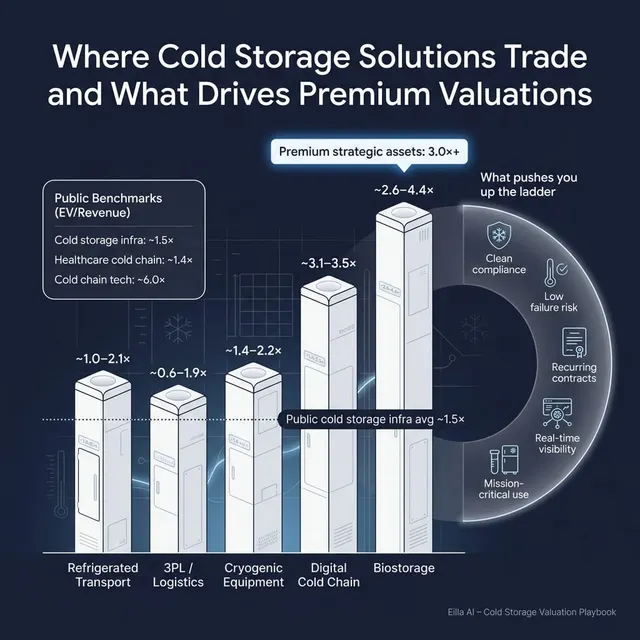
The data shows a wide valuation range because the sector includes several different types of businesses. Traditional refrigerated transport and general logistics assets usually trade at lower revenue multiples. Cold storage infrastructure sits in the middle. Life sciences biostorage, cryogenic equipment, and software-enabled logistics can achieve meaningfully higher multiples when the business has real differentiation.
These ranges are illustrative, not formal valuation advice. The same revenue number can produce very different enterprise values depending on margins, growth, contracts, customer concentration, asset quality, compliance, and buyer appetite.
4.1 Private Market Deals - Similar Acquisitions
In the private transaction data, traditional freight transportation and specialized temperature-controlled delivery deals averaged about 1.3x revenue, with a median around 1.2x. Integrated 3PL, freight forwarding, and contract logistics deals averaged about 1.2x revenue, with a median around 1.3x. These are useful reference points for businesses where most revenue comes from transport, warehousing, and logistics services.
More differentiated categories traded higher. Cryogenic equipment, gas storage, transport systems, and protective pharma packaging deals averaged about 1.7x revenue, with a median around 1.8x. Digital logistics software, visibility, and transport management platforms averaged about 3.5x revenue, with a median around 3.1x. Biostorage, cryogenic storage, and life sciences sample management averaged about 4.4x revenue, although the median was lower at about 2.6x, showing that the premium depends heavily on the quality and strategic relevance of the asset.
The pattern is clear. Buyers usually pay lower multiples for companies that look like standard logistics operators, and higher multiples for businesses with compliance, technology, specialized infrastructure, engineered products, or mission-critical customer use cases.
This does not mean every pharma cold chain or software-enabled logistics business receives a premium. Buyers will test the claim. They will look for proof in gross margin, retention, audit history, contract terms, performance data, and customer dependency.
4.2 Public Companies
Public company multiples give founders a useful reference point, but not a direct price tag. Public companies are usually larger, more diversified, more liquid, and easier for investors to buy or sell. A smaller private company will often trade at a discount unless it has unusual growth, scarcity, or strategic value.
As of mid to late 2025, the public companies in and around cold storage solutions showed very different trading levels by category. Cold storage infrastructure and temperature-controlled warehousing traded around 1.5x revenue on both average and median, with average EV/EBITDA around 10.8x and median around 9.6x. Healthcare and pharmaceutical cold chain logistics averaged about 1.4x revenue, but the median was much lower at about 0.5x, reflecting the mix of very large, low-margin distributors and more specialized cold chain players.
The highest public-market revenue multiples were in logistics software, cold chain equipment, and enabling technology. That group averaged about 6.0x revenue, with a median around 5.6x. The average EV/EBITDA was inflated by high-growth or low-current-earnings companies, but the median EV/EBITDA of about 19.2x still shows that public investors assign higher value to technology-led, scalable, higher-margin models.
Founders should use public multiples as a reference band. They are helpful for understanding how investors value different business models, but they must be adjusted for your company’s size, growth, margins, customer risk, and private-company liquidity.
A small regional cold storage business is unlikely to receive the same multiple as a scaled public infrastructure platform. But a scarce, high-growth, compliance-heavy, technology-enabled cold chain asset may attract strategic attention that pushes valuation above what a simple public comp screen would suggest.
5. What Drives High Valuations - Premium Valuation Drivers
High valuations are rarely caused by one factor. They usually come from several strengths working together: predictable revenue, strong margins, customer stickiness, clear differentiation, and a credible buyer universe.
Regulated life sciences and compliance-critical infrastructure
Buyers pay more when a cold storage company sits inside regulated healthcare, pharma, biologics, or clinical trial workflows. In these markets, customers care about compliance, audit trails, product integrity, and documented quality performance.
If your facilities or services are tied to GMP, cGMP, validated storage, chain-of-custody processes, or pharma-grade quality systems, buyers see less substitution risk. They understand that customers cannot easily move sensitive materials to a cheaper provider without risk.
Practical examples include validated freezers, biological sample storage, clinical trial depot services, specialty pharma handling, and quality systems that have already passed demanding customer audits.
Hardware-plus-software or data-enabled logistics
The data shows stronger valuation potential when a company is not just storing or moving goods, but also controlling visibility, workflow, monitoring, and decision-making.
This matters because software and data can make your business harder to replace. If customers rely on your dashboards, alerts, temperature records, risk scoring, shipment visibility, or compliance documentation, your company becomes more embedded in their daily operations.
For founders, the key is proving that technology is not just a sales slide. Buyers will ask whether customers pay for it, use it regularly, and depend on it.
Mission-critical failure costs
Some cold chain services are valuable because the cost of failure is unusually high. Organ transport, biologics, clinical samples, vaccines, cell therapies, and high-value pharma products are obvious examples.
In these categories, customers do not choose only on price. They choose based on reliability, response time, documentation, and trust. A buyer will pay more if you can show low incident rates, strong service-level performance, and a history of protecting valuable products.
The best evidence is specific and measurable: temperature excursion rates, claim history, on-time performance, audit outcomes, customer retention, and contract renewal behavior.
Specialized cold-chain and cryogenic know-how
Engineered cold chain and cryogenic equipment businesses often receive stronger attention because the product is harder to copy. Custom thermal-control systems, cryogenic storage, specialized packaging, dry vapor shipping, and engineered gas handling solutions can create real differentiation.
The more your business relies on proprietary designs, technical know-how, qualification cycles, or aftermarket support, the less it looks like a commodity logistics provider.
Buyers like this because replacement is harder. Customers may need to validate equipment, train staff, integrate monitoring, and trust the provider over time.
Strategic fit with a larger platform
Strategic buyers often pay more when your business solves a specific problem for them. Maybe you give them a cold storage footprint in a geography they want. Maybe you add pharma cold chain capability to a broader logistics network. Maybe your software layer improves their existing infrastructure.
This is where buyer mapping matters. The highest-value buyer is not always the obvious buyer. It may be a packaging company, healthcare logistics platform, life sciences tools business, infrastructure investor, industrial equipment group, or 3PL that wants to move deeper into temperature-controlled services.
Strong margins and clean revenue quality
High gross margins and strong EBITDA margins can signal a better business model. They may show pricing power, specialized know-how, software economics, facility efficiency, strong utilization, or disciplined operations.
Buyers will also study revenue quality. Recurring contracts, low churn, multi-year agreements, minimum commitments, and diversified customers all support higher confidence.
A simple rule applies: buyers pay more when they believe next year’s revenue is already mostly visible.
Strong management and clean financials
Even a highly attractive cold storage company can lose value if the financials are messy or the business depends too heavily on the founder.
Buyers pay more when there is a capable leadership team, clear reporting, reliable monthly financials, organized contracts, documented operating procedures, and no surprises. This reduces the buyer’s fear that performance will decline after closing.
6. Discount Drivers - What Lowers Multiples
Discounts usually come from risk. Buyers reduce valuation when they see uncertainty around revenue, margins, compliance, customer retention, or future investment needs.
The most common discount driver is commodity positioning. If your business looks like basic warehousing or transport capacity, with limited differentiation and price-sensitive customers, buyers will likely anchor valuation to lower logistics multiples.
Low margins are another major issue. Cold storage is energy-intensive, labor-dependent, and capital-heavy. If gross margins are thin or EBITDA margins are weak, buyers will ask whether the business has pricing power or whether future capital expenditures will consume cash flow.
Customer concentration can also reduce value. If one or two customers represent a large share of revenue, buyers may worry that the business is more fragile than the headline numbers suggest. This is especially important if contracts are short, informal, or easily terminated.
Operational risk is a major issue in this sector. Buyers will carefully review temperature excursions, spoilage claims, equipment failures, refrigeration uptime, maintenance history, backup power, food safety compliance, pharma quality systems, and insurance claims. A poor record does not always kill a deal, but hiding or failing to explain problems can damage trust quickly.
Other discount drivers include:
Discounts are not permanent. Many can be improved before sale. But buyers will usually pay for what is proven, not what is promised.
7. Valuation Example: A Cold Storage Solutions Company
The following example is fictional. The company, revenue level, valuation range, and multiples are illustrative only. This is not investment advice, and it is not a formal valuation.
Imagine a fictional company called PolarPoint Cold Chain. PolarPoint generates USD 10m of annual revenue. It operates a regional temperature-controlled storage and distribution business with a mix of frozen food customers, specialty food producers, and a growing healthcare logistics segment.
The valuation logic starts by choosing the right comparison set. PolarPoint is not a pure software company, so it should not be valued like a high-margin logistics software platform. It is also not a pure commodity trucking business, because it has recurring storage revenue, specialized temperature-controlled facilities, and some healthcare cold chain work.
The most relevant reference points are cold storage infrastructure, temperature-controlled warehousing, refrigerated logistics, and selected life sciences cold chain comps if the healthcare segment is meaningful and well documented.
A reasonable base case might use private and public reference points around 1.2x-1.8x revenue for a solid cold storage and temperature-controlled logistics business. If PolarPoint has stronger margins, long-term contracts, high utilization, and meaningful healthcare compliance capabilities, the multiple could move higher. If it has weak margins, spot revenue, customer concentration, or aging facilities, the multiple could move lower.
In the discounted case, PolarPoint may have short-term contracts, low EBITDA margins, old refrigeration assets, high customer concentration, and weak KPI reporting. Buyers would likely value it closer to standard logistics or asset-heavy service multiples.
In the base case, PolarPoint is a good regional operator with positive EBITDA, decent customer retention, recurring storage revenue, and clean enough financials. This is a solid business, but not yet a scarce strategic asset.
In the strong case, PolarPoint has long-term contracts, strong facility utilization, good margins, clean service-level data, diversified customers, and a real healthcare or pharma cold chain segment. Buyers can underwrite more predictable revenue and lower operating risk.
In the premium strategic case, PolarPoint has something unusually valuable: validated pharma-grade infrastructure, embedded monitoring software, documented compliance performance, scarce locations, or a capability that a larger logistics or healthcare platform urgently wants. In that situation, valuation may move beyond simple private-market averages.
The main lesson is that two cold storage businesses with USD 10m of revenue can be worth very different amounts. Revenue matters, but revenue quality matters more. Buyers pay for proof that the business will keep growing, keep customers, protect margins, and avoid operational failures.
8. Where Your Business Might Fit - Self-Assessment Framework
Use this framework as a practical starting point. Score each group from 0 to 2. A score of 0 means the factor is weak or unproven. A score of 1 means it is decent but not yet a clear strength. A score of 2 means it is a real valuation strength.
Be honest. The goal is not to create a perfect score. The goal is to identify where improvement could have the biggest valuation impact before you sell.
Interpretation:
A high score does not guarantee a premium valuation. A low score does not mean your business cannot sell. But the framework helps show how buyers are likely to think.
If you are in the lower band, focus on fixing obvious diligence issues before launching a process. If you are in the middle band, focus on sharpening the story and proving the strengths. If you are in the top band, focus on creating competitive tension among the right buyers.
9. Common Mistakes That Could Reduce Valuation
The first mistake is rushing the sale. Many founders go to market before their numbers, story, contracts, and data are ready. This often leads to weaker buyer interest, lower offers, longer diligence, and more price chips later in the process.
The second mistake is hiding problems. Buyers will find issues in diligence. Temperature excursions, customer churn, margin pressure, equipment failures, litigation, safety issues, or weak contracts are not automatically deal-killers. But hiding them damages trust. A buyer who loses trust will either reduce price, add tougher terms, or walk away.
The third mistake is weak financial records. Cold storage buyers want to understand margin by service line, customer profitability, utilization, energy costs, labor costs, maintenance capex, claims, and revenue mix. If your financials cannot answer these questions, buyers will assume more risk.
The fourth mistake is not running a structured, competitive sale process with an advisor. Research commonly cited in M&A shows that a structured process with an advisor can lead to meaningfully higher purchase prices, often around 25%. The logic is simple: more relevant buyers, better materials, stronger positioning, and real competition usually produce better outcomes than one-off conversations.
The fifth mistake is revealing the price you want too early. If you tell buyers you want USD 10m of enterprise value, many will frame their offer around USD 10.1m or USD 10.2m. You have limited price discovery. A good process lets the market tell you what the business is worth before anchoring the discussion.
Industry-specific mistakes are also common. One is failing to document compliance and operating performance. In cold storage, a strong claims history, temperature control record, audit file, and maintenance log can directly support buyer confidence. Another is underinvesting in facility readiness. Aging refrigeration systems, poor backup power, or unclear capex needs can quickly become valuation discounts.
10. What Cold Storage Solutions Founders Can Do in 6-12 Months to Increase Valuation
Improve the numbers
Start by making your financials buyer-ready. Build clean monthly reporting for revenue, gross margin, EBITDA, customer profitability, utilization, energy costs, labor costs, claims, and maintenance capex.
Separate revenue by service line: storage, handling, transport, monitoring, packaging, value-added services, and any software or data revenue. Buyers pay more when they can see what is recurring, profitable, and growing.
Review pricing. Many cold storage companies underprice specialized handling, urgent work, pharma-grade requirements, energy pass-throughs, and value-added services. Sensible pricing improvements can increase EBITDA quickly, and EBITDA improvements often flow directly into valuation.
Strengthen revenue quality
Push for longer customer contracts where possible. Add minimum volume commitments, clearer renewal terms, energy adjustment clauses, and service-level definitions.
Reduce customer concentration if you can. Even a few new meaningful customers can help if they show that the business is not dependent on one relationship.
Track retention and expansion. Buyers like seeing that customers not only stay, but also buy more services over time.
Prove operational reliability
Organize the data that shows you are a safe pair of hands. This includes temperature excursion history, claims, spoilage, audit outcomes, equipment uptime, preventive maintenance, backup power testing, service-level performance, and safety records.
If you serve food, healthcare, pharma, or biologics customers, make compliance evidence easy to review. Buyers should not have to dig for proof.
Invest selectively in monitoring and reporting. You do not need a massive technology rebuild in 6-12 months, but better dashboards, alerts, customer reporting, and clean historical data can improve buyer confidence.
Reduce obvious risk
Fix contract gaps. If large customers operate on informal arrangements, try to formalize the relationship before a sale process.
Build a stronger management bench. Buyers worry when every decision depends on the founder. Give key managers visible ownership of operations, finance, sales, and customer relationships.
Clean up legal, insurance, lease, and facility documentation. Buyers discount uncertainty. Organized diligence materials make the business feel lower-risk.
Sharpen the buyer story
Do not describe your company as "a cold storage provider" if it is more than that. Describe the specific problem you solve: reducing spoilage, protecting biologics, enabling pharma distribution, supporting grocery networks, managing temperature-sensitive last mile, or providing regulated sample storage.
Map the buyer universe carefully. The best buyer may be a strategic logistics platform, a healthcare services company, a packaging business, an infrastructure investor, a life sciences tools company, or a private equity-backed cold chain platform.
The goal is to make buyers see why your business is not just another logistics asset.
11. How an AI-Native M&A Advisor Helps
An AI-native M&A advisor can help you reach a broader and more relevant buyer universe. Instead of relying only on the obvious acquirers, AI can screen hundreds of potential buyers based on deal history, strategic fit, financial capacity, geographic overlap, customer synergies, and acquisition behavior. More relevant buyers can create more competition, stronger offers, and a higher chance of closing if one buyer drops out.
AI can also speed up the early process. Buyer matching, outreach preparation, marketing materials, diligence support, and data organization can move faster when AI supports the heavy lifting. That can help founders reach initial conversations and offers in under 6 weeks, depending on readiness and market conditions.
The best process still needs expert human advice. Experienced M&A advisors know how to frame the story, manage buyers, protect confidentiality, create competitive tension, and negotiate terms. AI enhances that work by making research, preparation, and buyer coverage faster and broader.
For cold storage solutions founders, the benefit is simple: better preparation, better buyer targeting, and a more professional process without traditional bulge bracket costs. If you would like to understand how an AI-native process can support your exit, book a demo with one of our expert M&A advisors.
Are you considering an exit?
Meet one of our M&A advisors and find out how our AI-native process can work for you.


