
The Complete Valuation Playbook for Packaging and Labeling Solutions Businesses
A practical guide to how packaging and labeling solutions businesses are valued and what drives higher multiples.

If you own a packaging or labeling solutions business and are thinking about a sale in the next 1-12 months, valuation is probably one of the biggest questions on your mind. The hard part is that this sector does not have one simple answer. A custom label converter, a flexible packaging manufacturer, a packaging distributor, and an industrial packaging automation company can all sit under the same broad "packaging" umbrella, but buyers value them differently.
Now is an important time to understand that difference. Packaging buyers are still active, but they are selective. They are looking for businesses with reliable demand, strong margins, differentiated production capability, sustainability relevance, and customer relationships that are hard to replace.
This playbook shows what packaging and labeling solutions businesses actually sell for, what pushes a company toward the top or bottom of the range, and what you can do in the next 6-12 months to improve your position before a sale.
1. What Makes Packaging and Labeling Solutions Unique
Packaging and labeling is not one market. It is a collection of related business models that serve consumer goods, food and beverage, healthcare, industrial, logistics, apparel, personal care, and many other end markets.
The main types of businesses include:
The unique valuation issue in this sector is that buyers do not pay for "packaging exposure" alone. Packaging is necessary, but some packaging businesses are much more defensible than others. A business that sells standard boxes from third-party suppliers is usually easier to replace than a business that produces validated labels for pharmaceutical packaging, designs line-integrated coding systems, or supplies high-performance food packaging with strict quality requirements.
Buyers will always check a few core risks. They will look at customer concentration, raw material exposure, margin stability, production capacity, machinery condition, supply chain dependence, environmental compliance, quality claims, and whether customer relationships depend too heavily on the founder.
They will also ask a simple question: "If we owned this company, could we grow it without breaking it?" If the answer is yes, valuation usually improves. If the answer depends on one owner, one plant, one customer, or one aging machine line, the multiple usually comes under pressure.
2. What Buyers Look For in a Packaging and Labeling Solutions Business
Buyers start with the basics: revenue scale, growth, profitability, cash flow, customer retention, and how clean the financial records are. These matter in every sale process.
But in packaging and labeling, buyers go further. They want to know what kind of demand you serve. Are your products mission-critical, or are they easily swapped out? Are you solving compliance, traceability, branding, shelf impact, sustainability, or production efficiency problems? Or are you mainly competing on price?
A buyer will also care about the quality of your revenue. Repeat orders from long-term customers are more valuable than one-off jobs. A recurring label program for a food, pharma, or personal care customer is easier to underwrite than unpredictable custom print projects. Contracted volume, repeat SKUs, approved-vendor status, and long qualification cycles can all support a stronger valuation story.
Margins are another major filter. Buyers will look at gross margin by product line, EBITDA margin, machine utilization, waste rates, labor productivity, and pricing discipline. A packaging business with strong revenue but weak margins may still sell, but buyers will usually ask whether the business is underpriced, inefficient, or exposed to commodity pressure.
How private equity buyers think
Private equity buyers are not just asking, "What is this business worth today?" They are asking, "Can we buy this at a fair price, improve it, and sell it later for more?"
They think about three things:
In packaging and labeling, those value levers often include price increases, cross-selling more products to existing customers, adding sales coverage, buying smaller competitors, improving procurement, reducing waste, upgrading equipment, and expanding into higher-margin or more regulated end markets.
The more clearly you can show those levers before a sale, the easier it is for a buyer to justify a stronger offer.
3. Deep Dive: Commodity Packaging vs Mission-Critical Packaging
One of the biggest valuation questions in this sector is whether your business sells commodity packaging or mission-critical packaging.
Commodity packaging is still useful. Customers need boxes, bags, labels, films, containers, and sleeves. But if a customer can switch suppliers quickly based on price, availability, or delivery time, buyers will treat the revenue as more fragile.
Mission-critical packaging is different. It may involve compliance labels, traceability, product safety, regulatory information, food and pharma packaging, production-line printing, brand-critical graphics, or packaging systems that sit directly inside a customer's workflow. In these cases, switching suppliers can create operational risk. That makes the revenue more valuable.
The transaction data supports this distinction. The higher-quality outcomes in the deal set were generally tied to businesses with either meaningful scale, engineered solutions, high-margin production, or products embedded in customers' operating workflows. Simpler distribution and resale models tended to transact at lower revenue multiples, even when they had decent margins.
The lesson is not that every founder must turn a packaging business into an automation company. The lesson is that buyers pay more when your business is harder to replace.
If your business looks more like the left column today, you can still improve your position. Start by documenting repeat revenue, approved-vendor relationships, quality performance, delivery reliability, and customer-specific specifications. Then identify which customers rely on you for more than just the physical product.
4. What Packaging and Labeling Solutions Businesses Sell For - and What Public Markets Show
Valuation in this sector is usually grounded in revenue and EBITDA multiples. A revenue multiple compares the company's enterprise value to its annual revenue. EBITDA is a simple profit measure before interest, taxes, depreciation, and amortization. Buyers often use both.
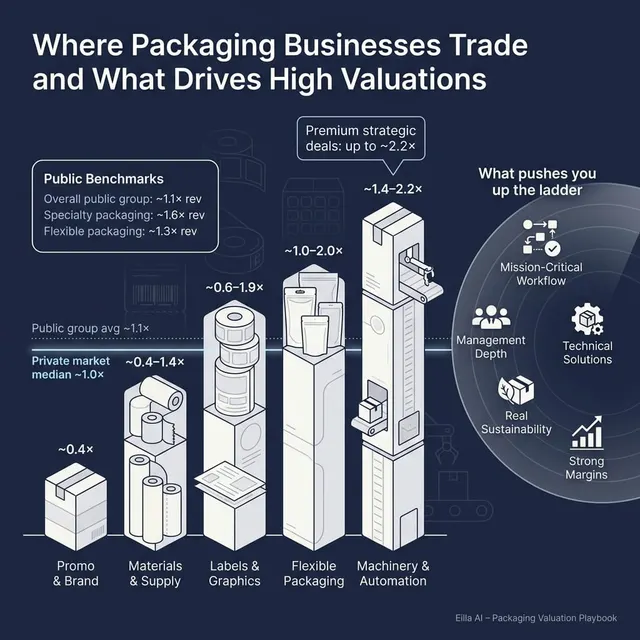
The data shows a wide range. Public companies in and around packaging trade around 1.1x revenue and 9.7x EBITDA on average, with medians closer to 1.0x revenue and 7.6x EBITDA. Private precedent transactions show a similar overall picture, with average revenue multiples around 1.2x and average EBITDA multiples around 6.9x.
4.1 Private Market Deals - Similar Acquisitions
The private transaction data suggests that packaging and labeling businesses often sell between roughly 0.4x and 2.2x revenue, depending heavily on the segment. The broad average is around 1.2x revenue, with a median around 1.0x revenue.
The important point is that the upper end is not available to every business. Higher multiples tend to appear where the company has scale, engineered solutions, strong EBITDA margins, regulatory or quality-driven end markets, or global strategic relevance. Lower multiples are more common for distribution-heavy, commodity, or less differentiated businesses.
For a founder, the message is simple: do not anchor only to the highest transaction you hear about. Ask whether your business has the same scale, margins, customer quality, technical depth, and buyer relevance as the premium deals.
4.2 Public Companies
Public company multiples are useful because they show how investors value scaled businesses in related categories. But they are not a direct price tag for a private company. Public companies are usually larger, more diversified, more liquid, and easier for investors to buy and sell.
As of mid to end 2025, the public group data showed these broad valuation levels:
A few patterns stand out. Labels and product identification companies do not automatically trade at high revenue multiples. Flexible packaging and specialty printing can trade better when they show scale, margins, or differentiated customer relationships. Paperboard and rigid packaging businesses are often valued more on earnings quality, operational efficiency, and market position than on revenue growth alone.
Use public multiples as a reference band, not a direct answer. A smaller private company may deserve a discount if it has lower scale, weaker reporting, customer concentration, or owner dependence. But a scarce, high-quality business in a strategic niche can sometimes receive strong interest even if it is smaller.
5. What Drives High Valuations - Premium Valuation Drivers
Premium valuations usually come from a combination of factors. One strong feature helps, but several strong features together create the real valuation story.
Mission-critical customer workflow
Buyers pay more when your product is embedded in a customer's operations. This is especially true when your labels, coding systems, packaging graphics, or line equipment affect compliance, traceability, shipping, quality control, or production uptime.
For example, a label used for simple branding may be replaceable. A label tied to regulatory information, product tracking, or quality control is harder to replace. The buyer sees lower switching risk and more predictable demand.
Technical or engineered solutions
Packaging businesses that solve hard production problems usually attract stronger buyer interest than businesses that simply resell standard products. This can include engineered films, specialty adhesives, multi-layer labels, high-performance flexible packaging, automation, coding systems, or packaging machinery.
The reason is simple: technical capability creates barriers. Customers are less likely to switch if the product requires testing, validation, design support, or equipment integration.
Strong margins and visible cash flow
Buyers in this sector care deeply about profit quality. Revenue growth is helpful, but packaging buyers often pay more for businesses that already produce dependable EBITDA.
Strong margins tell a buyer that you have pricing power, production discipline, procurement control, or a differentiated product mix. Weak margins create questions about whether the business is competing only on price.
Attractive end markets
Not all customer exposure is equal. Buyers tend to like packaging businesses serving food, beverage, healthcare, pharmaceuticals, personal care, industrial compliance, and other markets where quality and reliability matter.
These markets can create stronger retention because supplier changes are harder. Customers may need testing, approvals, audits, or packaging validation before switching.
Sustainability with real customer pull
Sustainability is important, but it is not enough by itself. Buyers hear sustainability claims in almost every packaging process. They pay more when sustainability is backed by real capability.
That could mean recyclable materials, downgauging, compostable options, lower-waste production, energy-efficient operations, or products that help customers meet regulatory and retailer requirements. The key question is whether customers are actually buying because of it.
Scale and strategic fit
Larger packaging businesses often attract more buyer interest because they give acquirers more immediate impact. Scale can mean revenue size, production footprint, customer reach, installed base, or geographic coverage.
But scale must translate into strategic value. A buyer wants to know whether your business adds new customers, new capability, new geography, new products, or new manufacturing capacity.
Management depth and continuity
Many founder-led packaging businesses rely heavily on the owner. Buyers worry when customer relationships, pricing decisions, technical knowledge, and supplier relationships all sit with one person.
A strong leadership bench improves confidence. If your sales, operations, finance, and production leaders can run the business without you day to day, buyers can underwrite the transition with less risk.
6. Discount Drivers - What Lowers Multiples
Discount drivers are not moral judgments. They are risk signals. The more risk a buyer sees, the more they will reduce the multiple or push value into earnouts, seller notes, or delayed payments.
The most common discount drivers in packaging and labeling include:
Some discount drivers are fixable in 6-12 months. For example, you can clean up financial reporting, create customer margin analysis, document repeat revenue, formalize supplier agreements, and reduce founder dependence in sales.
Others take longer. Moving from commodity packaging into technical packaging is not a quick pivot. But even then, you can improve the story by showing which parts of your current business are stickier, higher-margin, or more strategic than they first appear.
7. Valuation Example: A Packaging and Labeling Solutions Company
This example is fictional. The company, revenue level, valuation range, and multiples are illustrative only. This is not investment advice, and it is not a formal valuation.
Imagine a fictional company called Summit Label & Packaging. It has USD 10m of revenue and provides custom labels, printed packaging materials, and short-run branded packaging for food, beverage, personal care, and light industrial customers.
It is not a software company. It is not a global packaging platform. It is also not a pure distributor. It has real production capability, repeat customer orders, and some technical label work, but it is still best valued against private label, packaging graphics, printing, and packaging services transactions.
Step 1: Select the right comparison set
For Summit, the most relevant data points are:
The logic is to avoid overreaching. If Summit is a custom label and packaging services business, it should not be valued like a global platform or packaging machinery company. But it also should not be dismissed as a simple distributor if it has repeat work, technical production, and customer-specific specifications.
Step 2: Apply a practical multiple range
For a USD 10m revenue company like Summit, a defensible core valuation range might be around 0.7x-1.2x revenue. That implies USD 7m-12m of enterprise value.
A weaker version of the same business might fall below that. A stronger version could push above it.
Step 3: What changes the answer?
Summit would be closer to the discounted case if revenue is project-based, customer concentration is high, margins are weak, the owner controls most relationships, and financial reporting is messy.
It would be closer to the core case if it has repeat customer orders, stable margins, good equipment, a reliable team, and a diversified customer base.
It could move toward the strong case if it has clear technical differentiation, high-margin regulated end markets, strong EBITDA, long-term customers, low churn, and a credible management team that can run the business after closing.
The big lesson is that two companies with USD 10m of revenue can be worth very different amounts. Revenue is the starting point. Business quality determines the multiple.
8. Where Your Business Might Fit - Self-Assessment Framework
Use this as a rough self-assessment. Score each factor from 0 to 2.
0 means weak or not proven. 1 means acceptable. 2 means strong and well documented.
Add up your score.
Be honest. The goal is not to give yourself the highest score. The goal is to identify which improvements could have the biggest valuation payoff before a sale.
9. Common Mistakes That Could Reduce Valuation
The first mistake is rushing the sale. A buyer will not pay full value just because the business is good. You need clean numbers, a clear story, organized diligence materials, and a competitive process.
The second mistake is hiding problems. If you have customer concentration, margin pressure, supplier issues, quality claims, or equipment needs, they will come out in diligence. Hiding them destroys trust and can reduce value late in the process.
Weak financial records are another major issue. Packaging businesses often have complex product mixes, raw material swings, freight costs, waste, spoilage, and customer-specific pricing. If you cannot show margin by customer or product line, buyers may assume the worst.
A fourth mistake is running an unstructured process. Research and market experience show that a structured, competitive sale process with an advisor can often lead to meaningfully higher purchase prices, sometimes around 25% higher than less competitive approaches. The reason is simple: buyers behave differently when they know other qualified buyers are also looking.
Another mistake is telling buyers the price you want. If you say you are looking for USD 10m of enterprise value, many buyers will anchor around USD 10.1m or USD 10.2m, even if they might have paid more. You kill price discovery before it starts.
Packaging-specific mistakes include failing to separate commodity work from higher-value work, failing to document quality performance, and failing to explain why customers keep buying from you. If buyers cannot see the sticky parts of the business, they may price it like a generic converter or distributor.
10. What Packaging and Labeling Solutions Founders Can Do in 6-12 Months to Increase Valuation
You do not need to transform the entire company before a sale. But you can make the business easier to understand, easier to trust, and easier to value.
Improve the numbers
Start with clean monthly financials. Separate revenue by product type, customer, end market, and repeat vs one-time work. Track gross margin by product line and customer.
Buyers want to know where the profit really comes from. If your food labels, healthcare packaging, or technical film work produce better margins than standard jobs, show it clearly.
Also review pricing. If raw material costs have moved but your pricing has not, even modest price adjustments can improve EBITDA before a sale.
Prove customer stickiness
Document repeat orders, contract history, approved-vendor status, long-term customer relationships, and renewal patterns. If customers have used the same specifications for years, show that.
Create a customer concentration analysis and explain the relationship quality behind the numbers. A 20% customer can be scary if the relationship is weak. It is less scary if you are deeply embedded, profitable, and hard to replace.
Reduce operational risk
Prepare a simple equipment schedule. Include age, condition, maintenance history, capacity, and any expected capital spending.
Track quality metrics such as returns, rejected batches, late deliveries, claims, and customer complaints. Buyers like businesses that can prove reliability, not just claim it.
Strengthen the team
Move key customer relationships beyond the founder. Introduce senior sales, operations, and finance leaders to important customers where appropriate.
Document key processes. Buyers do not expect perfection, but they do want to know the business will keep running after the owner steps back.
Build the valuation story
Do not just say you are a packaging company. Explain what makes your business harder to replace.
Are you faster? More technical? More reliable? Better with regulated customers? Better at short-run complexity? Better at sustainable materials? Better at design-to-delivery support?
A strong valuation story is not marketing fluff. It is a clear explanation of why customers stay, why margins are defensible, and why a buyer can grow the business.
11. How an AI-Native M&A Advisor Helps
An AI-native M&A advisor like Eilla AI helps by expanding the buyer universe far beyond the obvious names. AI can screen hundreds of qualified acquirers based on deal history, strategic fit, synergy potential, financial capacity, and other signals. More relevant buyers usually means more competition, stronger offers, and a higher chance the deal closes if one buyer drops out.
AI also helps compress the timeline. Buyer matching, outreach preparation, marketing materials, financial analysis, and diligence support can move faster than in a manual-only process. That can help founders reach initial conversations and offers in under 6 weeks, depending on the readiness of the business and the quality of the information available.
The best process still needs expert human judgment. Experienced M&A advisors know how to frame the story, manage buyer psychology, handle difficult diligence questions, and protect competitive tension. AI enhances that work by making the process broader, faster, and more data-driven.
The result is Wall Street-grade advisory quality without traditional bulge bracket costs. If you would like to understand how an AI-native process can support your exit, book a demo with one of our expert M&A advisors.
Are you considering an exit?
Meet one of our M&A advisors and find out how our AI-native process can work for you.


